Half of viewers miss the invisible gorilla — so do experts
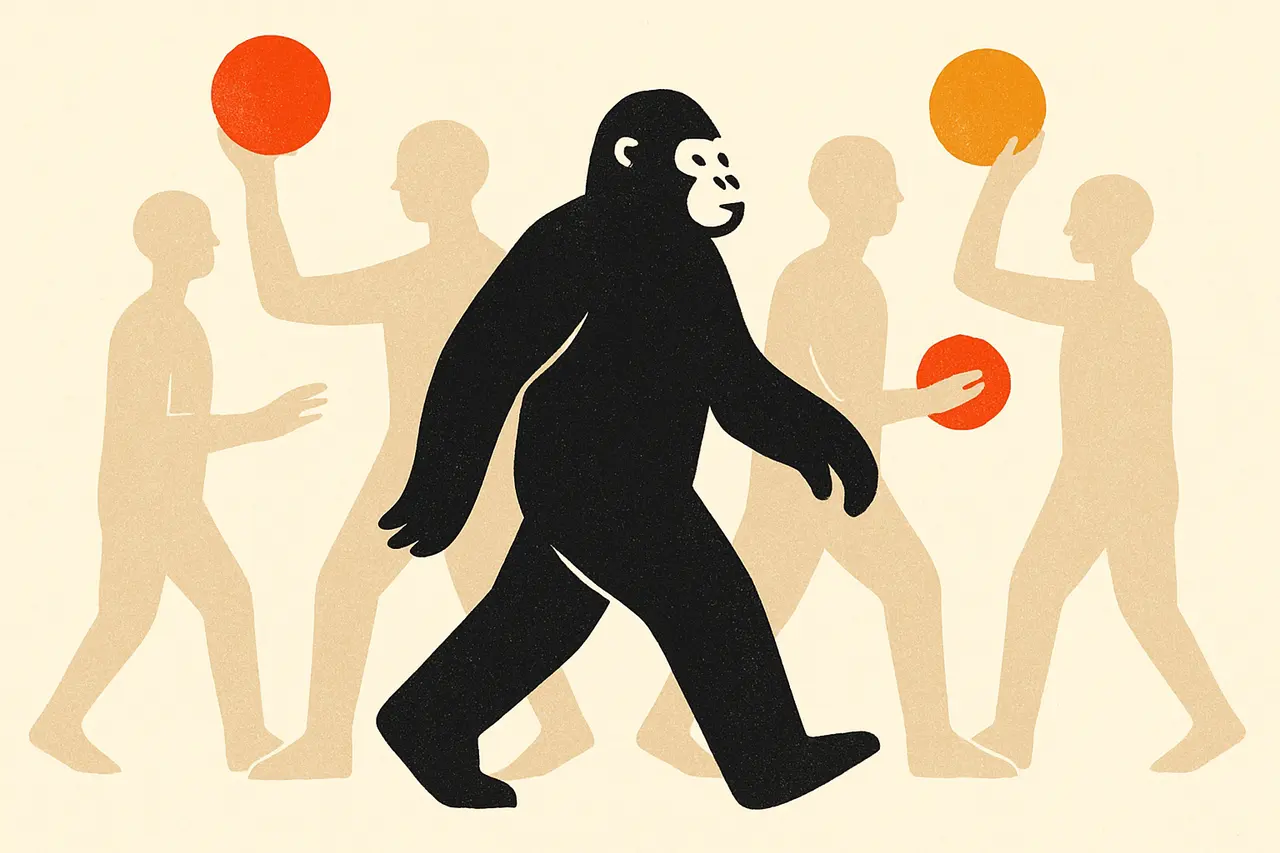
In the 1999 test, 55 of 96 viewers counting basketball passes never saw the gorilla walk through. Expert radiologists did even worse.
In a 1999 experiment by psychologists Daniel Simons and Christopher Chabris, 46% of 192 observers counting basketball passes failed to notice an unexpected figure walk through the video. In the versions with a person in a gorilla suit, 55 of 96 (57%) missed it. The effect is called inattentional blindness: when attention is locked on one task, even large, obvious things can go unseen.
Viewers watched two teams of three players, one in white and one in black, and silently counted passes made by one team. Partway through the 75-second clip, either a woman with an open umbrella or a woman in a gorilla costume walked across the scene for 5 seconds. Misses were more common when the counting task was harder, and when the scene was a ghostly overlay of separately filmed shots.
Was the gorilla study the first of its kind?
No, the gorilla was a modern remake. In the 1970s, psychologist Ulric Neisser showed viewers overlaid videos of ball games in which a woman with an umbrella strolled through; in one early test only 6 of 28 noticed her. Simons and Chabris refilmed the setup, sometimes with all players in a single, fully visible shot, and a third of viewers missed the event.
They also pushed the gorilla’s luck. In an extra condition, it stopped mid-court, faced the camera and thumped its chest, staying on screen for 9 seconds. Only half of the 12 new observers noticed.
Do experts notice the gorilla?
Mostly not; expertise doesn’t protect you. In 2013, Harvard researchers asked 24 radiologists to search lung CT scans for nodules, and inserted a gorilla 48 times the size of an average nodule into the final case. 83% did not report it, and eye-tracking showed most of those who missed it had looked directly at where it was, a gap between what the eyes take in and what we see.
The gorilla can be made easier to spot. A 2023 replication with more than 1,500 people at NYU found that a faster-moving or leaping gorilla was noticed far more often than the original slow walk.
Sources & references
5 referencesWell-established. Corroborated by 4 independent sources.