The bystander effect is real; the Kitty Genovese myth isn't
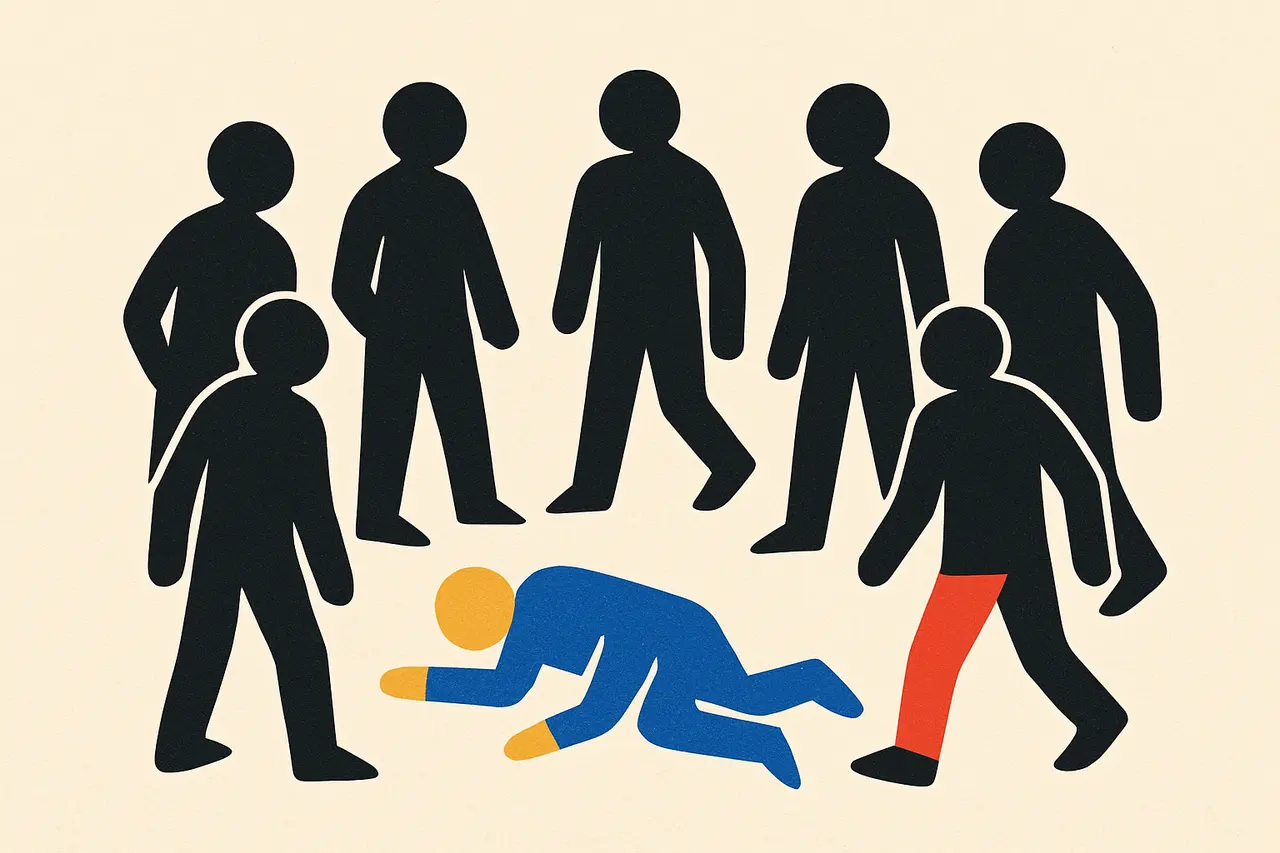
Each witness is less likely to act when others are present, yet CCTV of real street fights shows someone helps in 9 cases out of 10.
The bystander effect is real: the more people who witness an emergency, the less likely any individual among them is to step in. Psychologists John Darley and Bibb Latané demonstrated it in 1968, attributing it partly to diffusion of responsibility, where the duty to act is spread thinly across everyone present. A 2011 meta-analysis of more than 7,700 participants confirmed the effect, but found it weakens when a situation is clearly dangerous.
Did 38 people really watch Kitty Genovese being killed?
No: the true number of eyewitnesses to the 1964 murder in Queens was about 6 or 7. The case is the usual way the effect gets introduced, because The New York Times opened its front-page story by saying 38 “respectable, law-abiding citizens” watched a killer stalk and stab her in three separate attacks.
The record tells a different story. There were two attacks, not three, and most of the assault happened inside a foyer at the back of her building, out of sight of nearly everyone. A 2007 archival study in American Psychologist found no evidence that 38 people were present, that witnesses saw the murder, or that they all stayed passive.
Do bystanders actually help in real-life conflicts?
Usually, yes. In a study published online in 2019, researchers analysed security-camera footage of 219 public conflicts in the United Kingdom, the Netherlands and South Africa. In 9 out of 10, at least one bystander, and usually several, did something to help. Rates were similar in all three countries despite very different levels of perceived public safety, and more bystanders meant a higher chance that someone would intervene.
That fits with the lab work rather than contradicting it. Each person in a crowd may be a little less likely to act, but a crowd has many people in it, so the odds that somebody helps go up rather than down.
Sources & references
5 referencesWell-established. Corroborated by 3 independent sources.