How many senses do humans have? Far more than five
Aristotle argued there could be no sixth sense. Neuroscientists now count 22 to 33, and a single gene shows why body awareness makes the list.
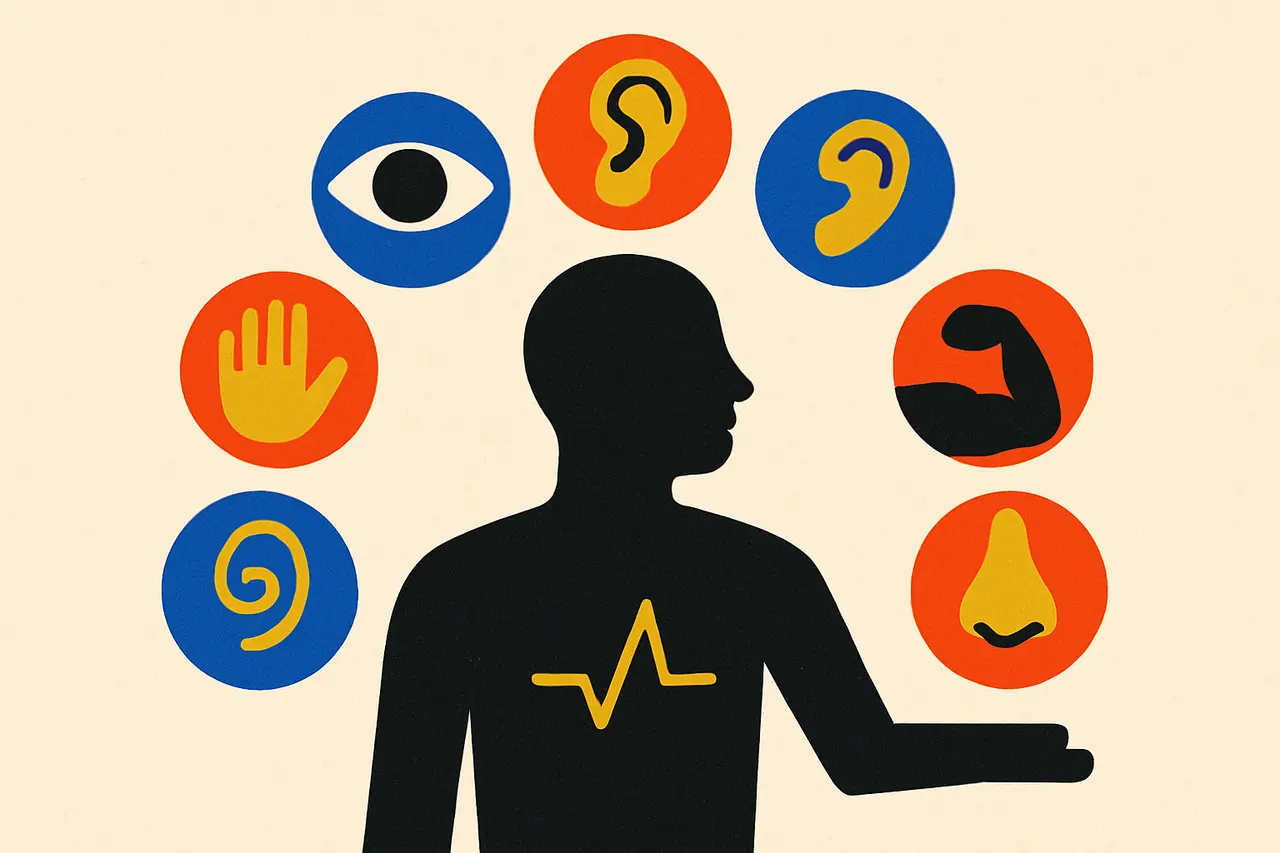
Humans have far more than five senses: depending on how you count, neuroscientists put the total somewhere between 22 and 33, according to Oxford experimental psychologist Charles Spence. The familiar five, sight, hearing, smell, taste and touch, go back to Aristotle, more than 2,300 years ago.
Aristotle did not just jot down a list. In Book III of De Anima (On the Soul) he set out to prove there could be no sixth sense beyond those five. The same thinker held that the world was built from five elements, a scheme science abandoned long ago; his sensory headcount has simply lasted longer.
The modern number varies because researchers split or lump differently. “Touch” alone bundles pain, temperature, itch and pressure, and what we experience as the flavour of food is really a blend of taste, smell and touch. Then there are senses Aristotle never listed, shown here beside his five:
| Sense | What it tracks | Listed by Aristotle? |
|---|---|---|
| Sight, hearing, smell, taste, touch | The familiar five | Yes |
| Proprioception | Where your limbs are without looking | No |
| Interoception | Changes inside your own body | No |
| Vestibular system | Balance and head movement, from the inner ear | No |
That vestibular sense is easy to overlook until it fails. About 15 percent of American adults, roughly 33 million people, reported a balance or dizziness problem in 2008, according to the NIH’s deafness and communication institute.
How we know proprioception is a real sense
In 2016 an NIH-funded team reported two patients in the New England Journal of Medicine who carried inactivating variants in PIEZO2, a gene for an ion channel that responds to mechanical force. Both had lost discriminative touch and had profoundly decreased proprioception, leaving their movements poorly coordinated.
Yet they could still walk, talk and write, and their clumsiness worsened sharply when they could not see, a sign that vision was standing in for the missing sense. That one faulty gene could strip away body awareness is strong evidence that proprioception is its own sense, with its own molecular machinery, rather than a footnote to touch.
Sources & references
5 referencesWell-established. Corroborated by 4 independent sources.