Your eyes have 120 million rods but only 6 million cones
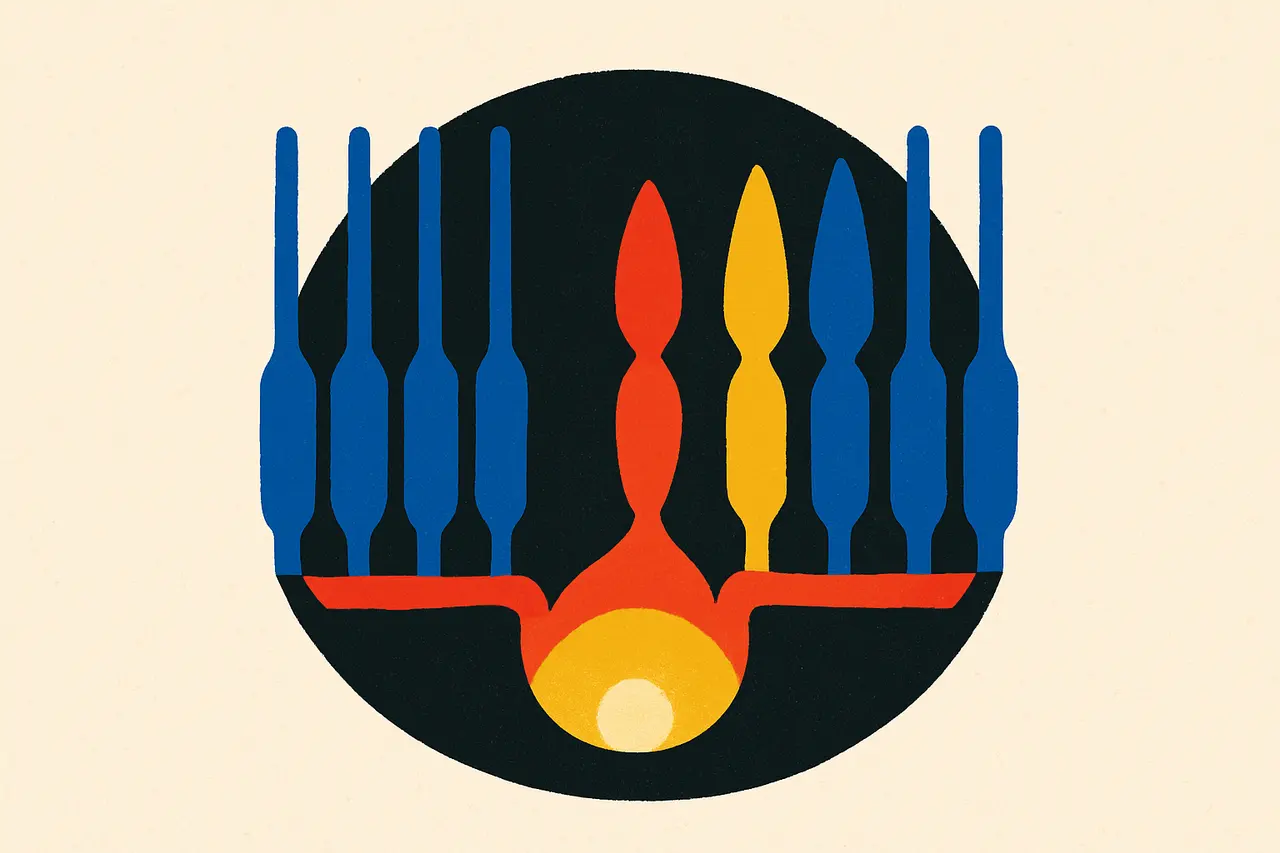
Rods outnumber cones about 20 to 1. One army sees in the dark, a smaller squad sees color, and sources disagree on how that squad splits.
The human retina holds about 120 million rods but only about 6 million cones, roughly 20 rods for every cone. Rods handle dim light and cannot see color; cones work in brighter light and deliver color and fine detail.
The two kinds are sorted by place. Cones crowd into the fovea centralis, a pit about 0.3 mm across at the center of the retina that contains no rods at all. A few degrees away, rods take over and spread across most of the retina, which is why they dominate peripheral and night vision. Stare straight at a faint star and it can vanish; look slightly to one side and it reappears, a trick astronomers call averted vision.
Color vision rests on three types of cone, loosely called red, green and blue, and sources disagree on how they split. The American Academy of Ophthalmology gives 60% red, 30% green and 10% blue; Georgia State University’s HyperPhysics gives 64%, 32% and 2%, out of 6 to 7 million cones. Both agree blue cones are the rarest, and they sit mostly outside the fovea, yet blue looks as vivid as red and green, which suggests the brain amplifies their signal.
Rods earn their numbers in the dark. They are more than 1,000 times as sensitive as cones and can reportedly be triggered by single photons. But they are slow to switch on: it takes 20 to 40 minutes in the dark before their pigment, rhodopsin, starts to help, and a few seconds of bright light undoes it. Because rods barely respond to deep red, astronomers and ship crews use dim red lights to keep their night vision.
The same bias explains a twilight oddity: as the cones shut down for the night, a rose’s green leaves start to look brighter than its red petals.
Sources & references
5 referencesWell-established. Corroborated by 3 independent sources.