The Gossamer Albatross Pedaled Across the English Channel
On this day · 12 June 1979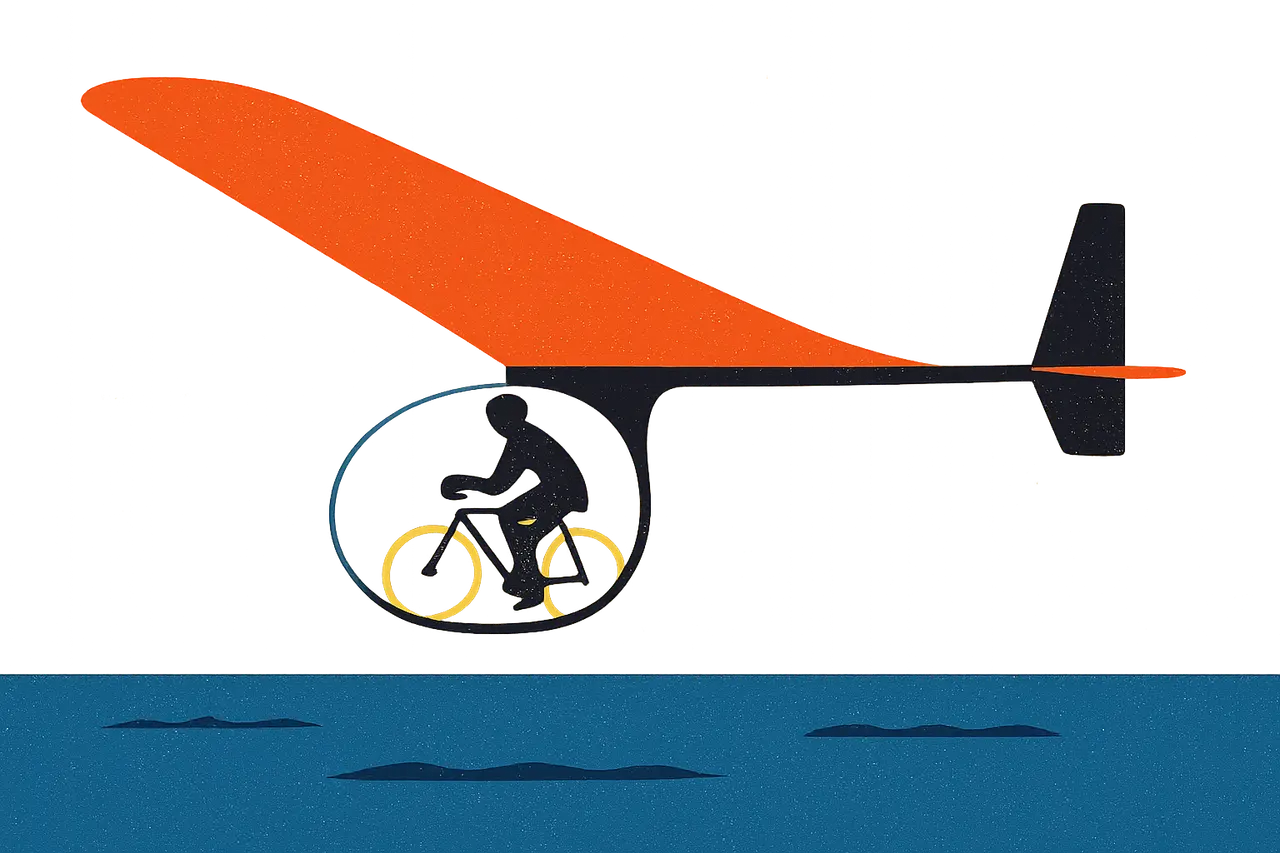
A featherweight aircraft powered by one cyclist's legs flew from England to France, claiming a prize that had stood unwon for years.
Just after dawn on June 12, 1979, cyclist and pilot Bryan Allen climbed into a gossamer-thin aircraft on the coast near Folkestone, England, and began to pedal. There was no engine. Every meter of altitude and forward thrust came from his own legs turning a propeller. Roughly three hours later he touched down on the beach at Cap Gris-Nez, France, becoming the first person to cross the English Channel in a human-powered aircraft.
The Gossamer Albatross was the work of aeronautical engineer Paul MacCready and his company AeroVironment. To stay aloft on muscle alone, the design stripped weight to the bone: a carbon-fiber frame wrapped in transparent Mylar film weighed about 71 pounds (32 kg) empty.
Allen completed the roughly 22-mile crossing in two hours and 49 minutes, fighting headwinds and dehydration the whole way.
The feat won the second Kremer Prize, a long-standing reward for human-powered flight, and proved that careful engineering could lift a person across open water on pedal power alone.
Sources & references
2 referencesWell-established. Corroborated by 2 independent sources.