Tenochtitlan fell in 1521 to an army less than 1% Spanish
On this day · 13 August 1521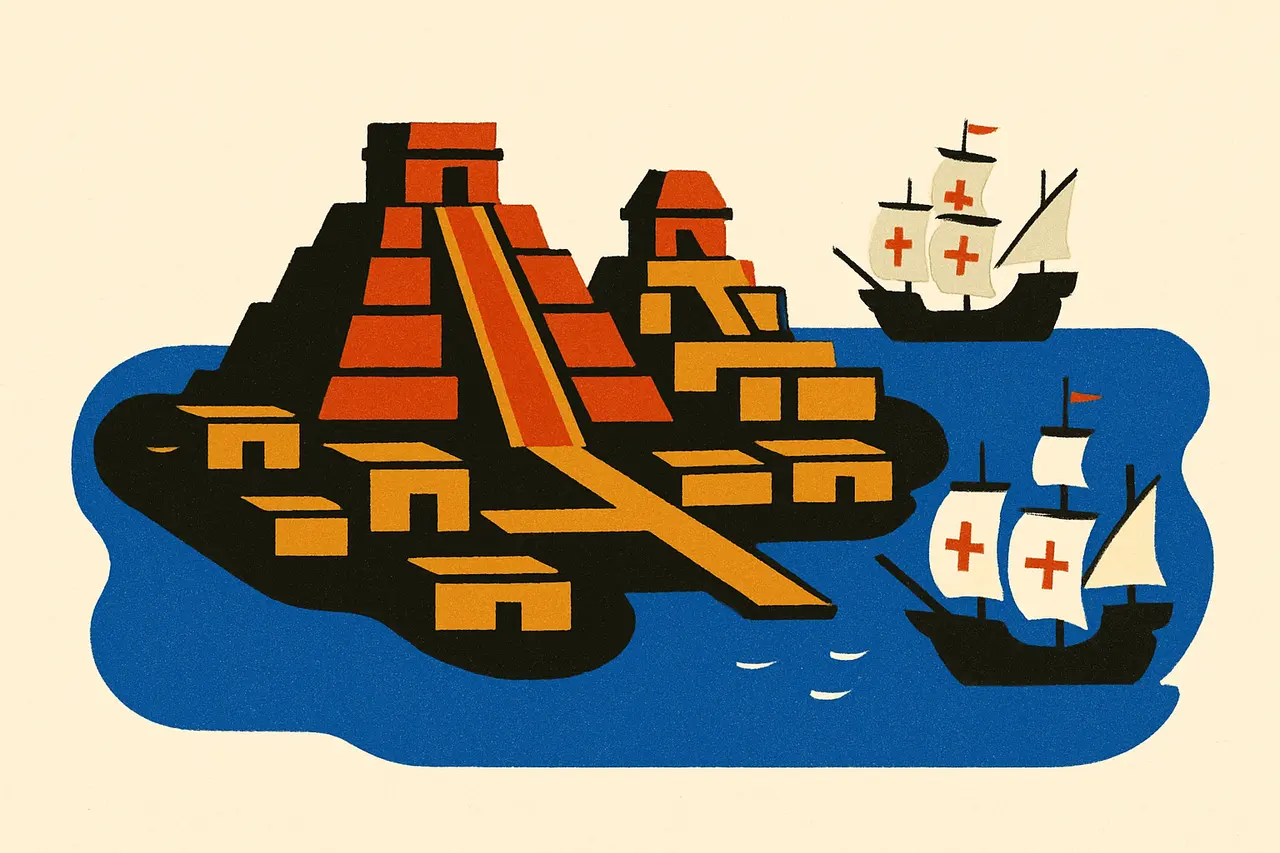
The Aztec capital surrendered on 13 August 1521 after a 75-day siege — to a force made up overwhelmingly of Indigenous warriors.
Tenochtitlan, the island capital of the Aztec (Mexica) Empire, fell on 13 August 1521, when its ruler Cuauhtémoc was seized on Lake Texcoco and resistance collapsed after a siege of about 75 days. Built on the lake and home to as many as 200,000 people, it was one of the greatest cities of its age.
The invaders had been awed by it in 1519, before Cortés first met Moctezuma on a causeway into the city. Bernal Díaz del Castillo, one of Hernán Cortés’s soldiers, recalled the first view of the Valley of Mexico:
“Some of our soldiers asked whether it was not all a dream.”
Did a few hundred Spaniards really conquer the Aztecs?
No. Historian Matthew Restall estimates that less than 1% of the army besieging Tenochtitlan was Spanish. Only about a thousand Spaniards were still present at the end of the siege; the bulk of the attackers were Nahua warriors — the Tlaxcalteca, long-standing enemies of the Mexica, and many former Aztec subjects who changed sides — alongside African soldiers and enslaved Taíno auxiliaries. The defenders, cut off on their island, were also fighting starvation and smallpox. Pushed back into the Tlatelolco district in July, they saw the attackers reach its great market on 1 August.
Cortés’s own report to Emperor Charles V describes the end. A brigantine captain, Garci Holguín, ran down a canoe carrying nobles; his archers held fire when told the ruler was aboard. Brought before Cortés, Cuauhtémoc reportedly asked to be killed with the Spaniard’s own dagger. Cortés dated the war’s end to Tuesday, the feast of St Hippolytus, and counted 75 days of siege.
Did the conquest end that day?
Not really. Restall argues that the Spanish conquest and colonisation began on 13 August. For another 26 years, campaigns were fought in and around the former empire, with Spaniards still outnumbered by the Nahua and other Mesoamericans fighting beside them. The “astonishing” tale of a handful of conquistadors toppling an empire, Restall argues, is itself a myth spread by the conquistadors and royal chroniclers.
Sources & references
3 referencesWell-established. Corroborated by 3 independent sources.