Persia's nine-day Royal Road courier isn't in Herodotus
The famous nine-day courier dash isn't in any ancient text — and the 'neither snow nor rain' line isn't the US Postal Service's motto either.
Herodotus reckoned Persia’s Royal Road from Sardis to the palace at Susa at 450 parasangs — about 2,500 km (1,550 miles) — and reckoned that a traveller covering a normal day’s stage would need ninety days, “neither more nor less.” The widely repeated claim that royal couriers did the trip in nine days does not appear in his text.
Where does the “nine days” figure come from?
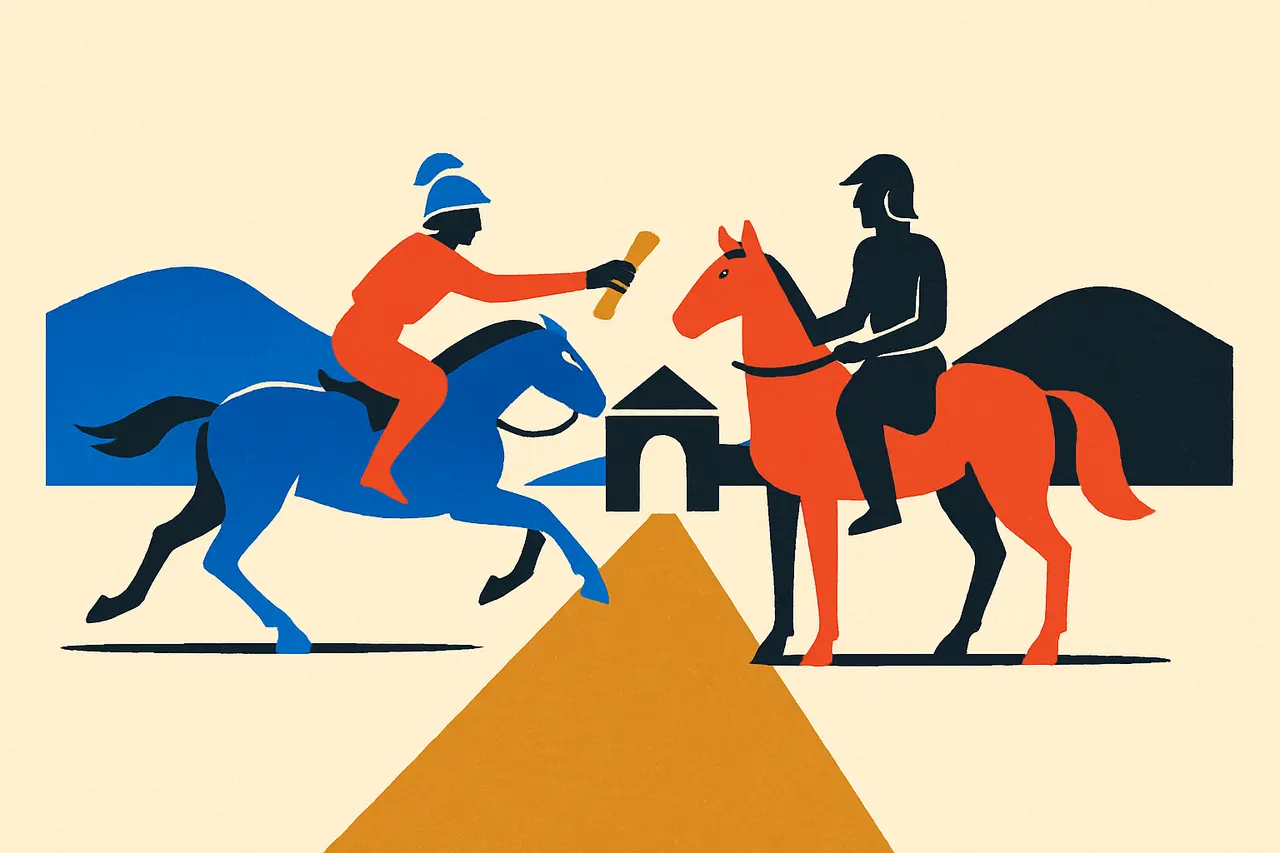
Not from any ancient source. In Book 5 Herodotus counts the staging posts and gives only the walking time. His celebrated description of the relay messengers comes in Book 8, and it concerns the riders who carried news of Xerxes’ defeat at Salamis in 480 BCE back to Persia; he gives no journey time at all. He explains the method instead: men and horses waited along the road, “each horse and man at the interval of a day’s journey”, so a dispatch never slowed for a tired rider. Totals of a week or nine days are modern estimates of what such a relay might manage, and they shift with assumptions about riding through the night.
The road was not even new under Darius I. The ancient-history site Livius notes it was probably laid out by the Assyrian kings to link Nineveh with Susa; the Persians extended and policed it, and clay tablets from Persepolis document the horse-changing relay on its 23-stage continuation to that city.
“Now there is nothing mortal that accomplishes a course more swiftly than do these messengers.” — Herodotus, Histories 8.98
Is “neither snow nor rain” the US Postal Service’s motto?
No. According to the USPS historian, the Postal Service has no official motto. The words carved over the old New York General Post Office on Eighth Avenue, which opened in 1914, were chosen by the building’s architect, William Mitchell Kendall, who adapted them from a translation of Herodotus 8.98 by Harvard’s George Herbert Palmer. Persia was not unique: the Inca ran a relay of runners along their own road network without horses at all.
Sources & references
5 referencesWell-established. Corroborated by 4 independent sources.