Mansa Musa's gold cut Cairo's gold price by 12% or more
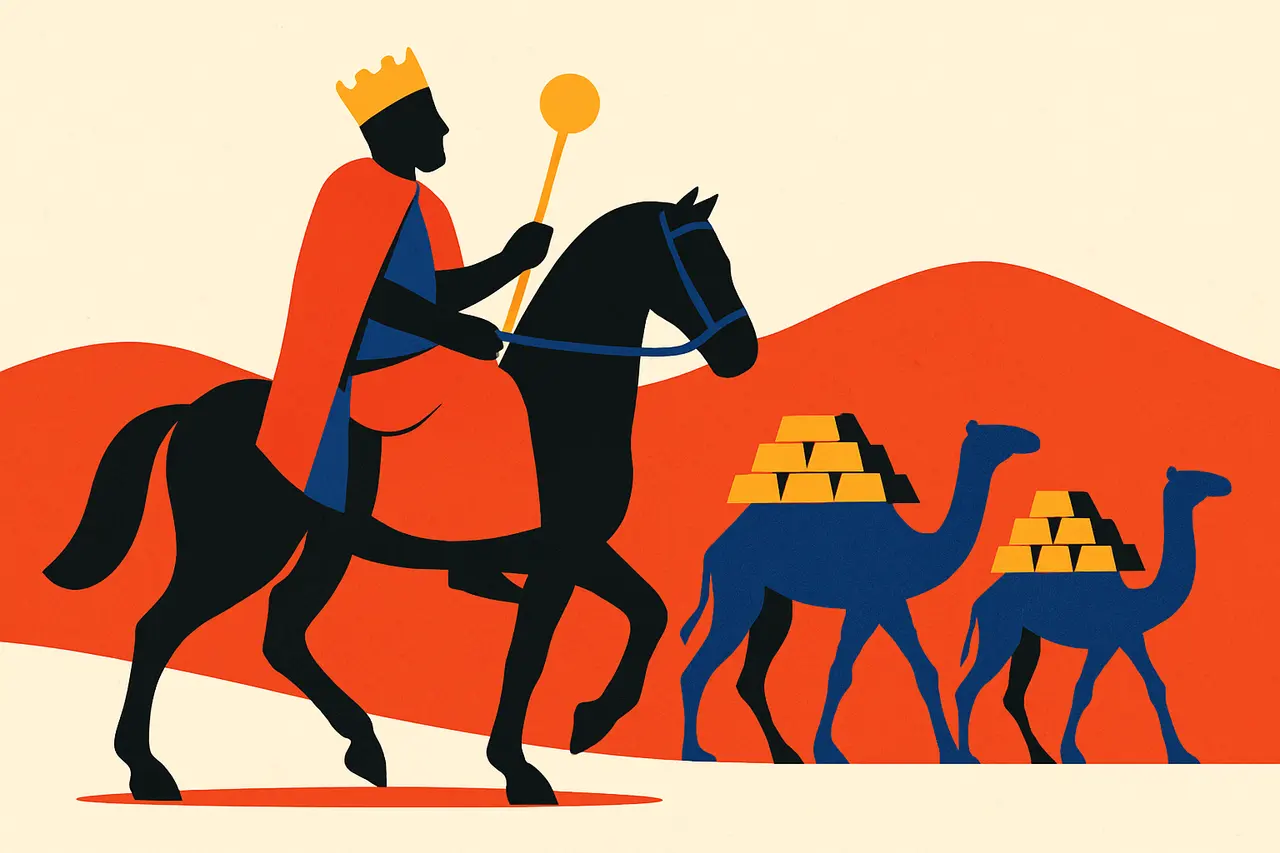
Mali's emperor spent so freely in Cairo in 1324 that gold stayed cheaper there for twelve years. The eyewitness numbers tell how much.
Mansa Musa, ruler of the Mali Empire, spent and gave away so much gold in Cairo on his pilgrimage to Mecca in 1324 that the metal’s price in Egypt fell by 12% or more, and it was still depressed about twelve years later, according to the Damascus-born historian al-Umari, who settled in Egypt afterwards and questioned people who had dealt with him.
That number matters, because the story is often told as if Musa single-handedly crashed Egypt’s economy. Al-Umari is more specific: he measured the effect in the exchange rate between the gold mithqal and the silver dirham.
| Cairo price of a gold mithqal | Silver dirhams |
|---|---|
| Before Musa’s visit | 25 or more |
| After his visit | 22 or less |
| When al-Umari wrote, ~12 years on | still 22 or less |
A fall of three dirhams in twenty-five is a lasting dent, not a collapse, but it is remarkable that one traveller’s spending registered in a major market at all. Al-Umari says Musa “flooded Cairo with his benefactions”, leaving no court emir or royal official without a load of gold, while Cairo’s traders made “incalculable profits” from his retinue. Arab writers put his entourage at tens of thousands of people, with camels each carrying about 136 kg (300 lb) of gold.
His hosts also remembered his pride. He spoke to the Egyptian sultan’s envoy only through an interpreter, despite speaking Arabic well, and refused outright to kiss the ground before Sultan al-Nasir until an adviser whispered to him; he then prostrated himself, he said, to “God who created me”.
The longer legacy was reputation. Musa’s empire, larger than Western Europe, entered the European imagination: the Catalan Atlas of about 1375, the earliest surviving map to depict him, shows him enthroned in a gold crown, holding a round gold object, with this caption:
“This king is the richest and noblest ruler of this whole region because of the abundance of gold that is found in his lands.” — Catalan Atlas, c. 1375
Sources & references
3 referencesWell-established. Corroborated by 3 independent sources.