Vulcan: the planet inside Mercury's orbit that never existed
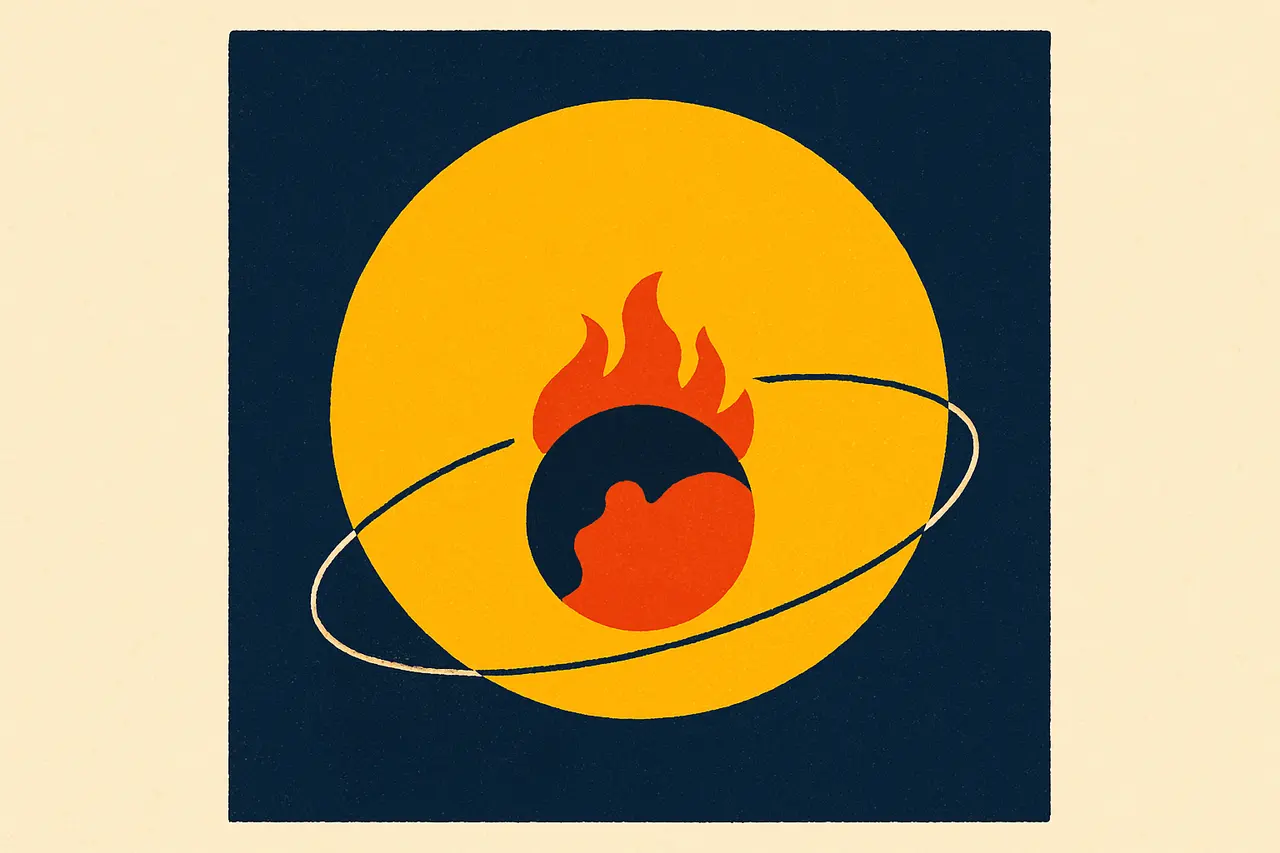
In 1859 Le Verrier blamed a tiny glitch in Mercury's orbit on an unseen planet. Einstein fixed the glitch; nobody ever found Vulcan.
Vulcan was a planet that French astronomer Urbain Le Verrier proposed in 1859 to orbit closer to the Sun than Mercury, to explain a small drift in Mercury’s orbit; it does not exist, and Einstein’s general relativity explained the drift in 1915.
Mercury’s closest point to the Sun, its perihelion, creeps forward every century. Nearly all of that is accounted for; the leftover is barely a hundredth of a degree:
| Share of Mercury’s perihelion drift | Arcseconds per century |
|---|---|
| Total observed | about 5,600 |
| Precession of Earth’s own axis | about 5,026 |
| Pull of the other planets | about 531 |
| Unexplained remainder | 43 (under 1%) |
| Remainder found by Le Verrier, with the planetary masses of his day | 38 |
Le Verrier presented his explanation to the Paris Academy of Sciences on 12 September 1859: an unseen planet, or perhaps a second asteroid belt hidden in the Sun’s glare. His reputation made the idea credible. In 1846 he had used the same reasoning, applied to oddities in Uranus’s path, to predict Neptune.
Within three months a country doctor, Edmond Lescarbault of Orgères, wrote that he had seen a small dark body cross the Sun nine months earlier. Le Verrier hurried to question him in person, and a contemporary account records his opening:
“I warn you I have come here with the intention of doing justice to your pretensions, and of demonstrating either that you have been dishonest or deceived.”
He left convinced the doctor had seen a transit of Vulcan. Few others were, and decades of transit watches and eclipse expeditions, including one Le Verrier led to Spain in 1860, produced only false alarms. Long after his death, Einstein showed that the curvature of spacetime near the Sun produces Mercury’s drift with no extra planet required.
A 2013 search of images from NASA’s twin STEREO spacecraft for “vulcanoids”, asteroids that could survive in a stable zone inside Mercury’s orbit, found none and ruled out any larger than 5.7 km across.
Sources & references
4 referencesWell-established. Corroborated by 4 independent sources.