The 1999 total solar eclipse was the 20th century's last
On this day · 11 August 1999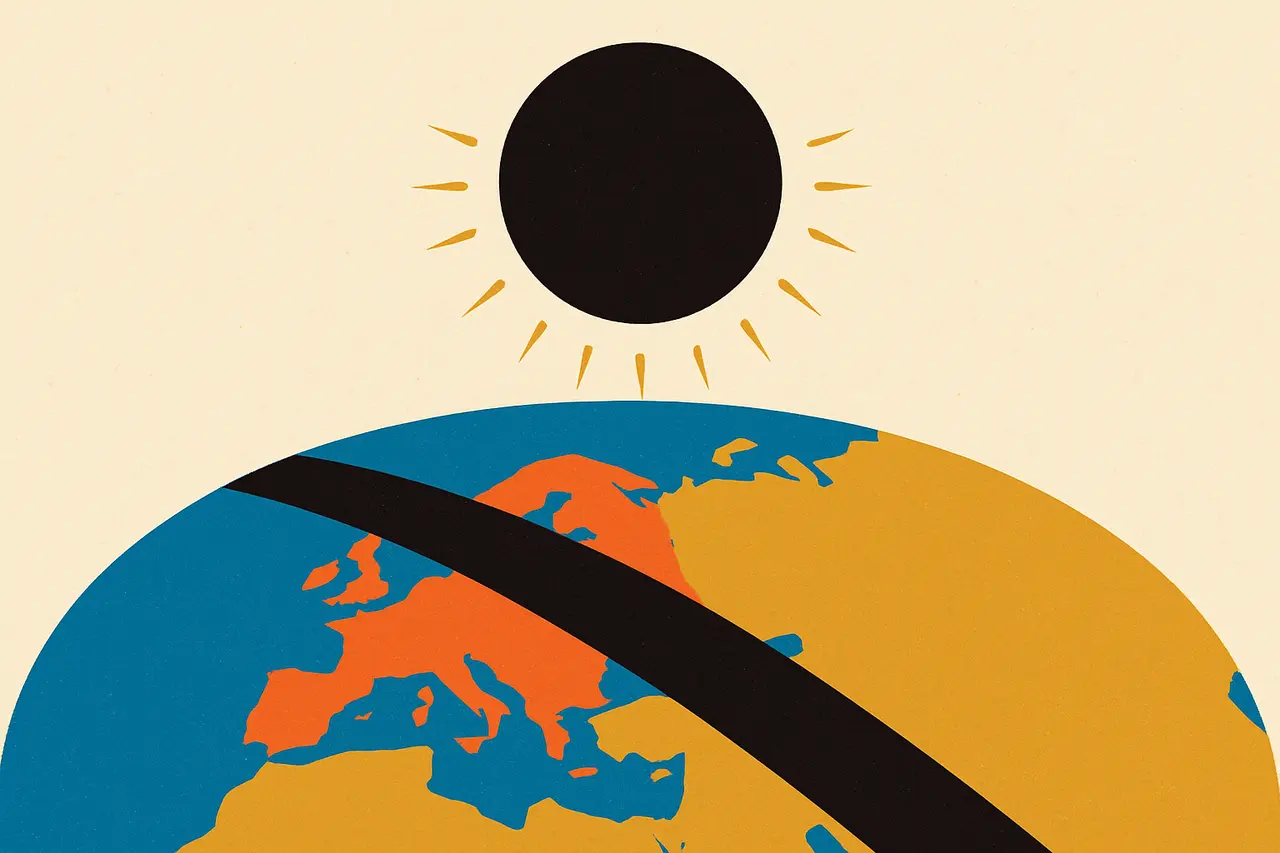
On 11 August 1999 the Moon's shadow ran 14,000 km from the Atlantic to the Bay of Bengal, narrowly missing London, Paris and Vienna.
The total solar eclipse of 11 August 1999 was the last of the 20th century: in 3 hours and 7 minutes the Moon’s shadow crossed the Atlantic, central Europe, the Middle East and India, and the European Space Agency estimates that up to 350 million people in Europe and Asia witnessed it.
The shadow touched down about 300 kilometres south of Nova Scotia at 09:31 UT, reached the Isles of Scilly and Cornwall about 40 minutes later, and left Earth over the Bay of Bengal at 12:36 UT. Its path was roughly 14,000 kilometres long yet covered only 0.2% of Earth’s surface.
Some big cities had near misses; others got the best seats. Plymouth, the largest English city in the path, got 1 minute 39 seconds of totality, while London saw only a partial eclipse, with the Moon covering 96.8% of the Sun’s width. The shadow’s southern edge passed 30 kilometres north of Paris (99.2%). Stuttgart and Munich got more than two minutes, while Vienna and Budapest, each about 40 kilometres north of the path, missed out. The best seat was near Râmnicu Vâlcea, Romania: 2 minutes 23 seconds, with the shadow 112 kilometres wide and the Sun 59° high. Bucharest, on the centre line, got 2 minutes 22 seconds, and Karachi 1 minute 13 seconds; Calcutta saw only a partial eclipse, with the Sun 2° above the horizon.
Eclipses recur in families called Saros series, whose members are separated by about 18 years and 11 days. The 1999 eclipse sat in a longer story:
- 1961: The previous time totality had fallen on central Europe.
- 11 August 1999: A member of Saros 145 crosses Europe and Asia.
- 21 August 2017: Its Saros successor crosses the United States, lasting up to 2 minutes 40 seconds.
- 2 September 2035: The next member of the family arrives.
The totals keep getting longer as the series matures.
Sources & references
5 referencesWell-established. Corroborated by 2 independent sources.