Einstein finished general relativity on 25 November 1915
On this day · 25 November 1915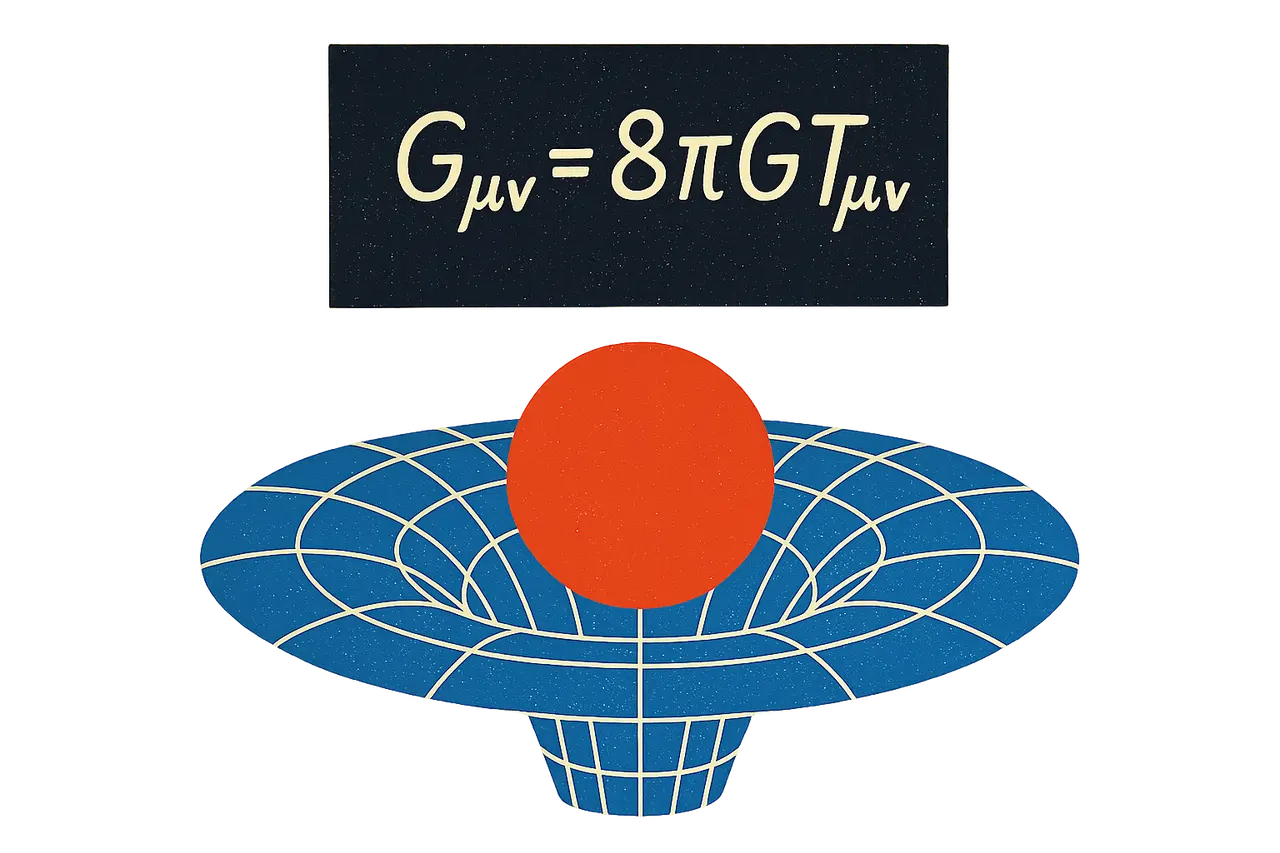
Einstein's final field equations reached the Berlin academy five days after Hilbert's — but Hilbert's own proofs show who really got there first.
Albert Einstein presented the final field equations of general relativity on 25 November 1915, in a short paper to the Prussian Academy of Sciences in Berlin, Die Feldgleichungen der Gravitation. It was the last of four communications he submitted on consecutive Thursdays that month, each revising the one before.
The equations tie the curvature of spacetime to the matter and energy within it. In the third paper, a week earlier, Einstein had used the theory to account for the 43 arc-seconds per century of Mercury’s perihelion motion that Newtonian gravity could not explain.
Why did it take Einstein so long?
Partly because he had nearly reached the answer three years earlier and then abandoned it. Working with his former classmate Marcel Grossmann in Zurich in 1912–13, Einstein wrote down candidate equations built on the Riemann tensor in what historians call the Zurich notebook, then gave them up, as he later put it, “with a heavy heart.”
He spent the next two years on a flawed alternative, the Entwurf (“outline”) theory, until he found in October 1915 that his argument for it was fallacious.
Did Hilbert get there first?
No, whatever the dates suggest. The mathematician David Hilbert, who had heard Einstein lecture on the Entwurf theory in Göttingen that summer, presented his own field equations on 20 November, five days before Einstein, which has fed claims that Hilbert won the race. But Hilbert’s paper was not published until March 1916. In the late 1990s the historian Leo Corry found its page proofs, stamped by the printer on 6 December 1915: they show Hilbert made significant changes after that date, and the proofs do not contain the Einstein equations. Hilbert had accepted Einstein’s own earlier “hole argument” against generally covariant equations, so the field equations in the proofs were not generally covariant. As a Physics Today history concludes, Einstein “need not have worried about Hilbert in November 1915.”
Einstein did worry, though. Knowing Hilbert was on his trail, he may have rushed his November equations into print, which helps explain why he had to correct them twice in three weeks.
Sources & references
3 referencesWell-established. Corroborated by 3 independent sources.