Nobody has proved what sank the USS Maine in 1898
On this day · 15 February 1898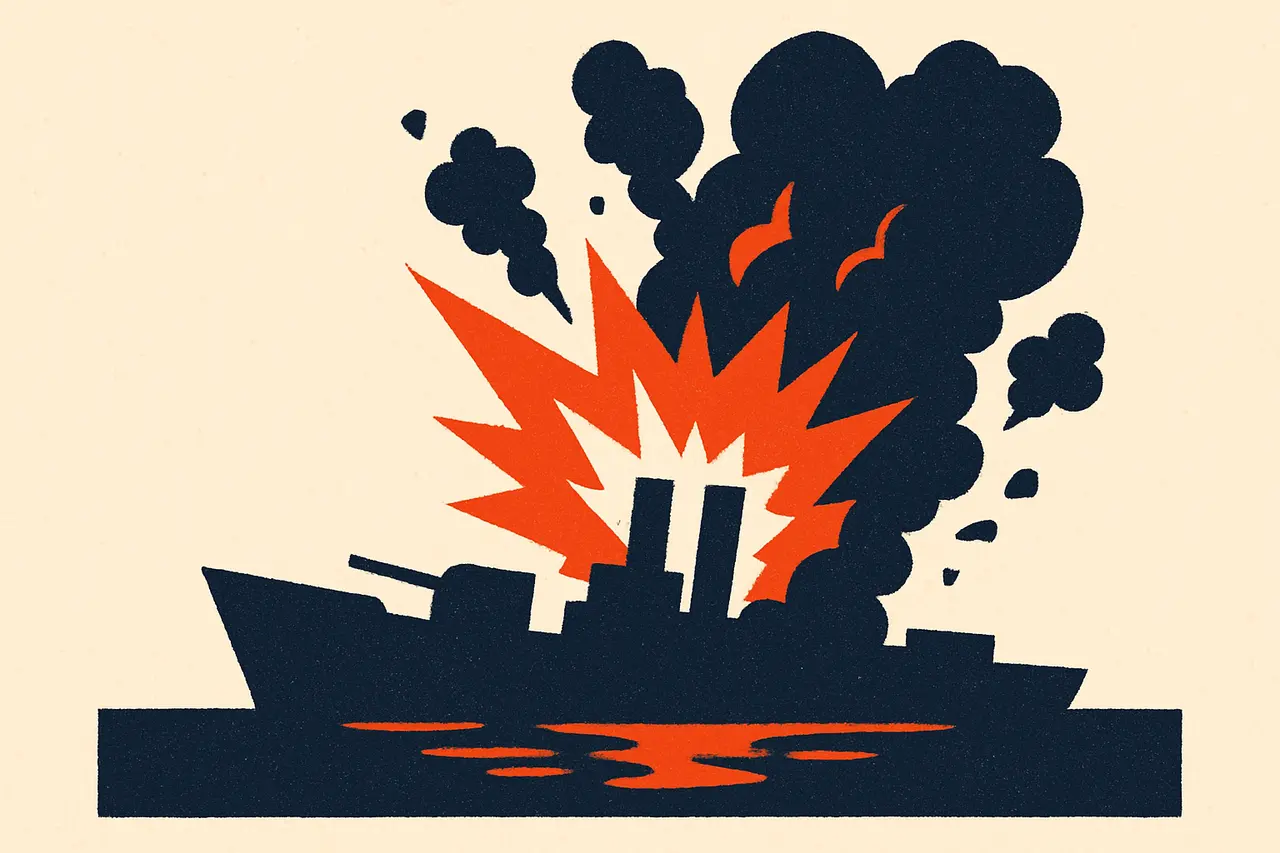
Two Navy boards blamed a mine; a 1976 study blamed a coal fire. More than a century on, the Maine explosion remains unsolved.
The battleship USS Maine blew up in Havana Harbor shortly after 9:40 p.m. on 15 February 1898, killing 260 of the roughly 350 men aboard — and despite three major investigations, nobody has ever proved what caused the blast.
The Maine had been sent to Cuba to protect Americans during the Cuban revolt against Spain. The explosion shattered the forward part of the ship, where most of the crew slept; 252 men were dead or missing that night and eight more died in Havana hospitals. American newspapers blamed Spain at once, and “Remember the Maine!” became a war cry. Congress declared war on 25 April 1898. The Navy’s own ship history is careful on this point: the sinking did not cause the war, but it accelerated a slide toward it and rallied opinion behind intervention.
Three verdicts and a burial at sea
- March 1898: A U.S. Navy court of inquiry concludes an underwater mine set off the forward magazines, but cannot link the blast to any person.
- 1911: Army engineers, authorised by Congress, raise the wreck. A second board finds an external explosion “of low magnitude” set off the magazine — though technical experts at both inquiries suspected a fire in a coal bunker beside the magazine.
- 16 March 1912: The refloated hulk is towed out and sunk in deep water in the Gulf of Mexico, taking the physical evidence with it.
- 1976: Admiral Hyman Rickover has explosives experts re-examine the record; they find the damage inconsistent with a mine and name spontaneous combustion of coal as the most likely cause.
Historians still argue both ways. Critics of Rickover doubt a bunker fire could go unnoticed, yet evidence of a mine remains thin, largely conjecture.
The dead had their own legacy. 230 Maine casualties lie in Section 24 of Arlington National Cemetery, only 62 of them identified, beneath the ship’s 62-foot mast. That war was the first in which the U.S. government repatriated service members who died overseas. The scale was small beside later harbour disasters such as the Halifax explosion of 1917, but its political blast radius was far larger.
Sources & references
4 referencesWell-established. Corroborated by 4 independent sources.