The Lusitania sinking didn't bring the US into WWI
On this day · 7 May 1915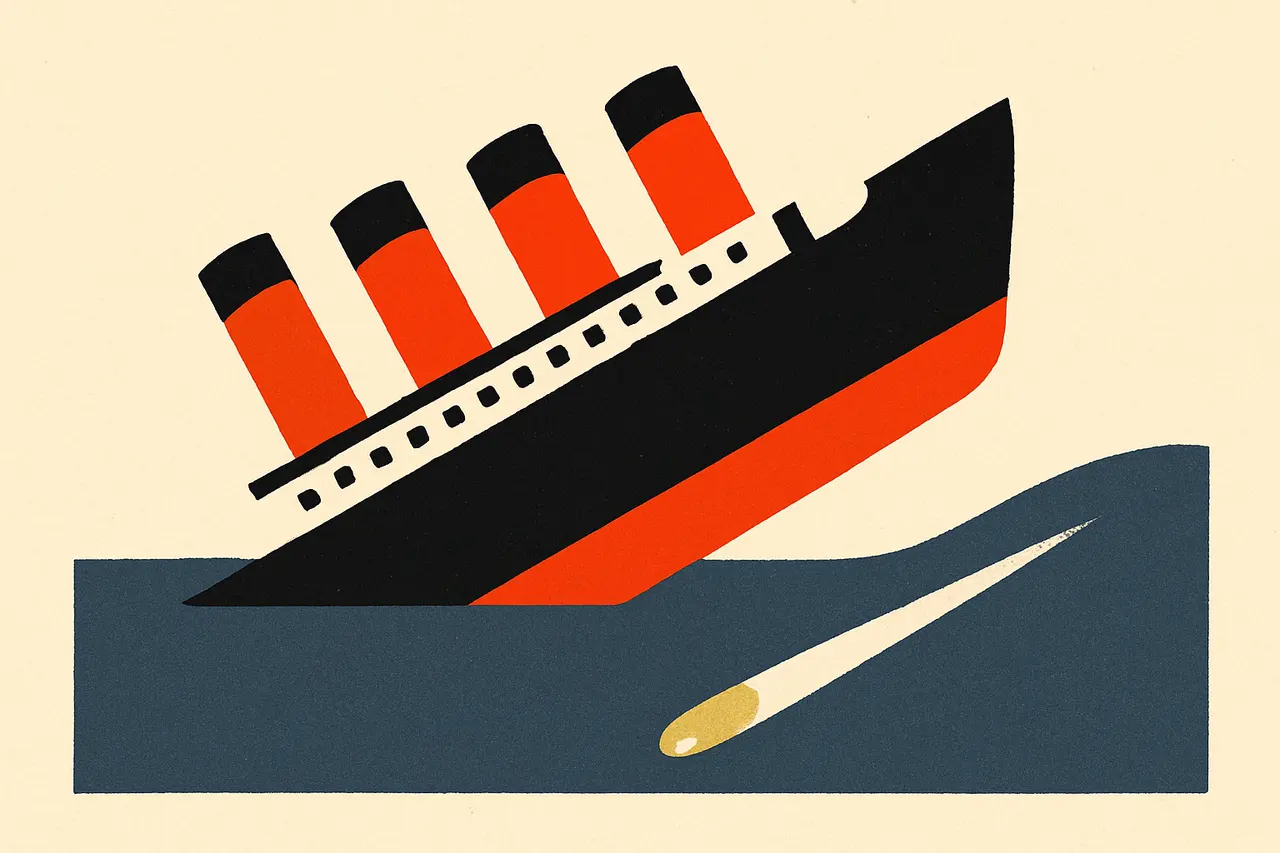
U-20 sank the liner in 18 minutes in May 1915, killing 128 Americans. Yet the US stayed neutral for almost two more years.
The German submarine U-20 torpedoed the Cunard liner RMS Lusitania off the south coast of Ireland on May 7, 1915. The ship sank in 18 minutes, and 1,198 of the roughly 1,960 people aboard died, 128 of them American. It is often remembered as the event that brought the United States into the First World War, but the US declared war 23 months later, for different reasons.
Kapitänleutnant Walther Schwieger fired a single torpedo, without warning, from about 200 metres. His war log, now in the US National Archives, records an “extraordinarily large explosion” that tore apart the superstructure and the bridge. A second blast followed inside the ship, and its cause is still argued over. Germany said the Lusitania was carrying munitions for the Allies, and divers on the wreck have since found large quantities of shells and cartridges. Whether that cargo caused the second explosion remains, as the Imperial War Museums puts it, controversial.
The road from the sinking to war was long:
- Spring 1915: Before the ship leaves New York, the German Embassy publishes newspaper notices warning Americans not to sail on liners bound for Britain.
- 1915: President Wilson protests but works to avoid war after the Lusitania and the Arabic, which together killed 131 US citizens.
- May 4, 1916: After the cross-Channel ferry Sussex is torpedoed, Germany accepts the “Sussex pledge” to stop attacking passenger ships.
- January 1917: British intelligence intercepts the Zimmermann telegram (January 19), and on January 31 Germany announces it will resume unrestricted submarine warfare.
- April 6, 1917: The United States enters the war.
The Lusitania shaped American opinion, but it was Germany’s return to sinking ships without warning, in a campaign meant to starve Britain into submission, together with the Zimmermann telegram, that tipped Wilson into war. Under international pressure, Germany’s high command made Schwieger apologise, then later gave him another boat. Neither he nor U-20 survived the war: he died when his later submarine, U-88, hit a mine in September 1917.
Sources & references
4 referencesWell-established. Corroborated by 3 independent sources.