The Brainless Cell That Solves Mazes
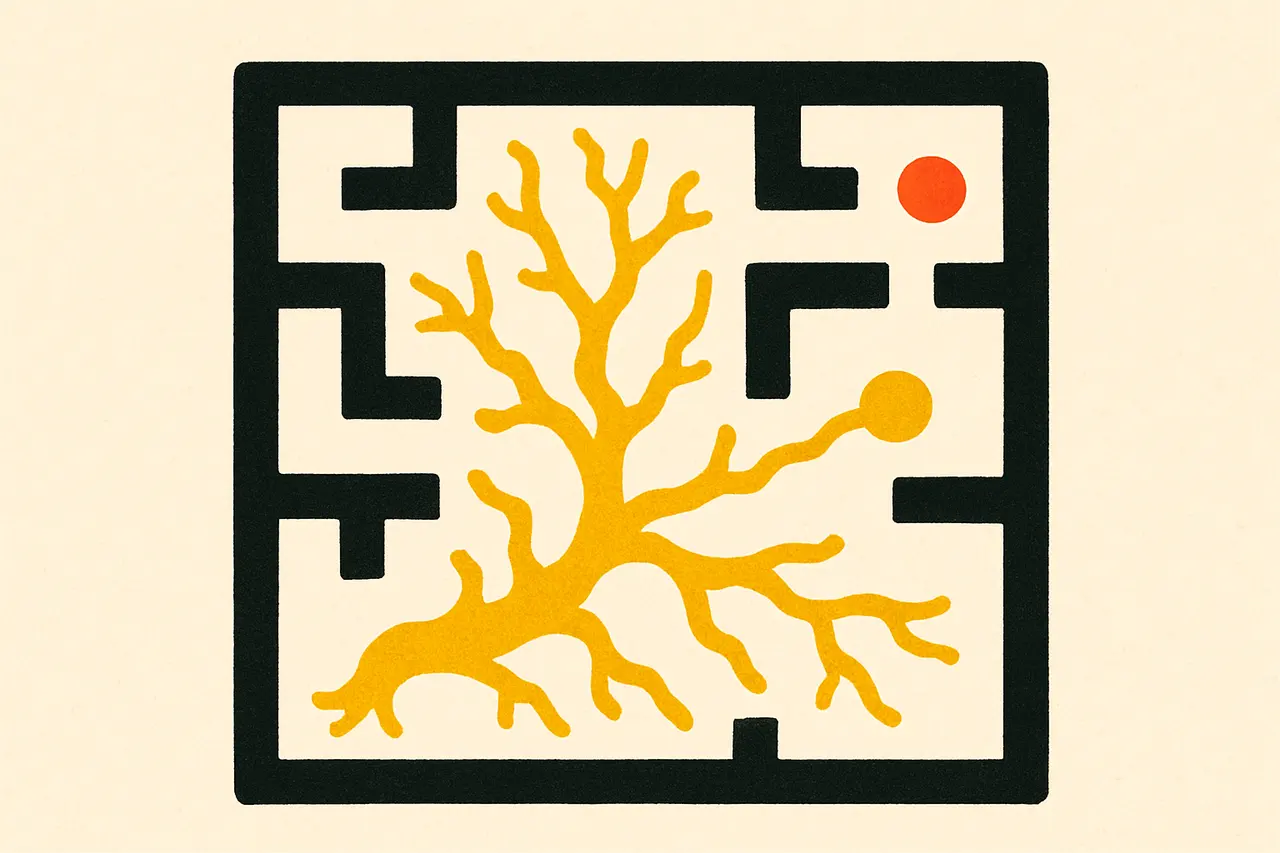
A single-celled slime mold with no brain or neurons can untangle a maze and remember where it has already been.
Physarum polycephalum is a slime mold: a giant single cell, sometimes spanning many centimetres, with no brain and no nervous system. Yet it behaves as if it can think. Placed in a maze with food at two exits, the organism explores every corridor, then retracts from the dead ends until its yellow body forms a single tube along the shortest path between the food sources.
How does a brainless blob avoid going in circles? A 2012 PNAS study by Chris Reid and colleagues found the answer outside the cell. As Physarum crawls, it lays down a mat of extracellular slime, and it actively avoids ground it has already coated.
The trail is an externalized spatial memory, marking “been there” so the cell can keep exploring somewhere new.
In a U-shaped trap test, slime molds on clean agar reached the goal 96% of the time; on pre-coated agar, stripped of that memory cue, success fell to just 33%. It is problem-solving without a single neuron.
Sources & references
2 referencesWell-established. Corroborated by 2 independent sources.