The Beetle That Fires Boiling Chemical Spray
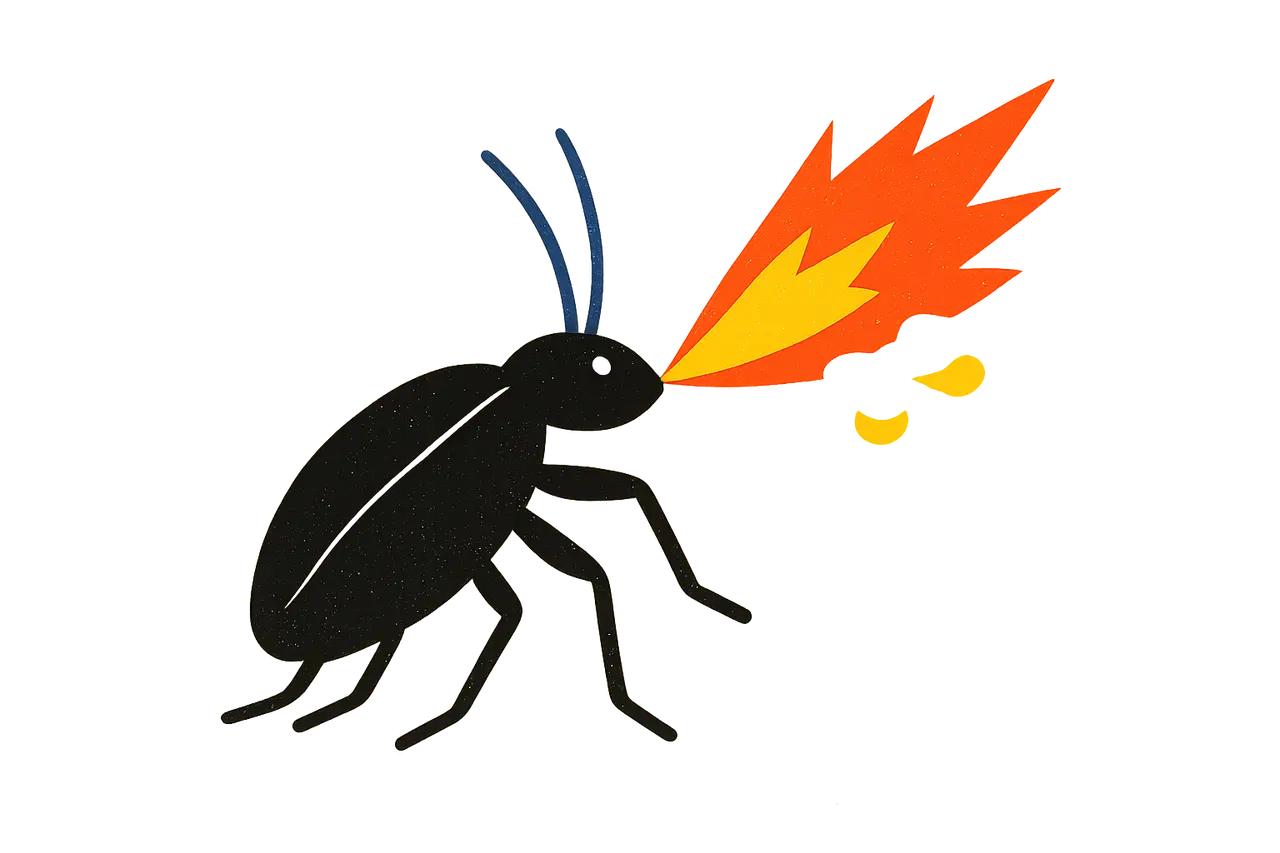
When a bombardier beetle is grabbed, it mixes two chemicals into an explosive, near-boiling jet aimed straight at its attacker.
The bombardier beetle carries a chemical weapon built from two harmless ingredients kept apart until the moment of attack. In one set of glands it stores hydroquinones; in a reservoir nearby it holds a solution of roughly 25% hydrogen peroxide. When a predator strikes, the beetle floods both into a tiny reaction chamber lined with catalase and peroxidase enzymes.
The result is an explosive, exothermic reaction. The enzymes convert the mixture into irritating p-benzoquinones, free oxygen and water, releasing about 48.5 kcal of heat per mole of product. That energy superheats the fluid to roughly 100°C — close to boiling — and blasts it outward at speeds up to 10 m/s over distances reaching 30 cm.
It is biochemistry running, quite literally, at 100°C.
Crucially, the spray is not a steady stream. MIT researchers using high-speed imaging found the beetle fires a pulsating jet, with repeated micro-explosions estimated at around 500 pulses per second. Each pulse briefly cools the chamber by drawing in fresh reactants, protecting the beetle’s own tissues while it scalds its enemy.
Sources & references
2 referencesWell-established. Corroborated by 2 independent sources.