Cicadas that count to 13 and 17 — both prime numbers
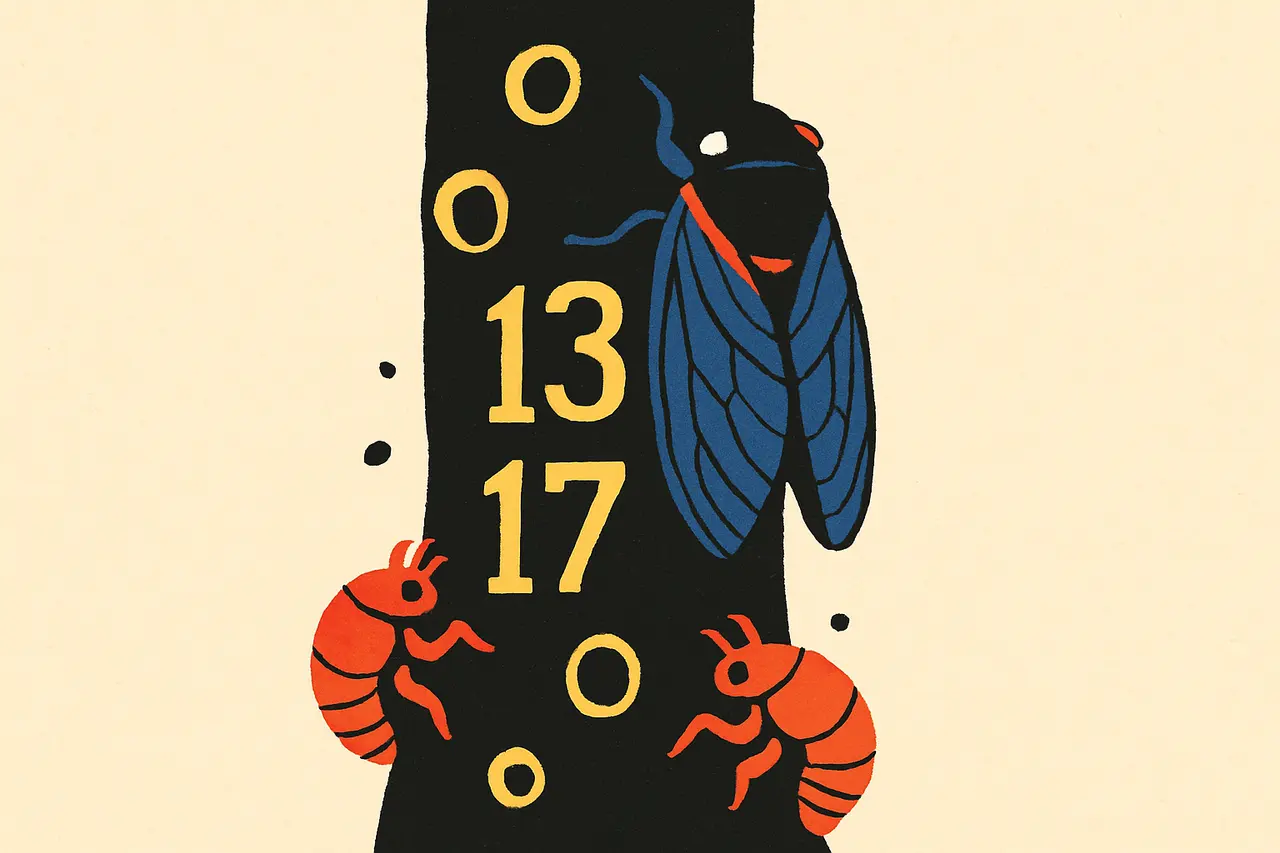
Periodical cicadas stay underground for prime-numbered years, then surface in overwhelming, synchronized billions.
Periodical cicadas (Magicicada) spend almost their entire lives underground, then erupt in vast, synchronized swarms after exactly 13 or 17 years. There are seven species: four on 13-year clocks and three on 17-year clocks.
Underground, the nymphs aren’t simply asleep. They feed on fluid drawn from tree-root xylem, and the seasonal ebb and flow of that sap appears to act as a calendar, letting them tally the passing years. The system isn’t perfect: every emergence sheds a few “stragglers” that surface one or four years off-schedule, which may be how new broods occasionally split off.
Both 13 and 17 are prime numbers, and that may be no accident. One classic argument, explored in mathematical models, is that a predator or parasite cycling every 2, 3, 4, or 6 years can rarely line up with a prime-numbered prey, so prime intervals minimize the odds of a specialist ever catching a peak year.
A second hypothesis points inward: because the least common multiple of 13 and 17 is 221, the two clocks almost never coincide, which keeps neighboring broods from interbreeding and producing hybrids on disruptive intermediate cycles.
The emergence itself is a final defense called predator satiation. When millions erupt at once — in regional groups called broods, like the enormous Brood X that blankets much of the eastern United States — birds, mammals, and reptiles simply cannot eat them all, and the survivors are free to mate. Between emergences, the insects are so tightly synchronized that adults are nearly absent for the 12 or 16 silent years in between.
Sources & references
2 referencesWell-established. Corroborated by 2 independent sources.