A honeybee's waggle dance is a map drawn in the dark
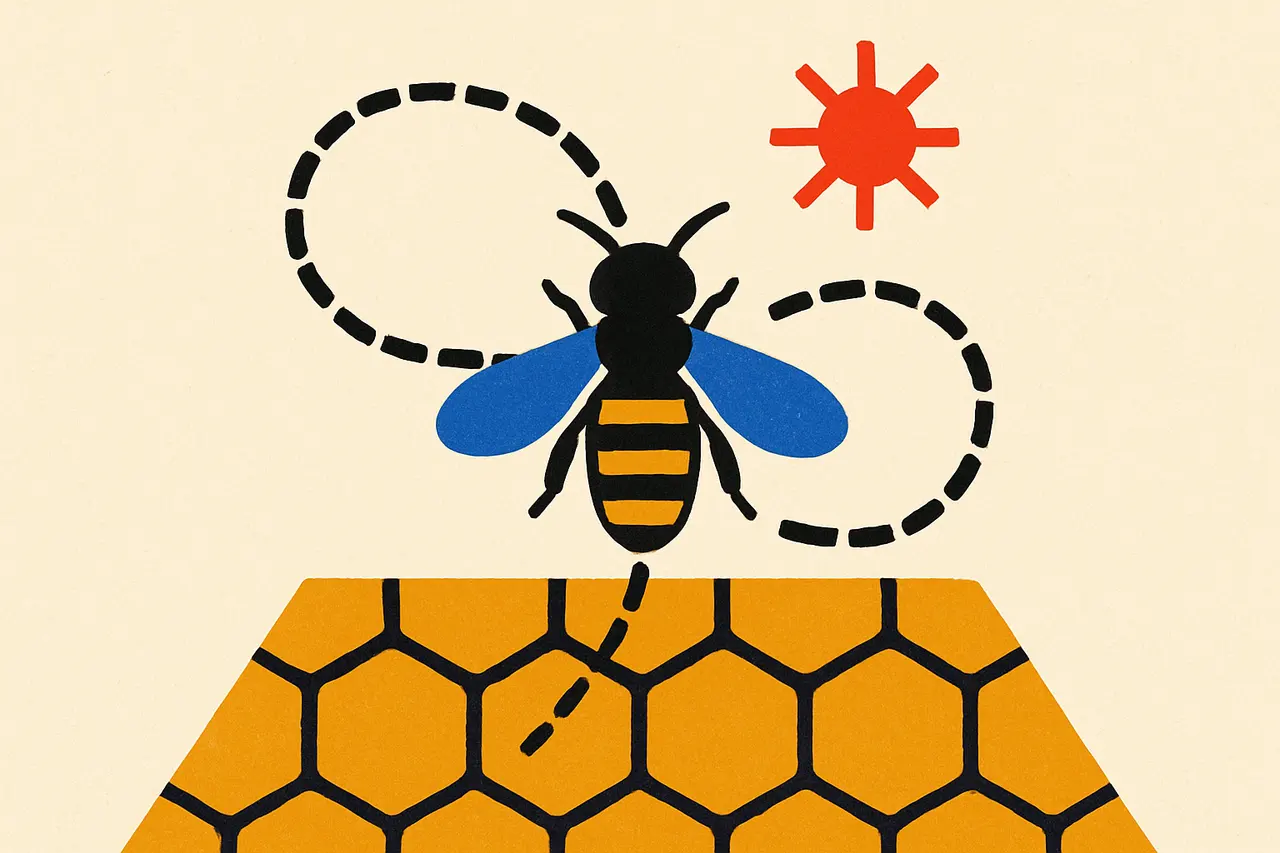
A returning forager tells the hive exactly where to fly using the angle and duration of a figure-eight dance.
When a honeybee finds food more than about 150 meters away, she returns to the pitch-dark hive and dances a figure-eight on the vertical comb. The straight “waggle run” through the middle is the message; closer finds get a simpler round dance, a tight circling that says only “food nearby, go look.”
Direction is encoded as an angle. The bee can’t point at the sun inside the hive, so she substitutes gravity: a run aimed straight up means “fly toward the sun,” and a run tilted 40 degrees to the right means the food lies 40 degrees right of the sun. Distance is encoded in time — the longer the waggle run lasts, the farther the food — which she gauges from the optic flow streaming past her eyes on the way out.
Karl von Frisch cracked the code over decades, marking individual foragers with dabs of colored paint and numbers, then setting feeding stations at carefully measured distances to read off how the timing tracked the range. He won the 1973 Nobel Prize in Physiology or Medicine.
Different honeybee races even keep slightly different “dialects,” pacing the same distance with different waggle durations. The clincher came from a mechanical mimic: a tiny robot bee programmed to waggle could send real recruits flying to a spot they had never visited.
The dance is one of the only known symbolic languages outside humans — an abstract signal standing in for a place. Scout bees even use it to argue, debating candidate nest sites until a swarm reaches consensus.
Sources & references
2 referencesWell-established. Corroborated by 2 independent sources.