Egyptian blue is the oldest known synthetic pigment
Made from sand, copper and natron about 5,000 years ago, Egyptian blue glows in infrared — and may now help keep roofs cool.
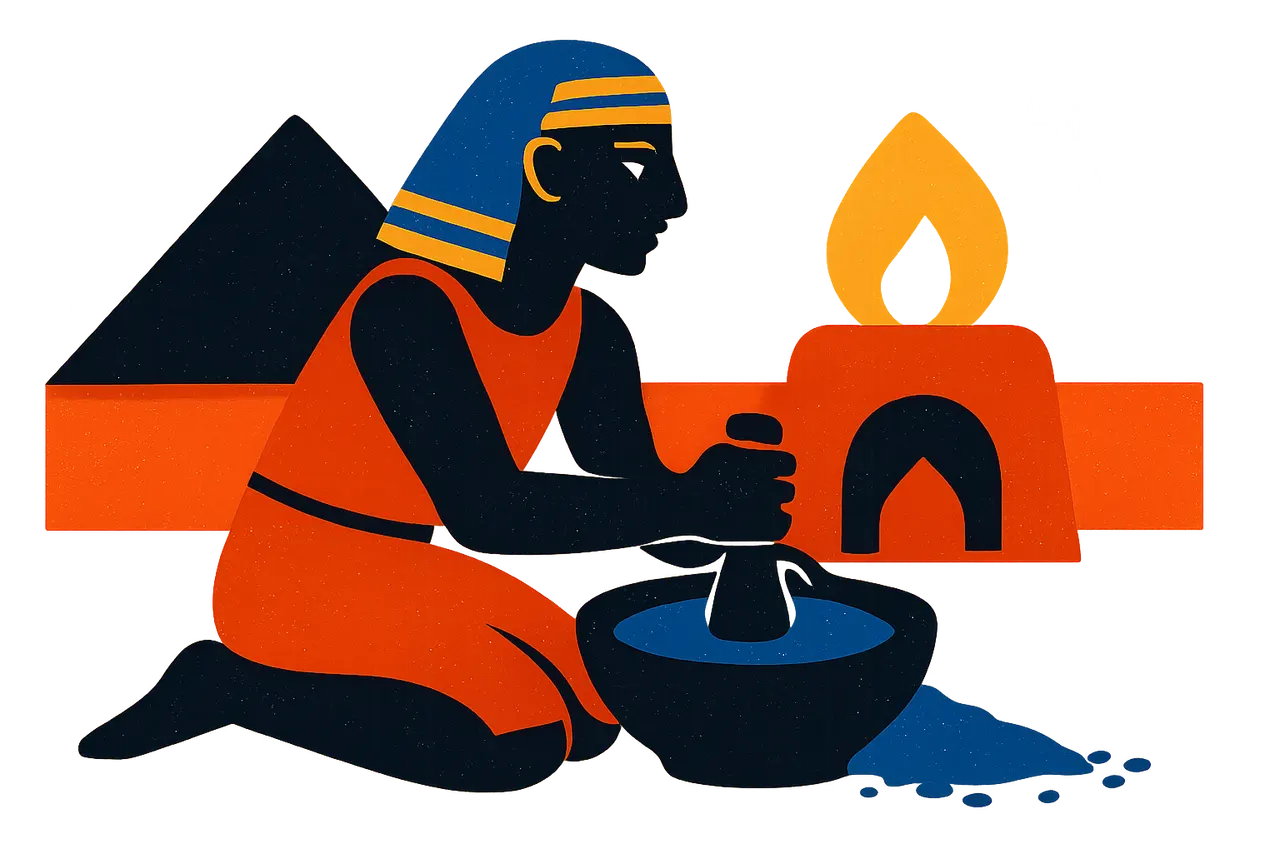
Egyptian blue, a calcium copper silicate that ancient Egyptians made by firing sand, copper, a calcium source and natron at around 1,000 °C, is the world’s oldest known synthetic pigment, in use about 5,000 years ago. It served as a cheaper substitute for turquoise and lapis lazuli on wood, stone and cartonnage, the papier-mâché-like material of mummy cases.
The best surviving ancient recipe is Roman. In the 1st century BC the architect Vitruvius described grinding sand with natron, adding filings of Cyprian copper, rolling the paste into balls and firing them in a furnace. He also believed the colour “was first manufactured at Alexandria” — a city founded in 331 BC, more than two and a half thousand years after Egyptian painters were already using it. Romans kept making the pigment, but by the Renaissance the method had largely been forgotten.
Recreating it has shown how variable the ancient product was. In 2025 a team led by Washington State University, working with the Carnegie Museum of Natural History and the Smithsonian’s Museum Conservation Institute, made 12 recipes, heating the mixtures for between one and 11 hours. The colour ranged from deep blue to dull grey or green, and small changes in process gave very different results. The surprise was that the bluest samples needed only about 50% of the blue-forming crystals; the rest could be almost anything.
The pigment’s modern appeal is invisible. When it absorbs visible light, Egyptian blue re-emits it in the near-infrared. In 2018 researchers at the US Lawrence Berkeley National Laboratory found that this fluorescence can be ten times stronger than previously thought, with the pigment emitting nearly as many photons as it absorbs. That could make it useful for coatings that keep roofs and walls cooler, and for tinted windows that send infrared light to solar cells at their edges.
WSU’s researchers also point to fingerprinting and counterfeit-proof inks — new jobs for a colour first mixed to paint the gods.
Sources & references
3 referencesWell-established. Corroborated by 3 independent sources.