Çatalhöyük: the 9,000-year-old town with no streets
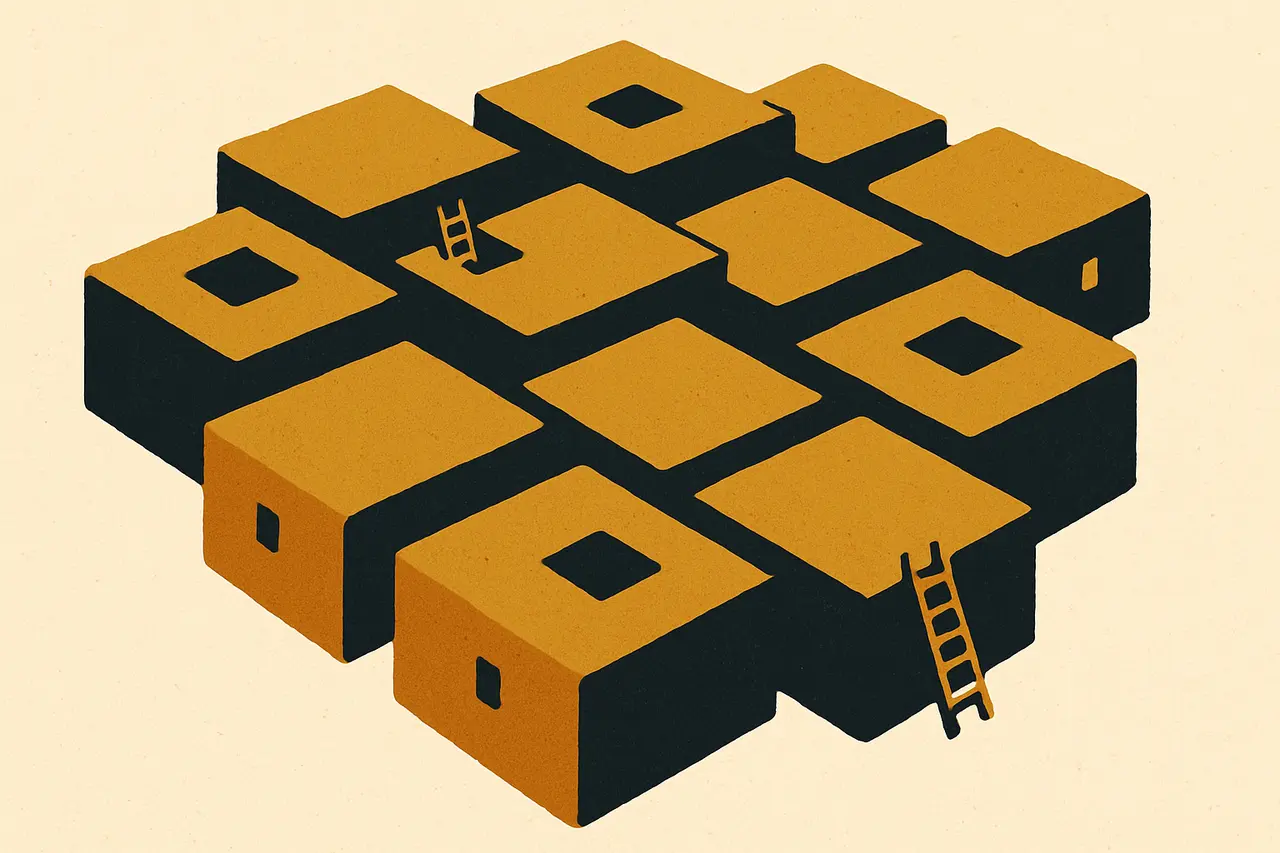
People in Neolithic Çatalhöyük walked across rooftops and climbed down ladders to get home — and buried their relatives under the floor.
Çatalhöyük, a Neolithic settlement in central Anatolia (modern Turkey) occupied roughly 9,000 to 7,000 years ago, had no streets: its mud-brick houses were built wall to wall, and residents walked across the rooftops and entered their homes down a wooden ladder through a hole in the roof. It is one of the earliest large farming settlements known, and a UNESCO World Heritage Site.
How did a town work without streets?
The roofs were the public space. Each house had a central room with an oven set below the ladder, where cooking and other daily work took place. Raised platforms served for sleeping and work, and the dead were buried beneath them. Walls were plastered white and painted with hunting scenes and geometric patterns. When a house wore out it was filled in and a new one built on its old walls, again and again, until the layers formed the mound that stands today.
Were the women in charge?
That idea goes back to James Mellaart, who excavated in the 1960s and took the site’s plump female figurines as a sign that women held a special place in its society. Beyond the figurines, though, there was little to test it — until DNA.
In 2025 a team of 47 researchers reported in Science on ancient genomes from 131 people buried under the floors. In the early centuries, those sharing a house were often biological families; later, unrelated people were frequently buried together. Where kinship did link a household, it ran through mothers. And once genetics could sex infant skeletons, baby girls turned out to have received five times more grave goods than boys.
The researchers stop short of “matriarchy”. Their conclusion is that households formed around women, not that women ruled — a pattern quite unlike the male-centred villages of Neolithic Europe that later descended from Anatolian farmers.
All of this happened in a community that ran for well over a thousand years without writing, which began as bookkeeping in Mesopotamia much later.
Sources & references
3 referencesWell-established. Corroborated by 3 independent sources.