Cleopatra lived closer to the Moon landing than the pyramids
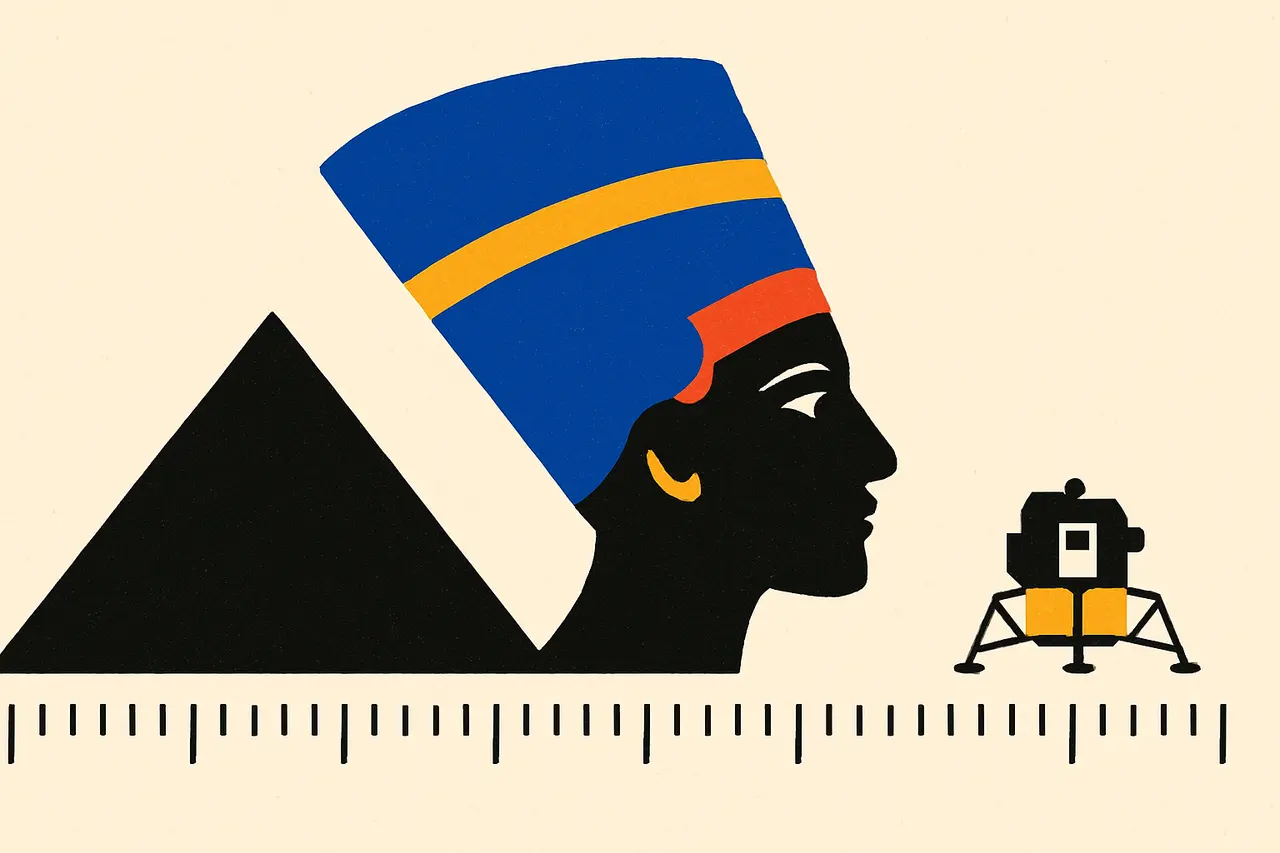
Born in 69 BC, Cleopatra was about 2,480 years younger than the Great Pyramid — and only about 2,037 years older than Apollo 11.
Cleopatra VII was born in 69 BC, about 2,480 years after the Great Pyramid of Giza was built for the pharaoh Khufu (c. 2551–2528 BC) and about 2,037 years before Apollo 11 landed on the Moon on 20 July 1969 — so she lived closer in time to the Moon landing than to the pyramid’s construction.
Her birth year comes from Plutarch, who wrote that when she died, in 30 BC, she was “forty years of age save one”. Measured from her death instead, the gaps are about 2,520 and 1,998 years. Either way the pyramid was about as old to her as the founding of the Roman Republic, in 509 BC, is to us.
| Event | Date | Years from Cleopatra’s birth |
|---|---|---|
| Great Pyramid built | c. 2550 BC | about 2,480 earlier |
| Cleopatra born | 69 BC | — |
| Cleopatra dies | 30 BC | 39 later |
| Apollo 11 lands | AD 1969 | about 2,037 later |
Could a different pyramid date flip it?
No. Scientific testing has pushed Khufu’s dates earlier, not later. When the David H. Koch Pyramids Radiocarbon Project dated flecks of charcoal and other organic material in the monuments in 1984, results for the Old Kingdom pyramids averaged 374 years older than the historical dates. A larger 1995 sampling came out 100 to 200 years older. Both widen the gap. For the claim to fail, the Great Pyramid would have to be about 450 years younger than any estimate — built around 2100 BC.
The twist is that pyramids were not a dead art in her day. South of Egypt, the kings and queens of Kush were still being buried under steep, slender pyramids at Meroë: 38 of its royal tombs belong to monarchs who ruled between 250 BC and AD 320, so pyramid-building overlapped Cleopatra’s lifetime.
Egypt’s own giant was, by then, simply ancient — the same kind of time warp that makes Oxford older than the Aztec empire. It still had more than a thousand years left as the tallest structure on Earth, a record it held for about 3,800 years.
Sources & references
5 referencesWell-established. Corroborated by 5 independent sources.