What happened when Earth passed through Halley's tail in 1910
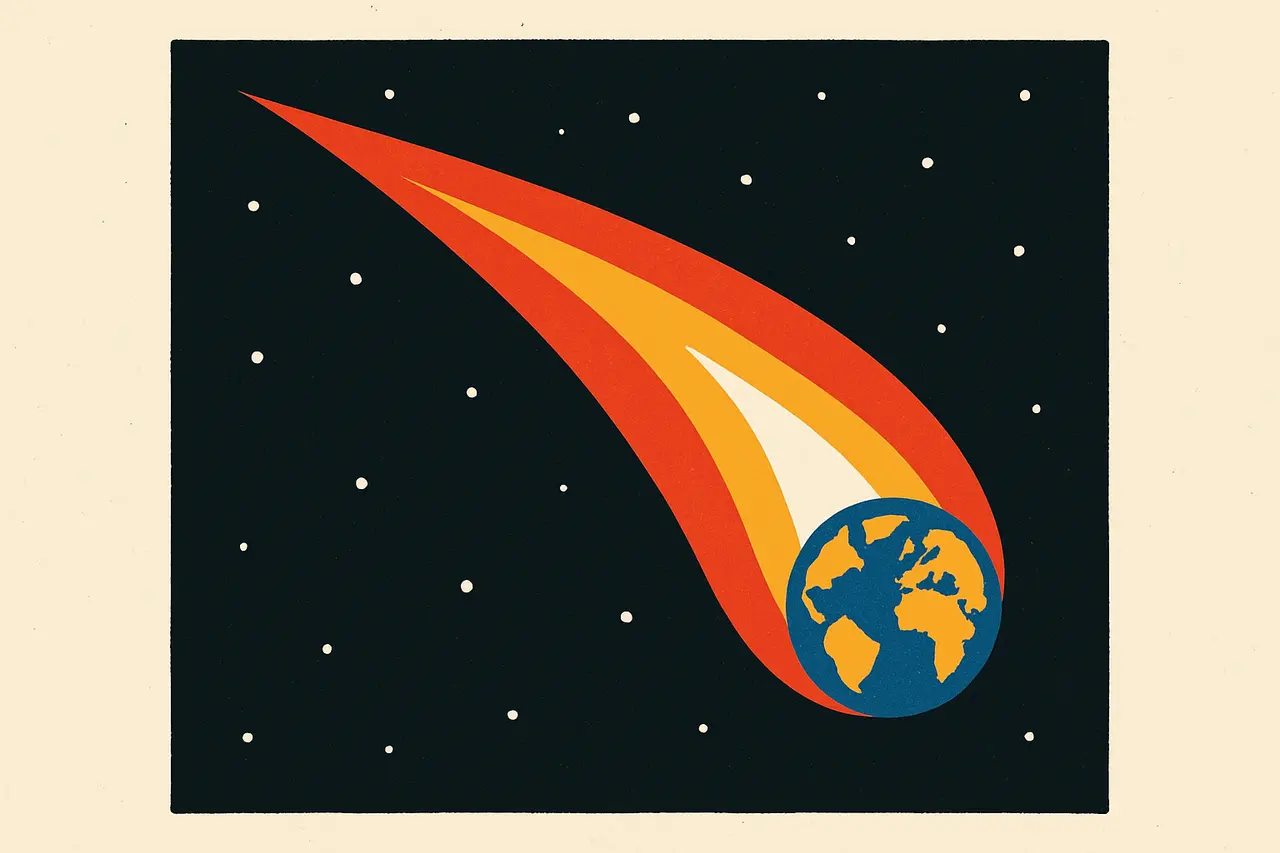
On 19 May 1910 Earth spent six hours in Halley's Comet's tail. Nothing happened, but scientists' speculation had already sparked a worldwide scare.
Earth passed through the tail of Halley’s Comet on 19 May 1910, spending about six hours in the faint far end of a tail millions of miles long, and nothing happened: dawn on 20 May was like any other day. The comet came within about 0.14 AU (roughly 21 million km) of Earth, three times closer than on its 1986 return. For astronomers, 1910 was a milestone of a different kind: it was the first apparition of Halley’s Comet to be photographed.
The panic, though, grew out of science, not old superstition. In late November 1909 the French astronomer Camille Flammarion, writing for the Paris edition of the New York Herald, noted that the tail was far sparser than a cloud, then speculated anyway that its hydrogen might strip the oxygen from our air. On 7 February 1910, astronomers at Yerkes Observatory announced that spectrograph analysis had detected cyanogen, a poison related to cyanide, in the tail. Asked about it by the New York Times, Flammarion went further:
The cyanogen could “impregnate the atmosphere and possibly snuff out all life on the planet.” (Camille Flammarion, 1910)
Other astronomers dismissed the danger, but the Times headline read “Comet’s Poisonous Tail”. Salesmen sold “comet pills”, bartenders claimed whisky would protect drinkers, and a Los Angeles broker offered “comet insurance” paying $500 to the families of anyone killed; at least 50 customers paid a quarter a week. Some households sealed their doors and papered over the keyholes.
The fear left a physical trace. In a remote cave in southern Puerto Rico, a charcoal drawing of a comet above a tomb is captioned “Recuerdos de Fernando Colón, Mayo 23, 1910”.
Researchers used the 1910 census to identify the artist as Fernando Colón-Vásquez, then 15, whose family seems to have trekked at least two hours through thorny scrub to shelter underground.
Sources & references
4 referencesWell-established. Corroborated by 4 independent sources.