Magellan reached Venus in 1990 and mapped 98% of it
On this day · 10 August 1990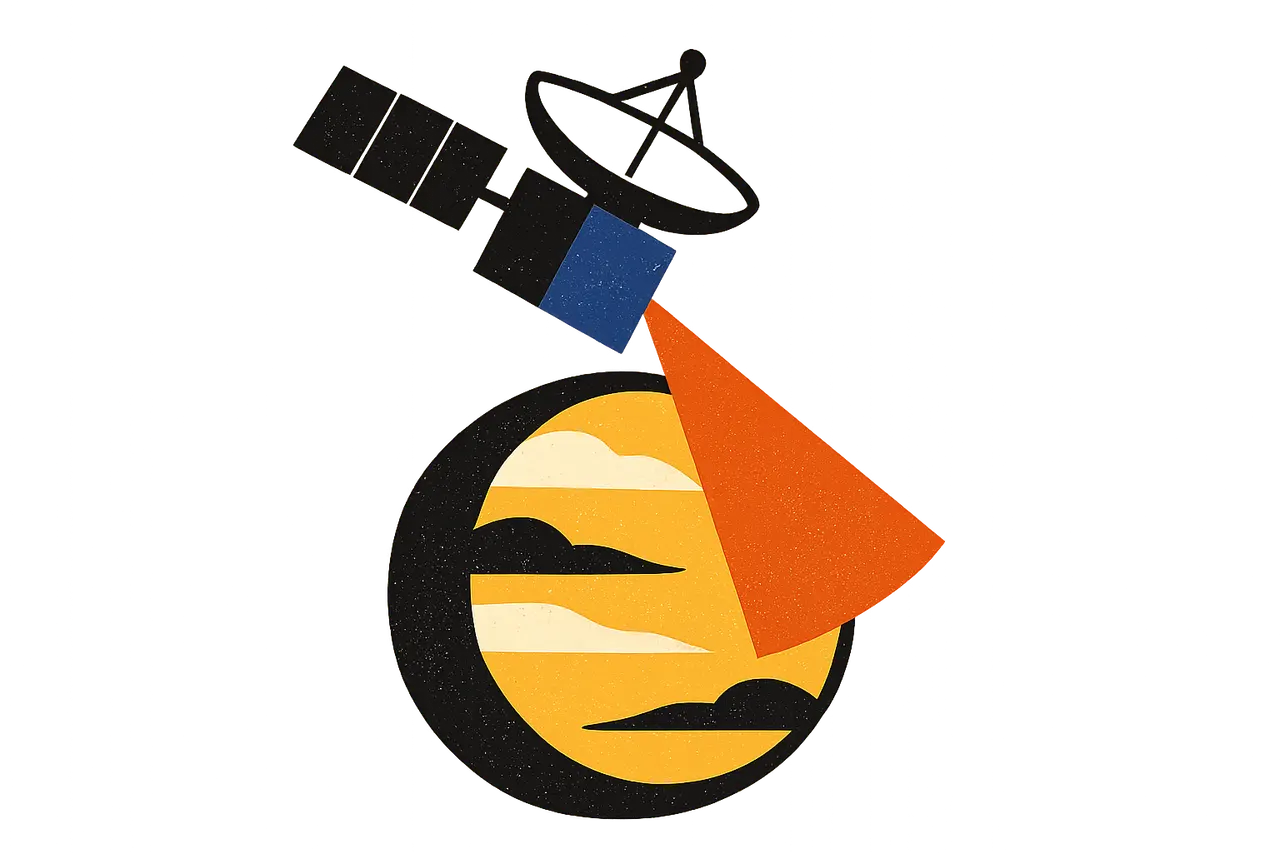
NASA's Magellan, built partly from spare parts, arrived at Venus on August 10, 1990 — and its 30-year-old radar images still yield discoveries.
NASA’s Magellan arrived in orbit around Venus on August 10, 1990, and over the next two years used radar to map 98% of a surface that is permanently hidden beneath sulfuric-acid clouds.
It was a thrifty machine. Its basic body was assembled from spare parts left over from Voyager, Galileo, Ulysses and Mariner 9. Because ordinary cameras see nothing but cloud at Venus, it carried synthetic-aperture radar, which builds images from radio echoes bounced off the ground.
Magellan was not the first spacecraft to peer through Venus’s clouds by radar — the Soviet Venera 15 and 16 had mapped part of the planet in the 1980s — but it set a far higher standard. It was designed to cover 70% of the surface. Each mapping cycle took 243 days, the time Venus needs to turn once beneath the orbit.
The mission, cycle by cycle
- May 1989: Magellan leaves Earth aboard Space Shuttle Atlantis.
- August 10, 1990: it arrives in orbit.
- May 1991: the first cycle is completed, revealing 83.7% of the surface. The second cycle raises coverage to 96%, and a third, focused on stereo, reaches 98%.
- 1993: controllers lower it into the upper atmosphere to aerobrake into a tighter orbit.
- October 1994: they send it plunging in for good.
It returned 1,200 gigabits of data, more than the 900 gigabits from all of NASA’s planetary missions combined at the time. The maps showed that at least 85% of Venus is covered by volcanic flows.
The data is still finding things. In 2023, researcher Robert Herrick and JPL’s Scott Hensley reported that, after about 200 hours of comparing Magellan orbits by eye, they had found a vent near the volcano Maat Mons that doubled in size between February and October 1991. It was the first direct evidence that Venus was volcanically active in recent times — spotted in data more than 30 years old.
Sources & references
4 referencesWell-established. Corroborated by 3 independent sources.