Galileo found Jupiter's four big moons in January 1610
On this day · 7 January 1610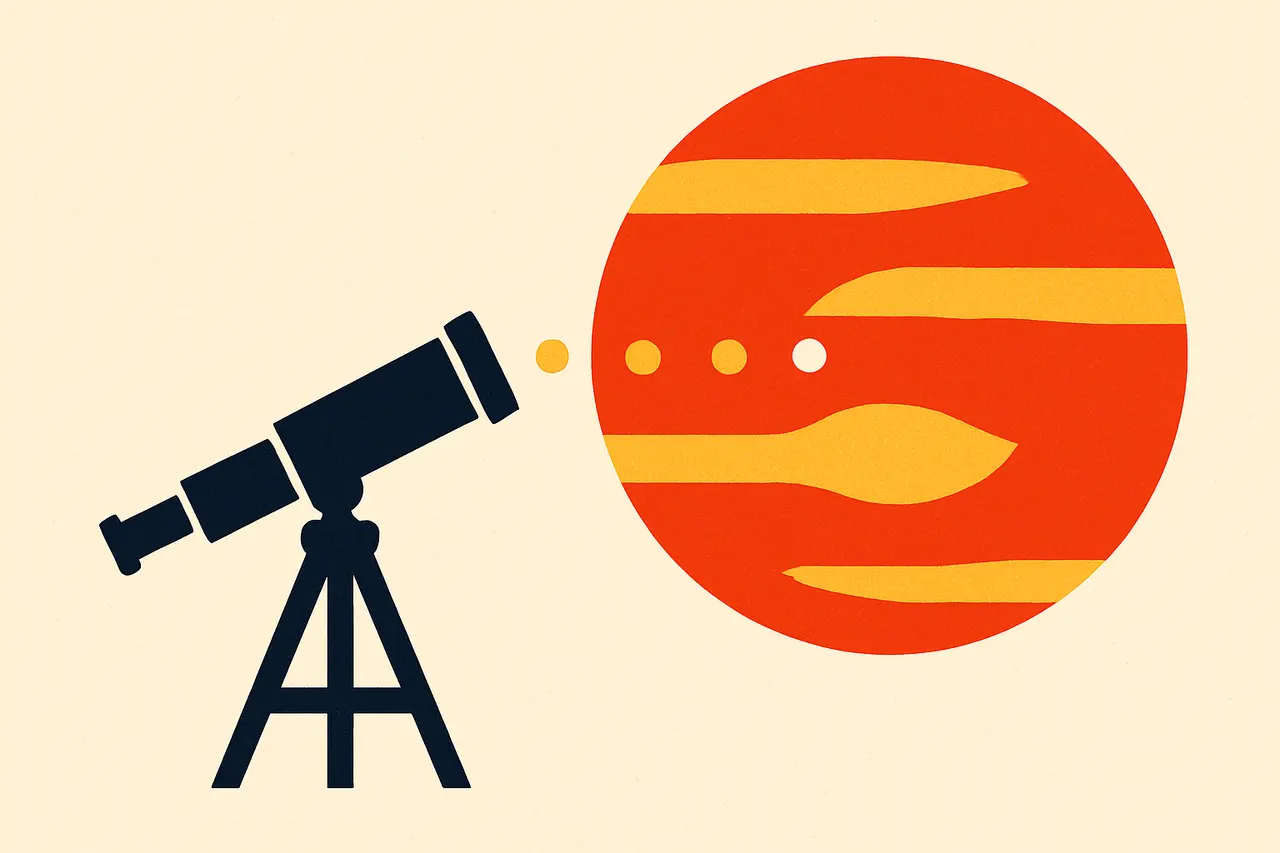
Galileo first took Jupiter's moons for stars. His night-by-night sketches show how, over one week in 1610, he realised they were orbiting Jupiter.
Galileo Galilei discovered Jupiter’s four largest moons in January 1610: he saw three of them on the evening of 7 January through his new 20-power telescope, spotted the fourth on 13 January, and by 15 January had concluded that all four were moons orbiting Jupiter.
He did not recognise them at once. At first he took them for three small stars lined up beside the planet, two east of Jupiter and one west, made a sketch, and thought little more of it. The next night all three were east, and Galileo wondered whether Jupiter, not the stars, had moved. After a cloudy 9 January, he saw only two on the 10th and guessed the third was behind the planet; he began to suspect the “stars” themselves were moving. By the 13th there were four in a line, and he was certain they were satellites.
- 7 January 1610: three “stars” spotted beside Jupiter.
- 13 January: the fourth appears.
- 15 January: Galileo concludes all four orbit Jupiter, then keeps watching for almost two months to work out their different orbital periods.
- 13 March 1610: Sidereus nuncius publishes the discovery, naming them the Medicean Stars after the Medici in a bid for patronage; Grand Duke Cosimo II promptly hires him as court Philosopher and Mathematician.
- 1614: Johannes Kepler suggests the names used today, Io, Europa, Ganymede and Callisto, which do not catch on for more than 200 years; Galileo himself simply numbered them I to IV.
- 1892: E.E. Barnard spots small Amalthea, the next moon of Jupiter found and the last moon in the solar system discovered by eye.
A planet carrying moons as it moved was strong evidence for the Copernican view that not everything circles Earth, and Galileo had become the first person since prehistoric times to find a new planetary object. NASA’s 2025 tally of Jupiter’s moons stood at 95.
Sources & references
3 referencesWell-established. Corroborated by 3 independent sources.