Cook landed at Botany Bay in 1770 — he didn't find Australia
On this day · 29 April 1770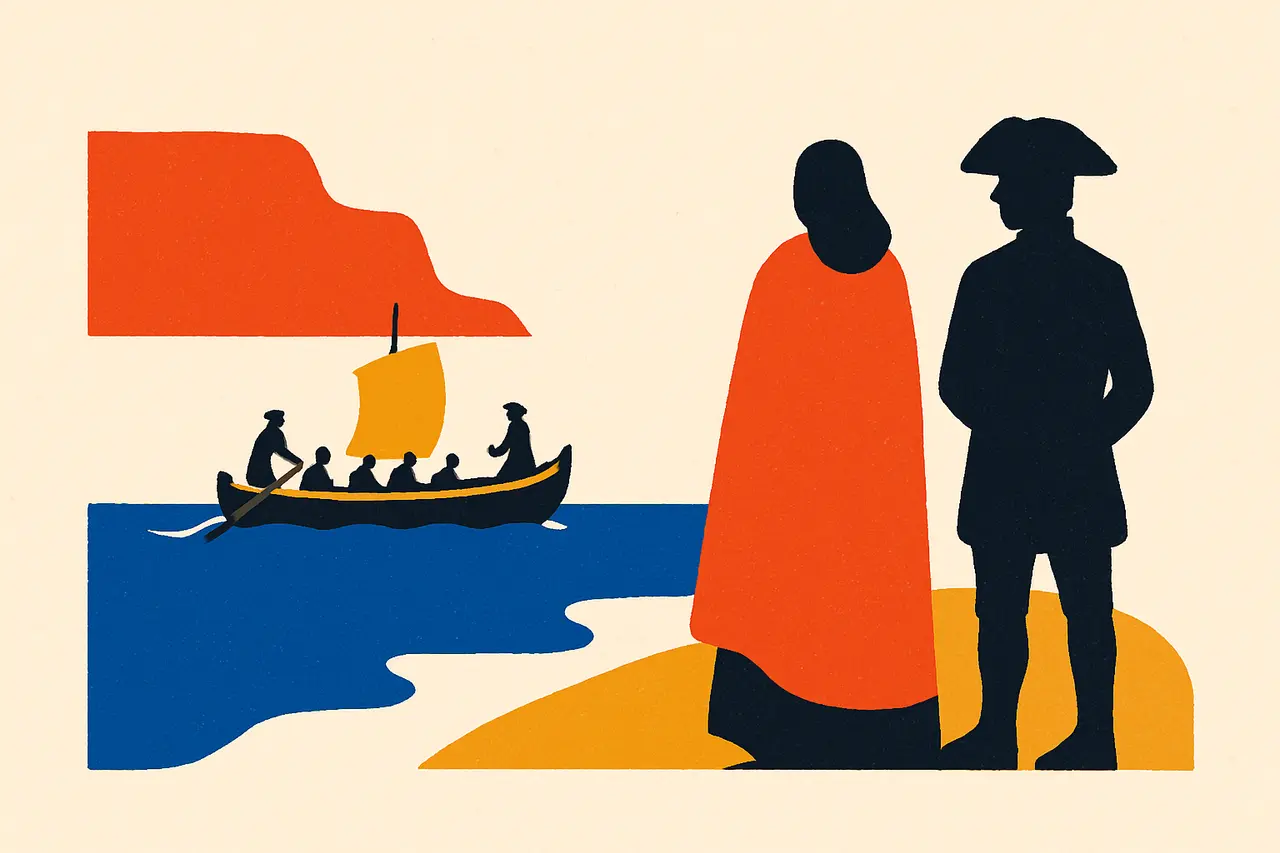
Cook's 1770 landing at Kamay was the first by Europeans on Australia's east coast, met by two Gweagal men and answered with musket shot.
Lieutenant James Cook and the crew of HMB Endeavour landed at Kamay (Botany Bay), south of present-day Sydney, on 29 April 1770 — the first recorded European landing on Australia’s east coast, on the country of the Gweagal people. They stayed eight days and sailed north on 6 May.
Did Cook discover Australia?
No, not even for Europe. Dutch navigators had charted the continent’s western and northern coasts and limited its southern extent during the 17th century. Cook’s contribution, as the State Library of South Australia puts it, was to establish the continent’s eastern limit. And the coast he reached was, of course, already home to the people who watched him arrive.
What happened when the boats came ashore?
Cook’s own journal is blunt. Two Gweagal men came down to oppose the landing. Cook fired a musket between them; when one threw a stone, he fired a second load of small shot, which struck the man, who picked up a shield to defend himself. Joseph Banks recorded that the party then took away forty or fifty spears from the huts nearby. Over the following days the local people avoided every offer of presents. Cook summed up their attitude:
“All they seem’d to want was for us to be gone.” — James Cook, journal, 1770
The bay’s name took a while to settle. Cook’s log first called it Sting Ray’s Harbour, after catches like one ray that weighed 240 lb; he later changed it to Botanist Harbour, Botanist Bay and finally Botany Bay, for the plants his naturalists collected. Seaman Forby Sutherland, who died during the stay, was buried ashore on 1 May, and Cook named the bay’s southern point after him.
The visit’s long consequence came eighteen years later, when the First Fleet arrived to found a British colony and dropped anchor in the same bay before moving to Port Jackson.
Sources & references
4 referencesWell-established. Corroborated by 4 independent sources.