Britain's first atomic bomb exploded inside a ship in 1952
On this day · 3 October 1952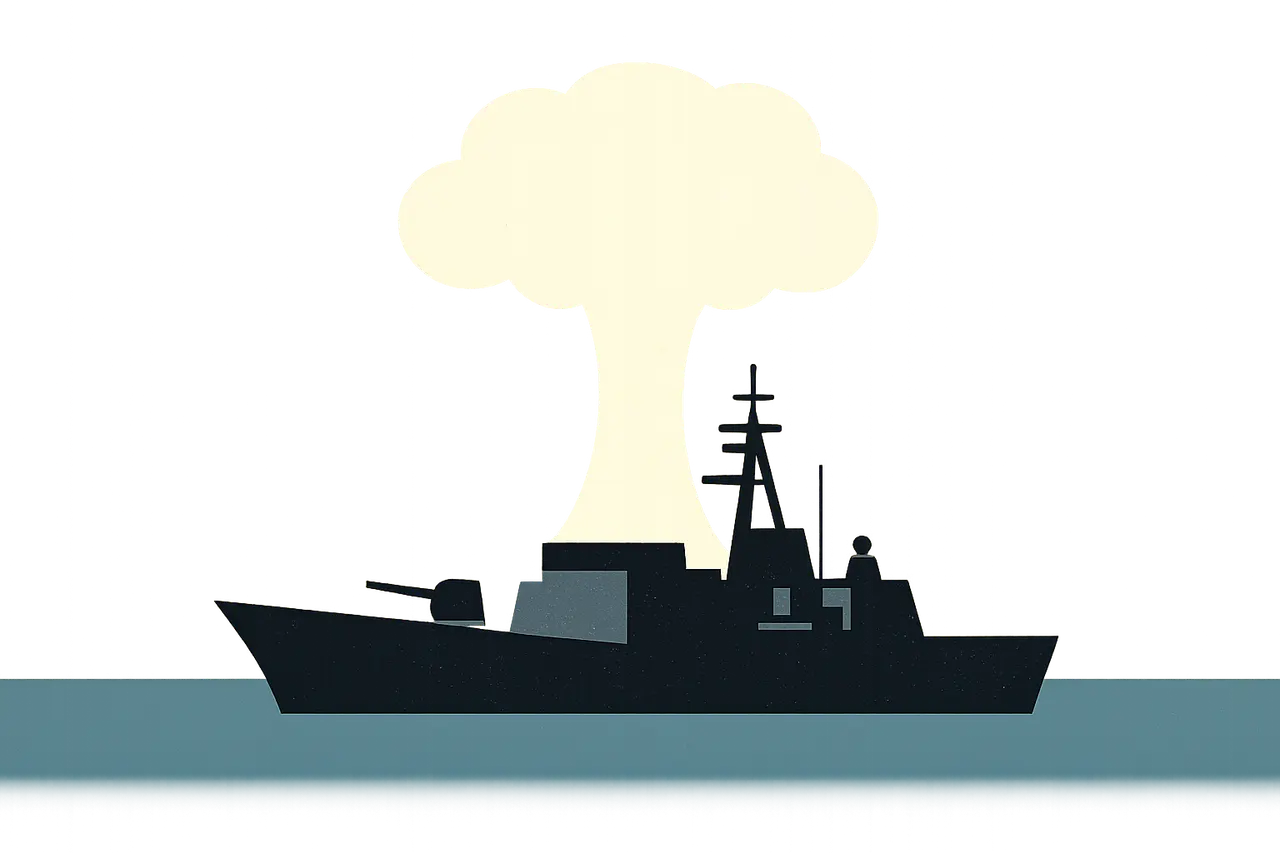
Operation Hurricane hid Britain's first atomic bomb in a frigate off Western Australia — a test so secret Australia's own cabinet wasn't consulted.
Britain tested its first atomic bomb on 3 October 1952 in Operation Hurricane, detonating a 25-kiloton plutonium device inside the hull of the frigate HMS Plym, anchored in the Montebello Islands off Western Australia. The blast vaporised the ship and made the United Kingdom the world’s third nuclear power, after the United States and the Soviet Union.
Why a ship? Planners feared an enemy could detonate a bomb offshore in a ship’s hold and send a devastating wave onto Britain’s coast, so the device was assembled below Plym’s decks partly to study that scenario. Components were loaded aboard at Stangate Creek, near Sheerness in Kent, in June 1952, and the plutonium core followed by Sunderland flying boat. Even a Barnsley maker of hot-water bottles played a part, supplying rubber airbags to hold the explosive lenses still.
The secrecy ran on both sides of the world. The bomb was approved in January 1947 by a small, secretive cabinet committee in London. When Clement Attlee asked Australia’s Robert Menzies to host the test, Menzies agreed without taking it to his own cabinet. A mishap then let British cables reach the Australian press ahead of a joint announcement planned for 18 February 1952, embarrassing Supply Minister Howard Beale, who had denied the rumours because nobody had told him. An eyewitness to the test described:
“a brilliant orange flash, followed by a boiling cloud of smoke, dust and water, shooting up into the sky with dramatic speed.”
The reckoning came later. In 1985, Australia’s Royal Commission into British Nuclear Tests criticised Menzies for bypassing cabinet and for choosing a site it judged insufficiently safe. Indigenous Australians on the mainland had been unknowingly exposed to radiation, and the Montebellos remain a hazard today: visitors are advised to spend no more than an hour near the test sites.
Sources & references
4 referencesWell-established. Corroborated by 4 independent sources.