Faraday discovered electromagnetic induction in August 1831
On this day · 29 August 1831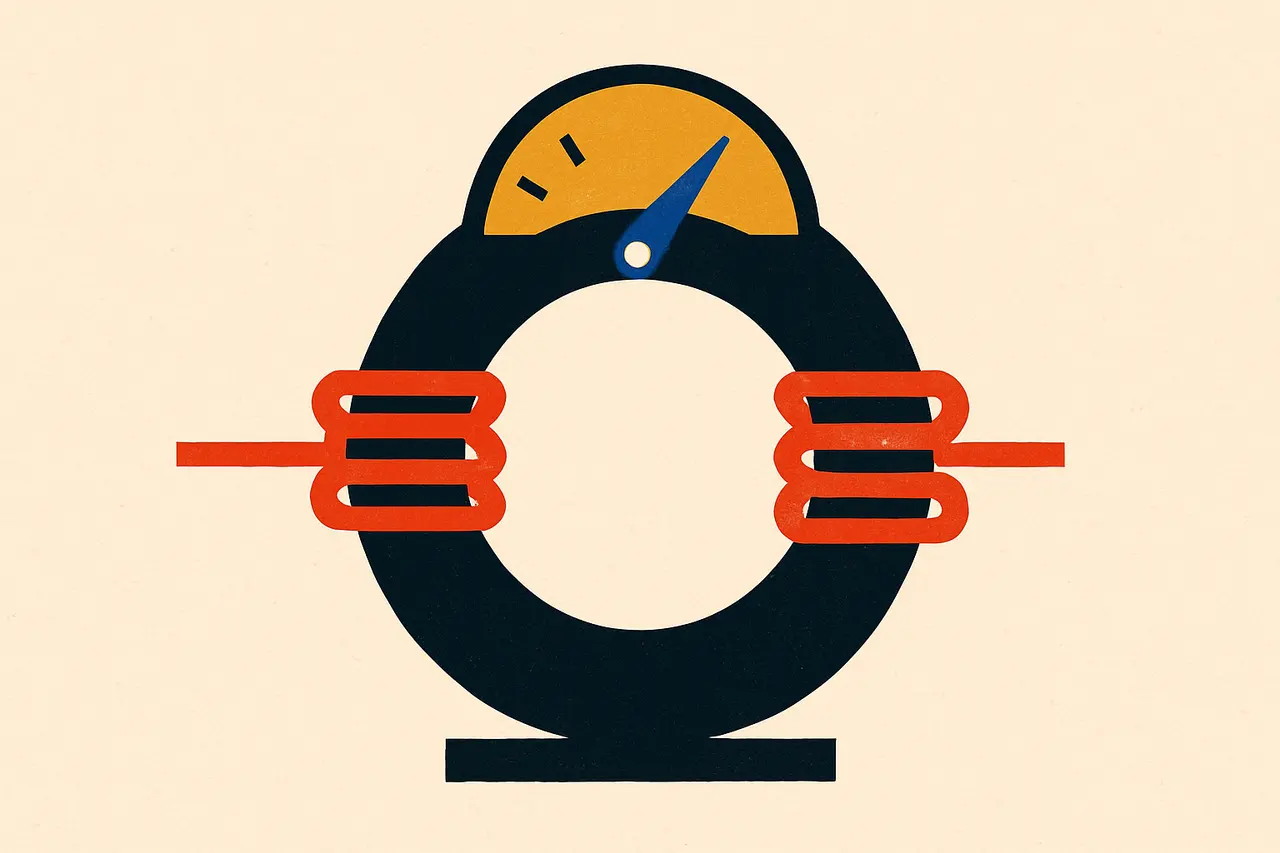
On 29 August 1831 an iron ring wound with bonnet wire made a needle twitch, and Faraday found the principle behind nearly all electric power.
Michael Faraday discovered electromagnetic induction on 29 August 1831 in the basement laboratory of the Royal Institution in London, using an iron ring wound with two separate coils of wire: switching a current on or off in one coil briefly produced a current in the other.
The apparatus was humble. Faraday wound the coils from ordinary wire made for bonnets, insulated them with cotton, and placed them on opposite sides of an iron ring that seems to have been made specially. The Royal Institution estimates the winding took about ten working days. When he connected the battery, a galvanometer on the second coil registered a current that lasted only a moment; disconnecting it produced another brief pulse. A steady current did nothing. Only a changing magnetic field induced electricity, the idea now known as Faraday’s law.
The ring, in effect the first transformer, survives and is on display in the Faraday Museum at the Royal Institution.
How the work unfolded:
- 29 August 1831: the induction ring works.
- Within months: Faraday moves a bar magnet back and forth through a stationary coil and gets a current from motion alone, the basis of his first generator.
- 24 November 1831: he reads his first paper on the discovery to the Royal Society.
- 1831 to 1838: he publishes 29 papers on electromagnetism, work James Clerk Maxwell later folded into his equations.
Was Faraday really first? The American Joseph Henry, experimenting with powerful electromagnets in Albany, recognised induction at about the same time. But Faraday published first, so the discovery of mutual inductance between two circuits is credited to him, while Henry is usually credited with self-inductance; the SI unit of inductance, the henry, carries his name.
The payoff is hard to overstate: virtually all electric power, whether the turbine is driven by coal, gas, nuclear, hydro or wind, is generated on the principle Faraday found in that ring.
Sources & references
5 referencesWell-established. Corroborated by 4 independent sources.