A single mutation made almonds safe to eat
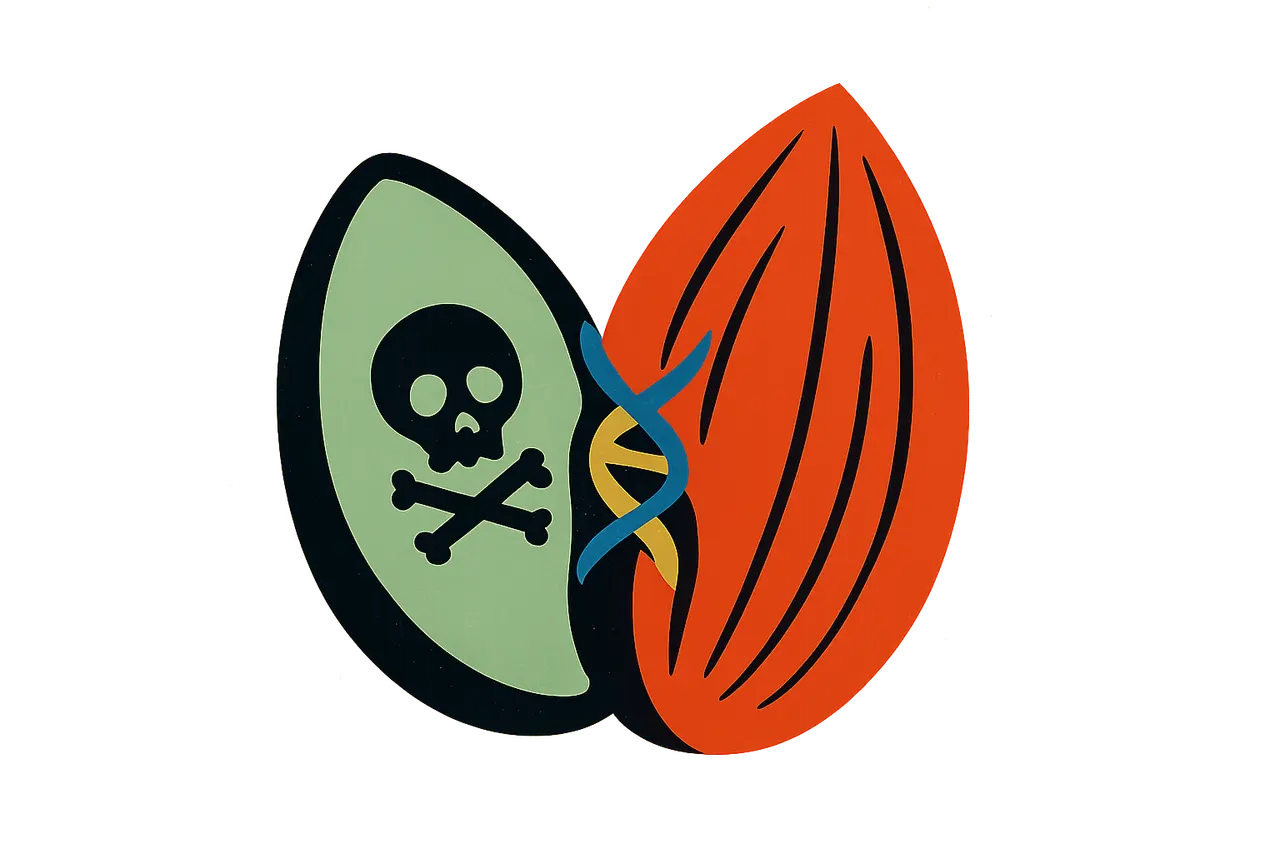
Wild almonds brim with cyanide, but one swapped amino acid in a single gene silenced the toxin and let humans domesticate the nut.
Every wild almond is, in effect, a poison capsule. Its kernel packs amygdalin, a cyanogenic compound that releases hydrogen cyanide when chewed - enough to make a handful of bitter wild almonds genuinely dangerous. So how did this toxic seed become one of the world’s most-eaten nuts?
In 2019, a team led by Raquel Sánchez-Pérez sequenced the almond genome and traced the answer to a 46,000-base-pair cluster of five related genes. One of them, a regulator called bHLH2, normally switches on the two enzymes that build amygdalin. Disable that switch and the cyanide pathway never fires.
The difference between toxin and snack is one letter of genetic code.
The off-switch turned out to be astonishingly small: a single point mutation that swaps one amino acid (leucine to phenylalanine) in the part of the bHLH2 protein where it pairs up to do its job. That tiny change stops it from activating the toxin genes, yielding a sweet, edible kernel. Early farmers who spotted those rare sweet trees and propagated them effectively domesticated almonds on the back of one accidental mutation.
Sources & references
2 referencesWell-established. Corroborated by 2 independent sources.