Apples don't grow true from seed — every variety is a graft of one original tree
Plant a Honeycrisp seed and you'll never get a Honeycrisp — every named variety is a clone grafted from one ancestral tree.
Here’s a genetic curveball hiding in your fruit bowl: the seeds inside a Honeycrisp will almost never grow into Honeycrisps.
Apples are extreme heterozygotes. Their genome is a jumble of mismatched genes inherited from two different parents, and because apple flowers are cross-pollinated, each seed is a fresh genetic shuffle. A seed from a Honeycrisp carries DNA from the Honeycrisp and from whatever distant tree’s pollen happened to fertilize that flower. The tree that sprouts is a brand-new, unpredictable variety — usually small, sour, and unremarkable.
Fewer than one seedling in thousands produces fruit good enough to sell, which is why most wild apple seedlings gave us cider, not dessert apples.
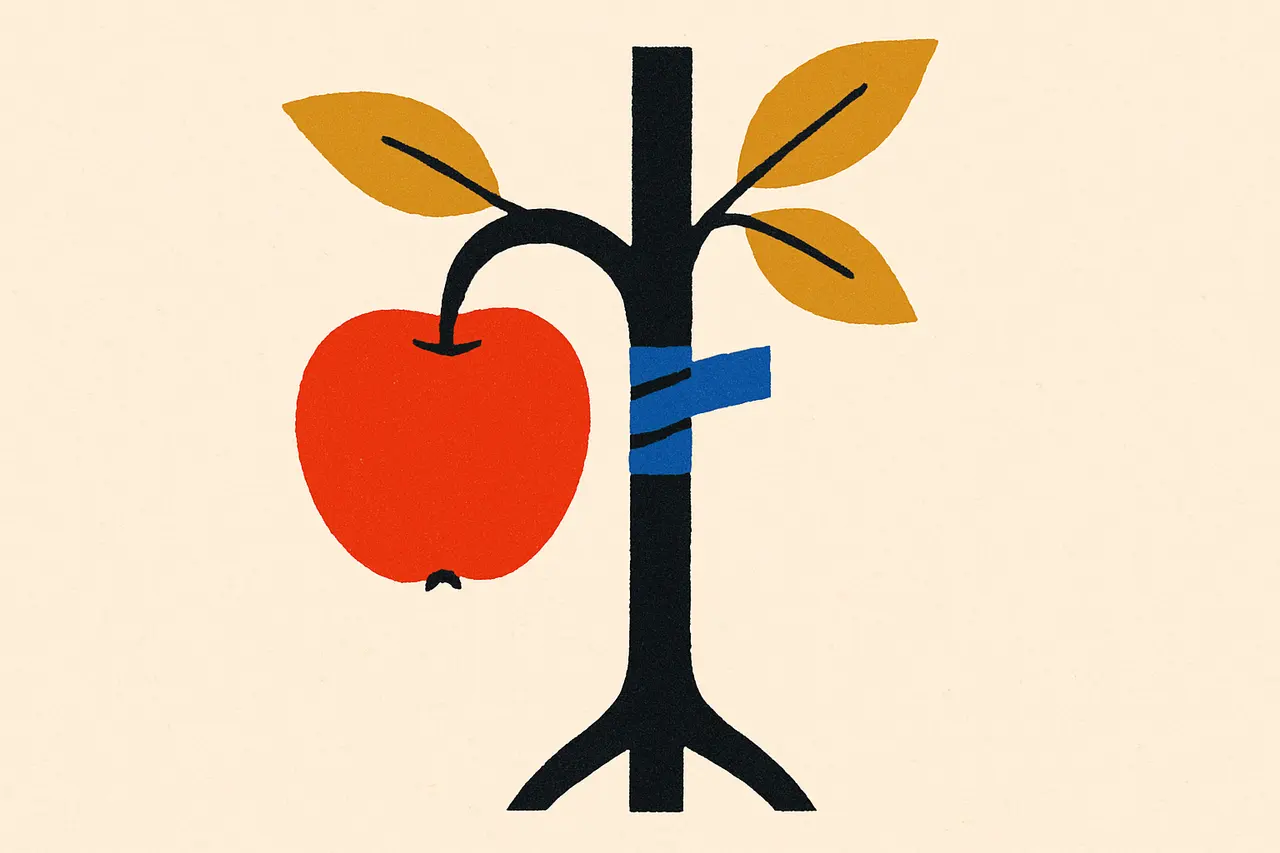
So how does every Honeycrisp taste identical? Cloning. The only way to reliably reproduce a named variety is grafting: cutting a twig (a scion) from the original tree and fusing it onto a separate rootstock, where the two heal together and grow as one plant. The fruit it bears is genetically identical to the parent twig, because no new sexual reproduction has occurred.
That means every Honeycrisp, Gala, or Granny Smith on Earth descends from a single ancestral tree. The original Granny Smith was a chance seedling found by Maria Ann Smith in Australia in 1868; every Granny Smith since is essentially a living cutting of that one tree, copied and re-copied for over 150 years.
An orchard of one variety isn’t really a family. It’s one tree, duplicated thousands of times.
Sources & references
2 referencesWell-established. Corroborated by 2 independent sources.