Wiley Post flew solo around the world in 7 days, 1933
On this day · 22 July 1933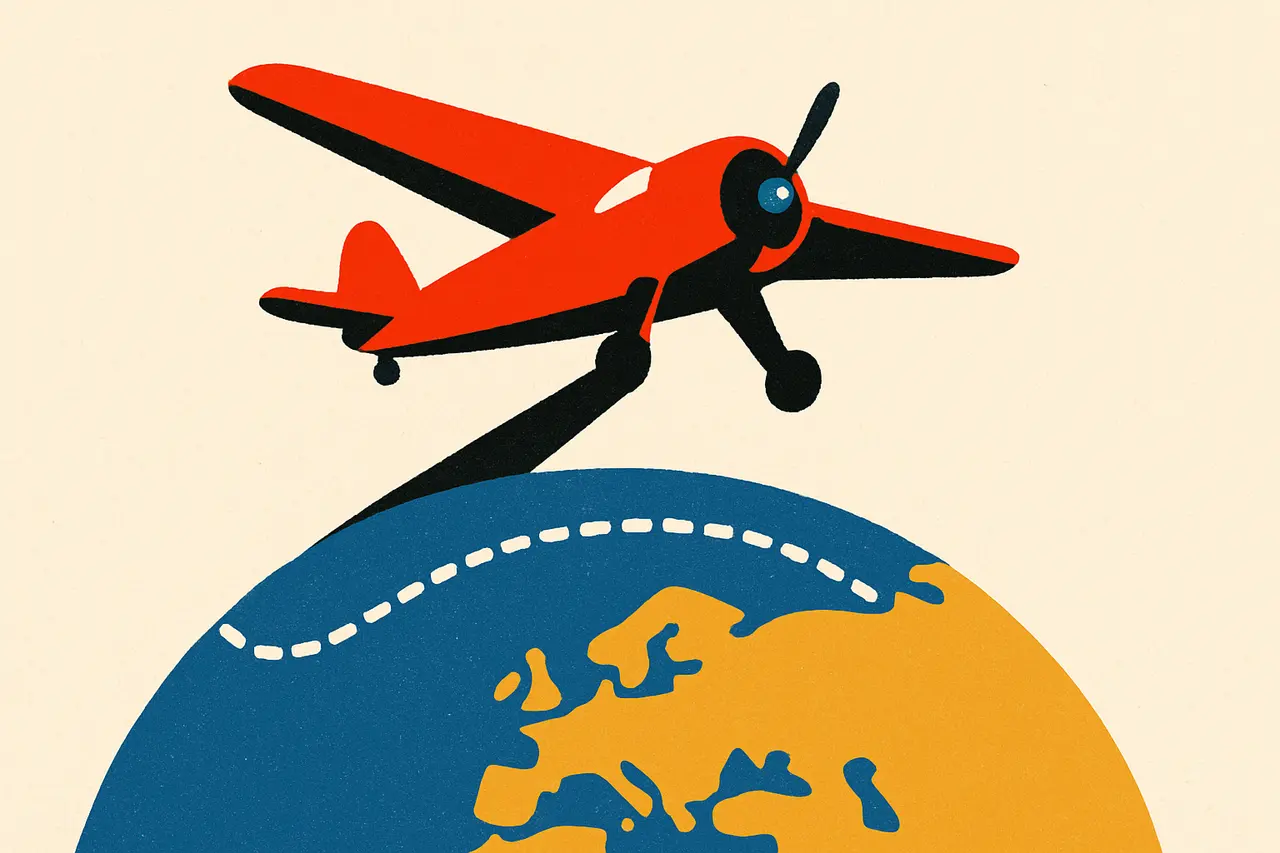
The one-eyed Oklahoman circled the globe alone in 7 days, 18 hours and 49 minutes, helped by an autopilot nicknamed Mechanical Mike.
Wiley Post became the first person to fly solo around the world on July 22, 1933, when he landed his Lockheed Vega Winnie Mae back in New York 7 days, 18 hours and 49 minutes after taking off on July 15. The Smithsonian’s National Air and Space Museum, which owns the aircraft, puts the circuit at 15,596 miles, flown with eleven stops.
That distance is shorter than it sounds. Post’s route ran across the top of the world, from New York nonstop to Berlin, then through the Soviet Union, Alaska and Canada, where the lines of longitude crowd together. It was well short of the 24,901-mile equator and of the 27,550 miles the US Army’s fliers covered in 1924. Against the earlier round-the-world flights, the pace looks like this:
| Flight | Year | Aboard | Time |
|---|---|---|---|
| US Army World Flight | 1924 | 8 airmen in 4 planes at the start | 175 days |
| Graf Zeppelin (airship) | 1929 | full crew | 20 days, 4 hours |
| Post and Harold Gatty | 1931 | 2 | 8 days, 15 hours, 51 min |
| Post, solo | 1933 | 1 | 7 days, 18 hours, 49 min |
Flying alone, Post beat his own two-man record by about 21 hours, despite stopping to repair a gyroscope and a bent propeller. He managed it with two new devices: a Sperry autopilot, nicknamed “Mechanical Mike”, that held the plane on course, and a radio direction finder that homed in on transmitters along the route. Both helped prove that machines could take over part of the navigator’s job. Post, who had lost the sight of his left eye in a 1926 oil-rig accident, did all the rest himself.
He kept pushing. The Winnie Mae was unpressurised, so Post helped design the world’s first pressure suit and flew into the stratosphere. He was killed with the humorist Will Rogers on August 15, 1935, when their floatplane crashed near Point Barrow, Alaska. The Winnie Mae and Mechanical Mike are now in the Smithsonian collection.
Sources & references
5 referencesWell-established. Corroborated by 3 independent sources.