'Kill them all' at Béziers comes from a later monk's story
On this day · 22 July 1209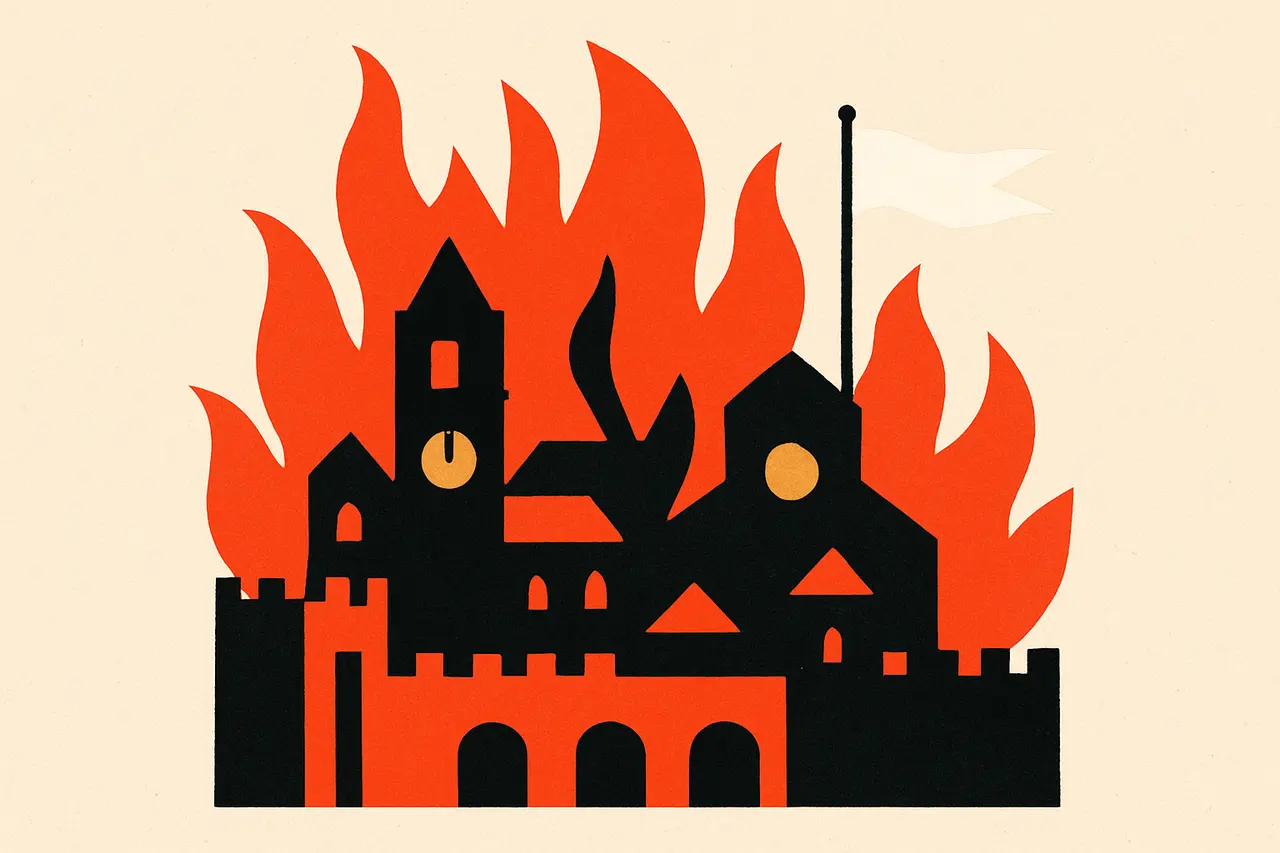
Crusaders massacred Béziers on 22 July 1209. The famous 'Kill them all' order comes from a German monk who wasn't there.
Crusaders sacked the southern French town of Béziers on 22 July 1209, the first major action of the Albigensian Crusade. Pope Innocent III had called the crusade against the Cathars, and the attackers killed Catholics and Cathars alike after the town refused its own bishop’s request to hand over 222 heretics. Unlike the crusades that had failed to hold Jerusalem against Saladin, this one was fought inside Christian Europe.
The town fell almost by accident. Defenders rode out to challenge the besiegers, and a rag-tag mob of camp followers rushed the walls. Within about three hours the crusaders held Béziers. People who had taken refuge in the church of Sainte-Madeleine were killed there, and the town was then set on fire in a quarrel over the loot.
Did the legate say “Kill them all”?
There is no reliable evidence that he did. The line comes from Caesarius of Heisterbach, a German Cistercian monk who was not present. His chapter goes on to describe events of 1212, so he was writing years afterwards. In his telling, the crusaders asked the abbot of Cîteaux, Arnaud Amalric, how to tell Catholics from heretics. The abbot “is said to have replied”: “Kill them all for the Lord knoweth them that are His”, a quotation from 2 Timothy 2:19. The same passage dates the crusade to 1210 and claims the city held more than 100,000 men, so it is not a careful record.
How many people died?
Arnaud’s own report to the pope boasted that “our men spared no one, irrespective of rank, sex or age” and killed almost 20,000 people. That is a claim made by the man in charge. World History Encyclopedia puts the town’s inhabitants at about 10,000, perhaps only 700 of them Cathars. Either way, a large share of the town was killed.
The terror worked. Narbonne surrendered at once and Carcassonne fell within a month. In Sainte-Madeleine, restored in 1999, scorch marks from the 1209 fire can still be seen in the stone.
Sources & references
5 referencesWell-established. Corroborated by 5 independent sources.