Stirling Bridge: how a narrow crossing beat England in 1297
On this day · 11 September 1297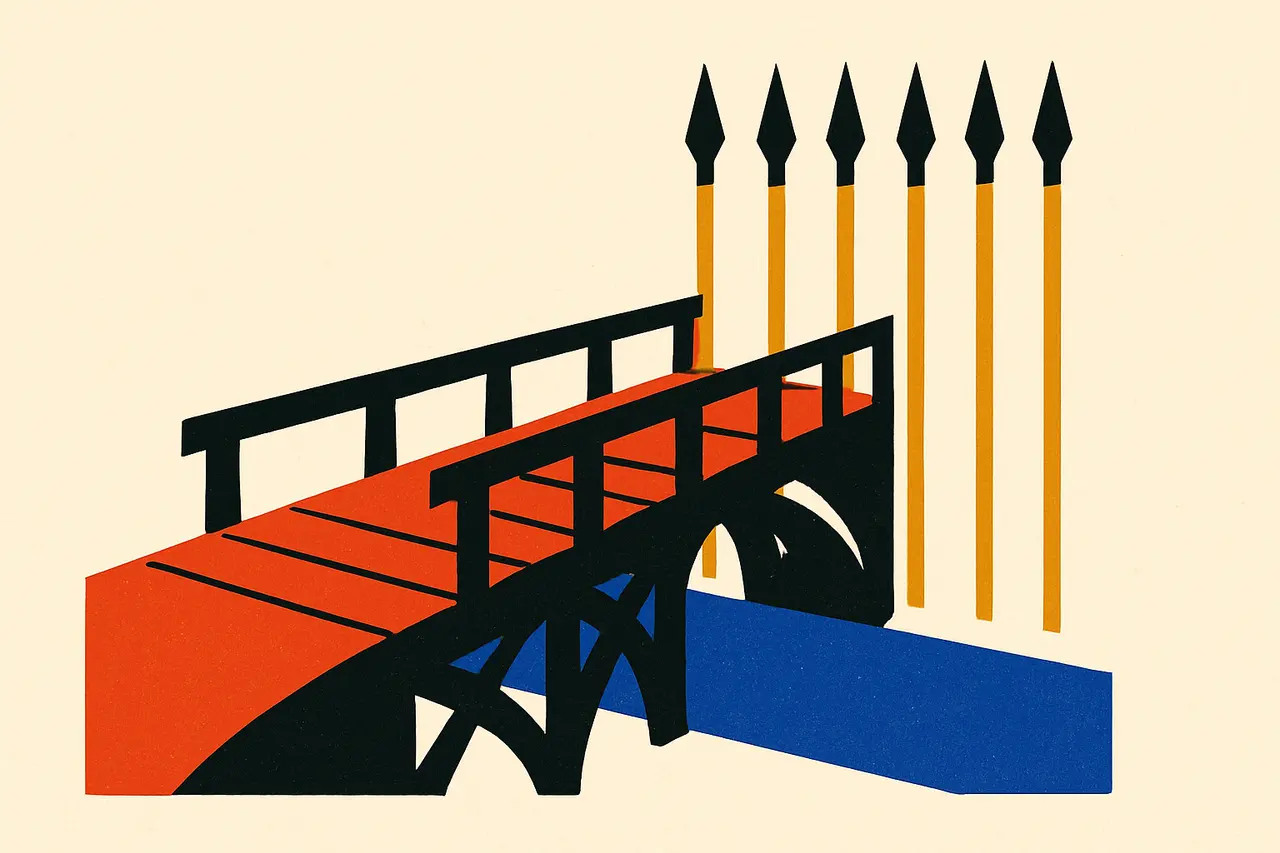
On 11 September 1297 Wallace and Moray let part of an English army cross the Forth, then cut it off at the bridge.
The Battle of Stirling Bridge, fought on 11 September 1297, was won by a Scottish army under Andrew Moray and William Wallace. It was fought against an English force led by John de Warenne, Earl of Surrey, and the treasurer Hugh de Cressingham. The English had to cross the River Forth by a single wooden bridge half a mile below Stirling Castle, wide enough for only two horsemen abreast.
The Scots waited on the Abbey Craig, just to the north-east. When as many English had crossed as they could handle, they charged down and sent spearmen to seize the foot of the bridge. The English on the north bank were trapped in a loop of the river on soft ground. Many drowned trying to get back. A Scottish knight in English service had offered to lead 500 horsemen across a nearby ford where sixty could ride abreast, but the English council refused to divide the army.
Chroniclers inflated the size of the armies, as this comparison from the Historic Environment Scotland battlefield inventory shows:
| Estimate of the English army | Cavalry | Infantry |
|---|---|---|
| Walter of Guisborough (chronicler) | 1,000 | 50,000 |
| Cressingham’s own muster, July 1297 | 300 | 10,000 |
| Modern reconstruction | 350 | 6,350 |
Guisborough says about 100 English men-at-arms and 5,000 foot soldiers died, Cressingham among them. The hostile Lanercost Chronicle adds that Wallace had a strip of Cressingham’s skin made into a sword belt. There is no evidence for the story that the Scots sabotaged the bridge. Stone piers thought to belong to it were found in 1905, about 60 m upstream of the later stone bridge.
On 11 October 1297 the two leaders wrote from Haddington to the mayors and communes of Lübeck and Hamburg that Scotland “has by arms been recovered from the power of the English”. The letter is still in Lübeck. It survived WWII in a salt mine and Soviet custody and was returned in 1990. Moray was dead of his wounds by November. Wallace, now Guardian, lost at Falkirk in 1298 and was executed in London in 1305.
Sources & references
3 referencesWell-established. Corroborated by 3 independent sources.