The First Moving Assembly Line Began Producing Ford Cars
On this day · 1 December 1913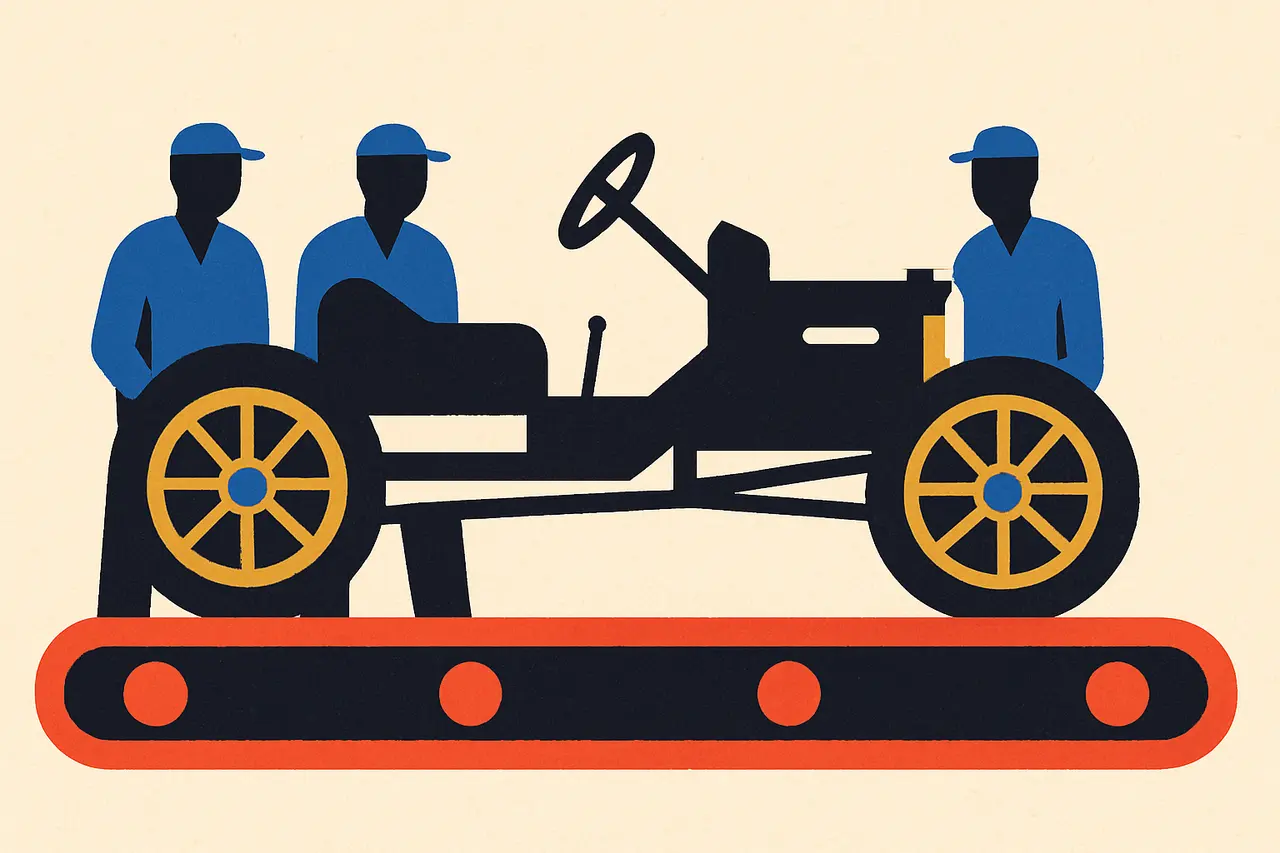
On December 1, 1913, Ford set a chassis in motion past stationary workers and quietly compressed twelve hours of labour into ninety-odd minutes.
At Ford’s Highland Park plant in Michigan, Henry Ford combined three ideas that already existed separately: interchangeable parts, finely subdivided labour, and a continuously moving line. Rather than building a car in one spot, the chassis glided past fixed stations while each worker repeated a single task. Ford borrowed the rhythm from grain mills, breweries and the overhead trolleys of Chicago’s meatpacking houses.
The payoff was startling. Assembling a Model T had taken roughly twelve and a half hours; the moving line cut that to about 93 minutes. Output that once trickled out in hundreds per day soon climbed into the thousands, and the savings flowed straight into the price tag.
The breakthrough was not a faster worker, but a factory that kept moving.
Cheaper cars put driving within reach of ordinary families and reshaped how the world built everything from appliances to aircraft. The full integrated line was first put into operation on December 1, 1913, a date now treated as the birth of modern mass production.
Sources & references
2 referencesWell-established. Corroborated by 2 independent sources.