Castle Bravo hit 15 megatons because of one wrong assumption
On this day · 1 March 1954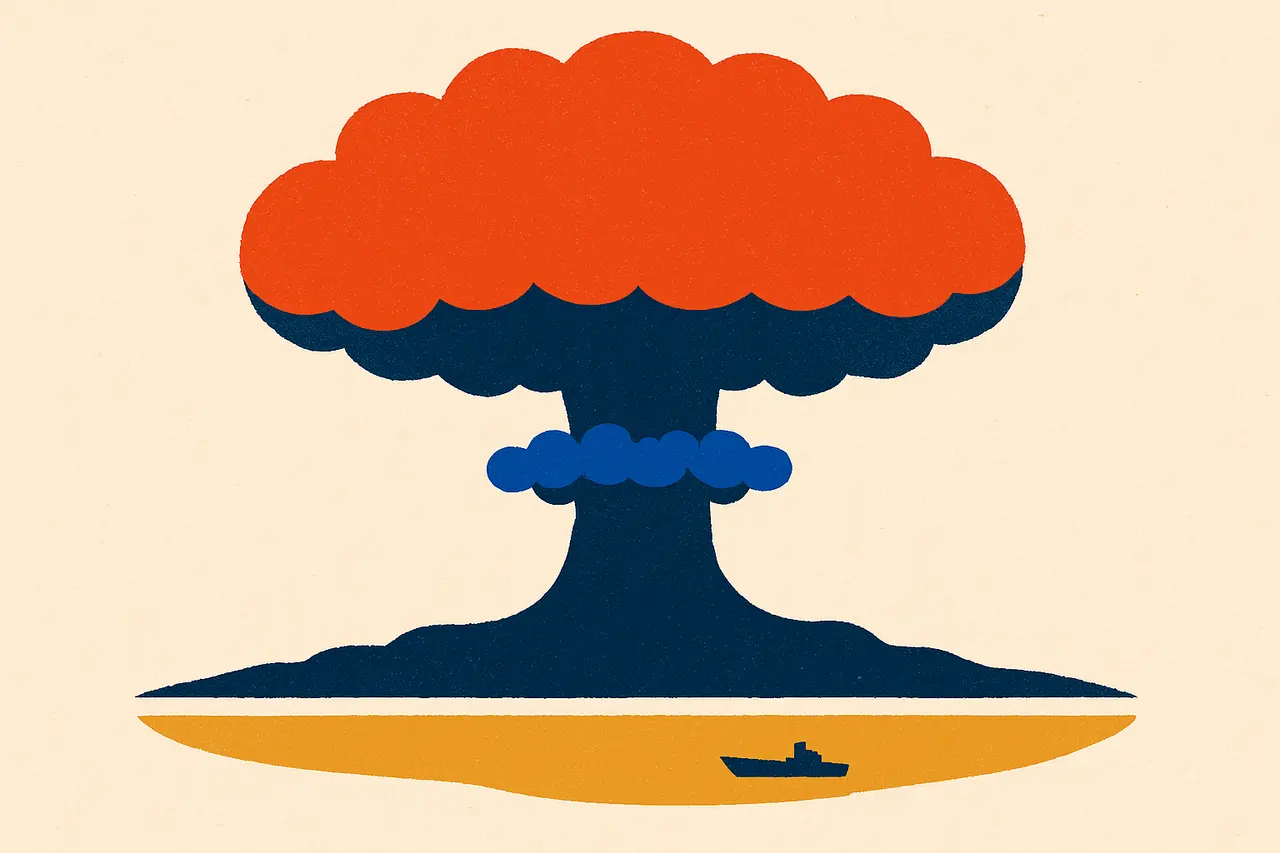
America's biggest nuclear test, on March 1, 1954, ran nearly triple its forecast, and nobody living downwind had been moved out of the way.
Castle Bravo, detonated at Bikini Atoll on March 1, 1954, yielded 15 megatons, nearly three times the 6 megatons its planners forecast and about 1,000 times the Hiroshima bomb, making it the largest nuclear explosion the United States has ever set off. Its fallout landed on people nobody had planned to protect.
Why was Castle Bravo so much bigger than expected?
The device, nicknamed Shrimp, used solid lithium deuteride as its fusion fuel, much of it the common isotope lithium-7, which the designers expected to contribute little. It proved far more reactive. Los Alamos designer Carson Mark explained in July 1954 that lithium-7 “had been assumed to be a much less good fuel than lithium-6.” Atomic Energy Commission chairman Lewis Strauss later told the public the yield was “about double” the estimate. It was closer to triple.
Why weren’t the islanders evacuated first?
Because the forecast said the fallout would not reach them. The weather briefing conceded that winds blew toward Rongelap and Rongerik, but predicted a travel time of 12 to 15 hours that would spare them, and the military turned down an evacuation capability on the grounds that there would be no fallout. Unlike the 1946 Bikini tests, nobody was moved in advance.
Merril Eisenbud, then head of the AEC’s Health and Safety Laboratory, later recalled the request his agency had made:
“[T]his was denied [by the military] on the basis that it wasn’t necessary; that there would not be any fallout.”
The fallout reached Rongelap, some 110 miles away, looking like snow, and children played in the irradiated flakes. Rongelap was evacuated two days later, and more than 230 people were moved from three atolls. The tuna boat Lucky Dragon No. 5 was coated in ash while fishing, reportedly 14 miles outside the Navy’s declared danger area, though Strauss claimed it was inside. All 23 crew suffered acute radiation poisoning, and radio operator Aikichi Kuboyama died that September of liver ailments possibly aggravated by the exposure.
Its solid fuel was a step beyond Ivy Mike, the refrigerated 1952 device that erased an island.
Sources & references
3 referencesWell-established. Corroborated by 3 independent sources.