Tennis counts 15, 30, 40 - and calls zero "love"
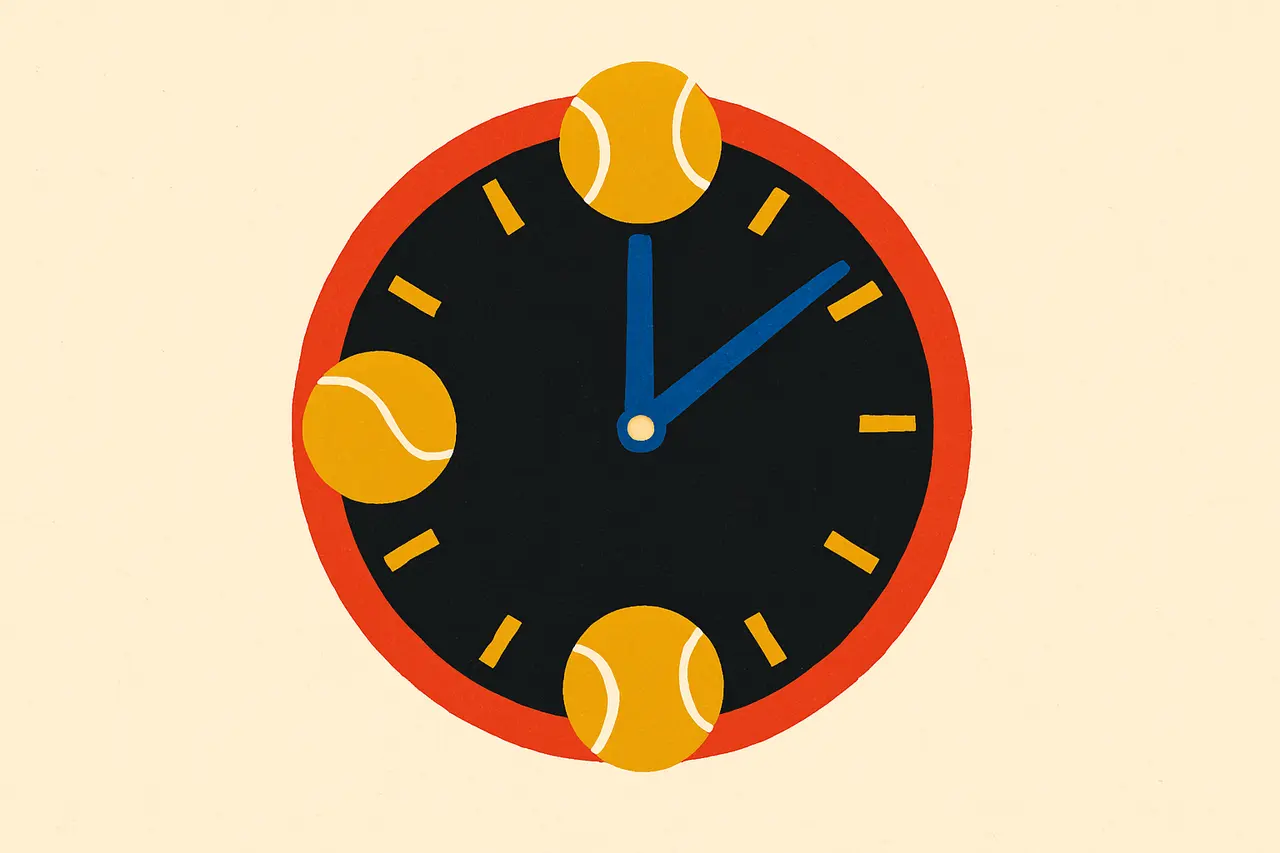
The strangest scoreboard in sport may come from a medieval clock face and a French word for egg.
A tennis game is scored not 1, 2, 3 but 15, 30, 40, game — and a score of zero is called “love.” Both quirks are centuries old and never fully explained.
The numbers are believed to be medieval French. The earliest known reference appears in a 1435 ballad by Charles d’Orleans mentioning quarante-cinq (“forty-five”). One popular theory holds that points were marked on a clock face — a quarter (15), a half (30), three-quarters (45) — with the hand sweeping toward 60 to close out the game. The snag is the tie. With deuce requiring a player to win by two points, a hand sitting at 45 would reach 60 on a single point and end a tied game outright. Moving the third mark back to 40 leaves room: from 40 the clock can advance to 50 (advantage) and only then to 60, so a deuce always resolves by the needed two-point margin.
A rival idea skips clocks entirely. In jeu de paume, the indoor ancestor of tennis, players supposedly advanced 15 feet toward the net each time they scored, with the final step shortened to 10 — giving 15, 30, 40.
“It never has been satisfactorily explained why three points equal 40 rather than 45.”
As for love, the favored guess is the French l’oeuf, “egg,” whose shape resembles a 0 — the logic that gives cricket a “duck.” A rival theory ties it to “playing for love,” for nothing. The Oxford English Dictionary has long been skeptical of the egg story, noting no firm evidence the French word ever passed into English tennis.
Sources & references
2 referencesWell-established. Corroborated by 2 independent sources.