A basketball's bounce returns only about 75% of its drop height
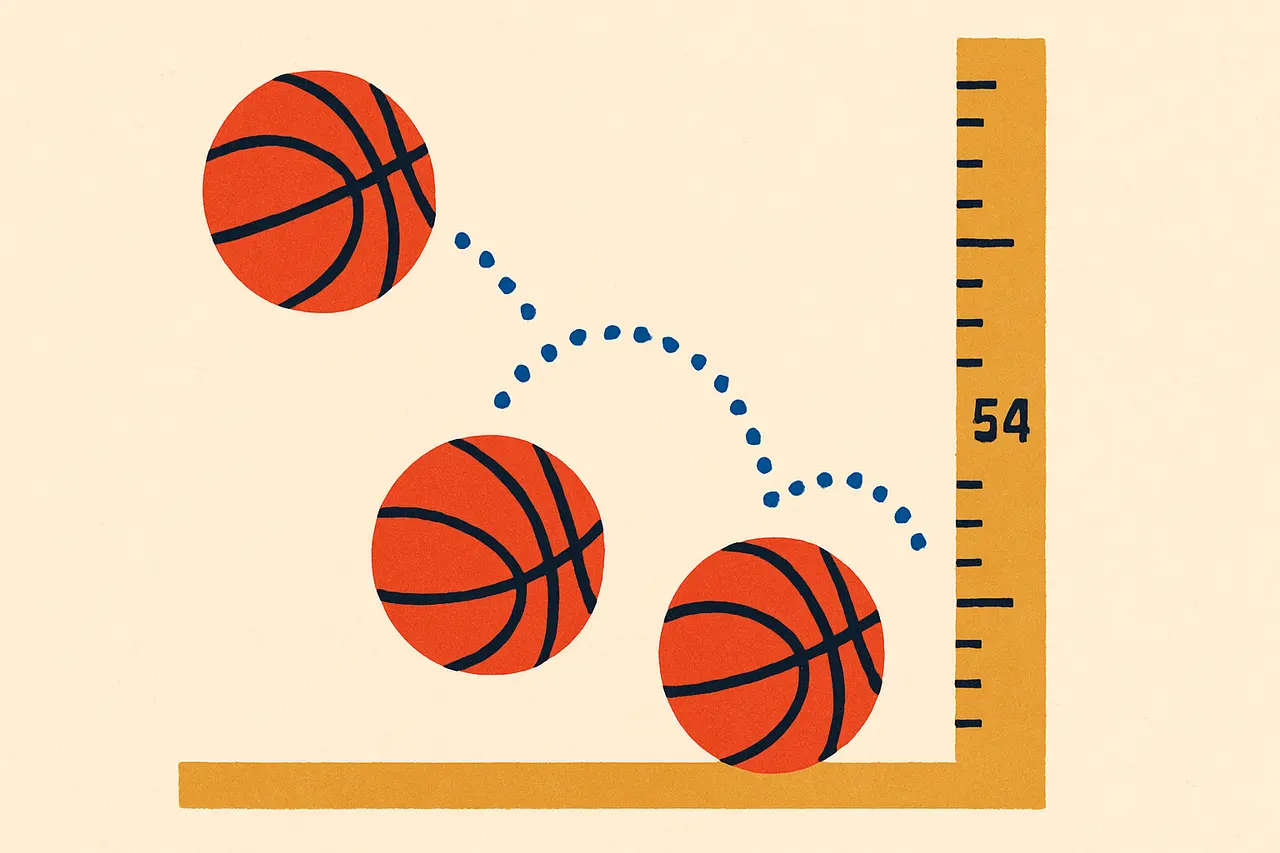
Regulation says a ball dropped from 6 feet must rebound to 49-54 inches - proof that every bounce quietly leaks away a quarter of its energy.
Drop a regulation basketball and it never comes all the way back up. By rule it isn’t supposed to. NCAA standards require that a ball dropped from 6 feet rebound to “not less than 49 inches” and not more than 54 - about 68 to 75% of the original height. Bounce it forever and it would still never clear that line. Where does the rest go?
The answer is hidden inside the ball. A basketball bounces because of the pressurized air packed into it. As the University of Illinois physics outreach team explains, on impact “the energy it picked up as it fell mostly goes into compressing the air inside,” which then springs back and pushes the ball off the floor.
But the rebound is never perfect. Some energy escapes as heat in the flexing rubber and as the faint thud you hear. Physicists capture this loss with the coefficient of restitution - the ratio of bounce speed to impact speed. For a regulation basketball it sits around 0.8, and squaring it gives the fraction of height returned: roughly three-quarters.
That is why inflation pressure is policed so carefully. Too soft, and the rubber absorbs too much energy, killing the bounce; too hard, and the ball flies past 54 inches. The narrow legal window - 7.5 to 8.5 psi in the pros - exists to make every arena’s bounce feel identical, so a dribble in one gym behaves exactly like a dribble in another.
Sources & references
2 referencesWell-established. Corroborated by 2 independent sources.