Before refrigeration, an ice trade shipped frozen lakes around the world
For decades, keeping food cold meant ice sawed from New England ponds and shipped worldwide — until machines made cold on demand.
Before the refrigerator hummed in every kitchen, keeping food cold was a global logistics problem solved by sawing up frozen ponds and shipping them around the world.
For most of history, preserving food meant salting, smoking, drying, or pickling — methods that worked but changed a food’s taste and texture. The alternative was ice, and a Boston entrepreneur turned it into an empire. In 1806, Frederic Tudor loaded a ship with 130 tons of New England pond ice and sailed it to the Caribbean. Insulated with sawdust, the blocks survived the tropical voyage, and the “Ice King” was born.
By the 1840s, ice cut from Massachusetts lakes was reaching Rangoon, Singapore, Hong Kong, and Rio de Janeiro.
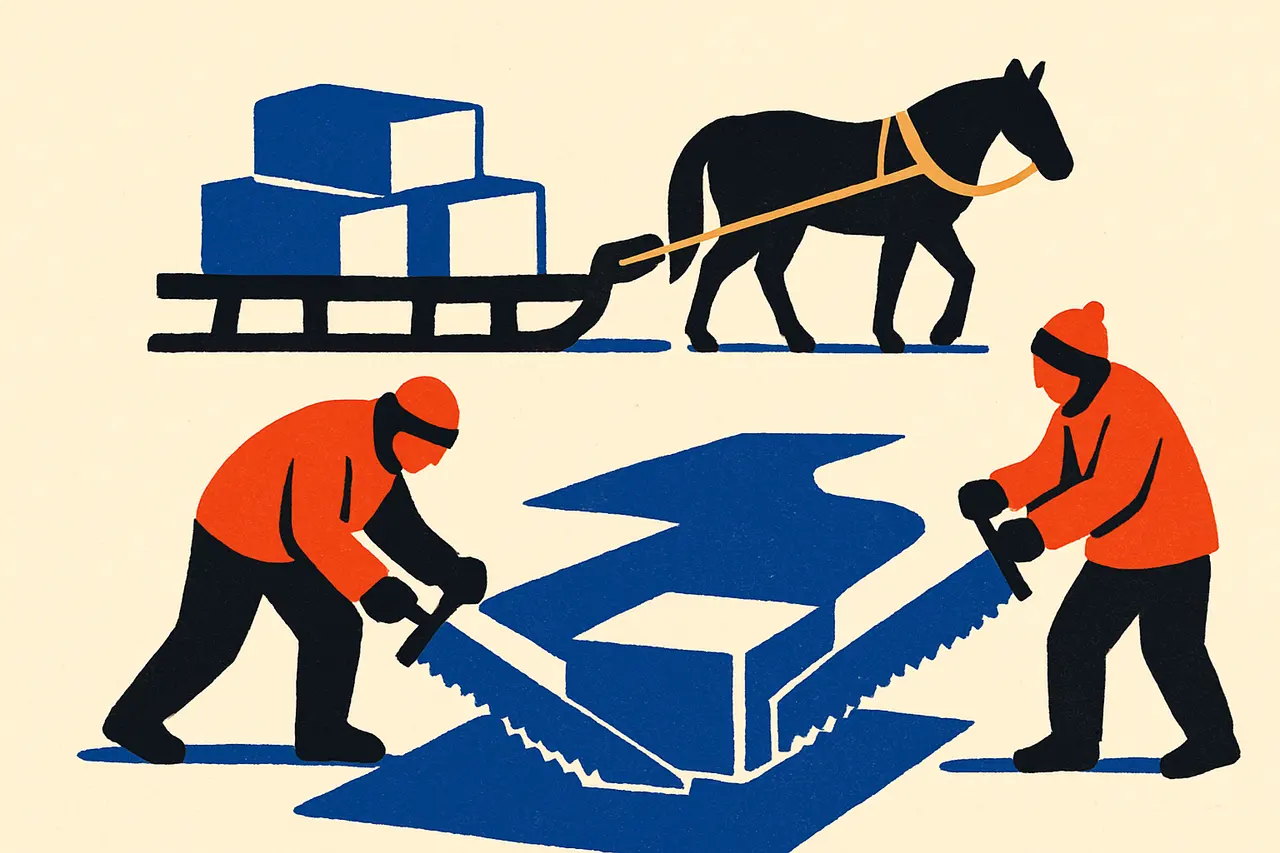
Workers harvested ice like a crop, dragging horse-drawn cutters across frozen lakes to score them into neat blocks, then storing the blocks in straw-packed icehouses. Homes kept perishables in an insulated wooden “icebox” restocked by the iceman. By 1879 the U.S. was harvesting an estimated 8 to 10 million tons of ice a year.
Then the trade collapsed. Beginning in the late 1880s, mechanical refrigeration let breweries, meat-packers, and railroads make cold on demand, free from warm winters and the pollution creeping into harvest lakes. Refrigerated rail cars carried fresh meat and produce across the continent, and from the late 1880s this radically changed the American diet, putting fresh food on tables year-round regardless of season.
The icehouses emptied, the lakes thawed unharvested, and the natural-ice industry quietly melted into history.
Sources & references
2 referencesWell-established. Corroborated by 2 independent sources.