Pluto was closer to the Sun than Neptune from 1979 to 1999
On this day · 7 February 1979
For 20 years Neptune was the outermost planet. Pluto's stretched, tilted orbit explains why, and a 3:2 rhythm keeps the two from ever colliding.
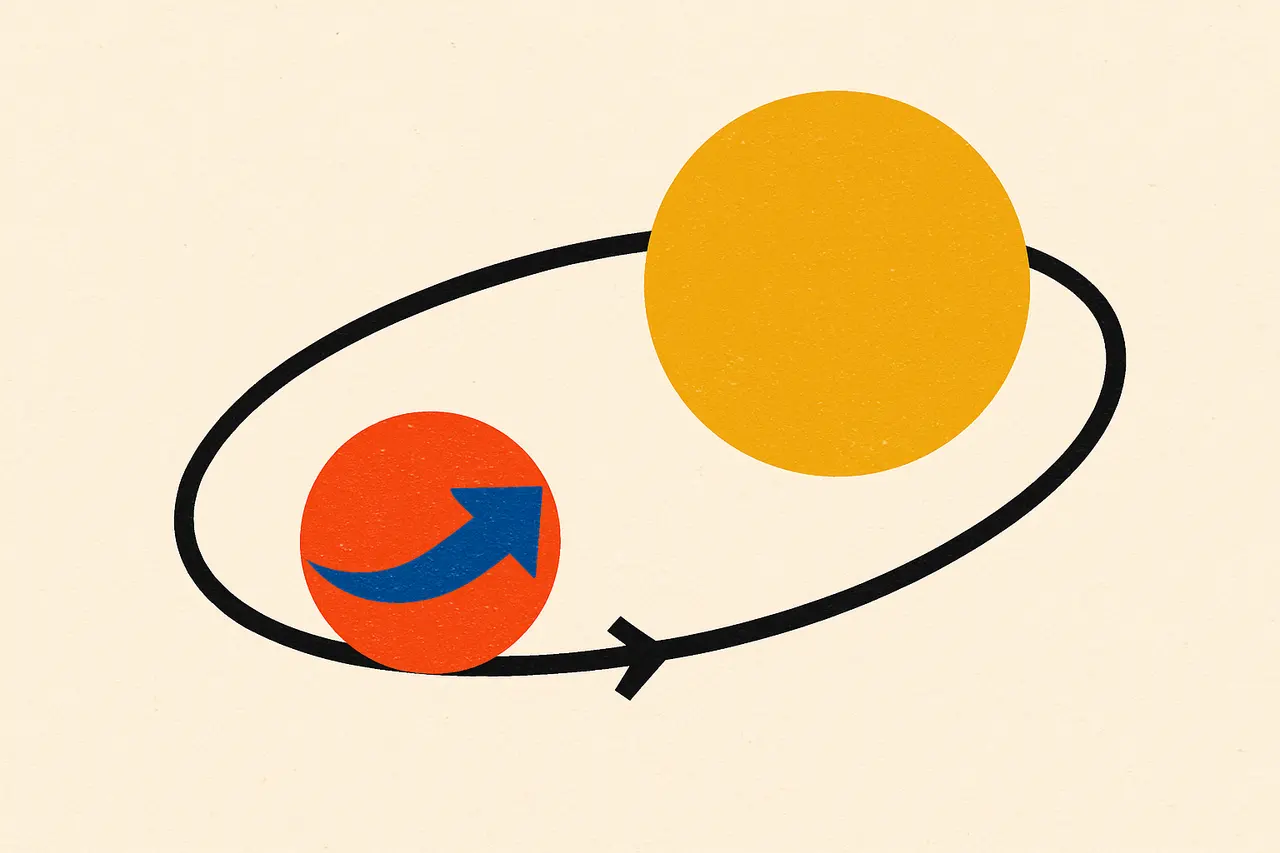
From February 7, 1979, to February 11, 1999, Pluto was closer to the Sun than Neptune, so for those 20 years Neptune, not Pluto, was the outermost planet. The swap happens because Pluto’s orbit is more stretched than that of any planet.
Pluto takes 248 years to circle the Sun on an orbit with an eccentricity of 0.25, so its distance swings from about 29.7 to 49.3 astronomical units (one AU is the Earth–Sun distance). Neptune keeps to a near-circle about 30 AU out, so for roughly 20 years of every lap Pluto slips inside it. The 1979–99 spell was centred on Pluto’s closest approach to the Sun, in 1989. Pluto was still classed as a planet then, so NASA’s StarChild described it as temporarily becoming the 8th planet from the Sun.
Why they never collide
Drawn flat on a page, the two orbits appear to cross, which raises the obvious question of a collision. There are two reasons it cannot happen. Pluto’s orbit is tilted about 17 degrees to the plane most planets share, the steepest of the nine classical planets and more than double Mercury’s 7 degrees, so when Pluto is inside Neptune’s orbit it is always well above it.
The stronger protection is timing. The two are locked in a 3:2 resonance: Pluto orbits the Sun twice for every three orbits of Neptune, which guarantees that Neptune is far away whenever Pluto reaches the crossing zone. Johns Hopkins APL points out that this lock is also strong evidence against an old idea that Pluto was an escaped moon of Neptune.
The next swap is a long way off. StarChild gave Pluto 228 years as the farther body after 1999, which points to the late 2220s, and Caltech’s IPAC says it will be more than 230 years before the two trade places again.
Sources & references
4 referencesWell-established. Corroborated by 4 independent sources.