Mars Pathfinder carried the first rover to work on Mars
On this day · 4 December 1996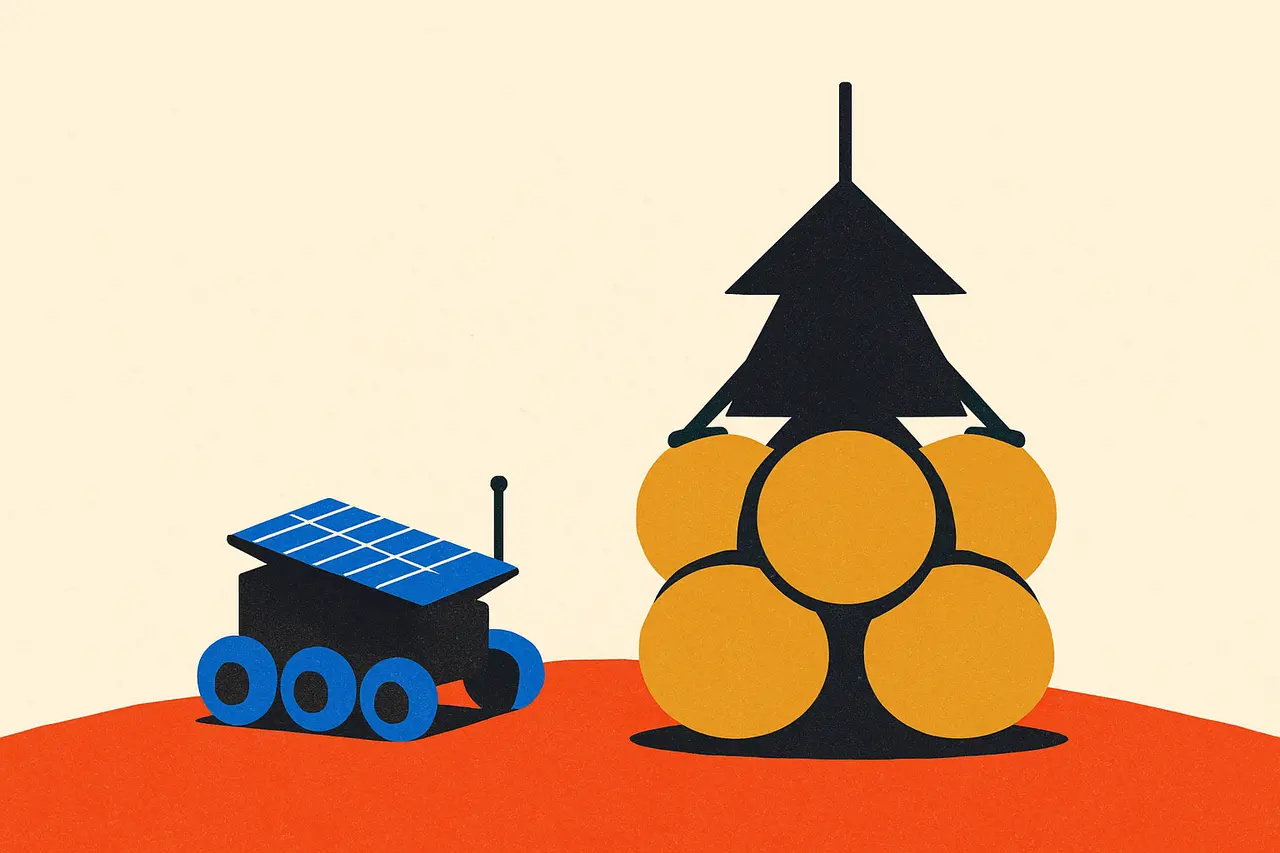
Launched 4 December 1996, Pathfinder bounced onto Mars on airbags and let Sojourner roll out, a rover first the Soviets had narrowly missed.
NASA launched Mars Pathfinder on December 4, 1996, on a Delta rocket from Cape Canaveral; on July 4, 1997 it landed in Ares Vallis and released Sojourner, the first wheeled vehicle to operate on another planet.
Pathfinder launched a month after Mars Global Surveyor but took a faster, 212-day route and arrived more than two months earlier. It ended a near 15-year lull after Viking: since its landing, at least one spacecraft has been working at or on Mars without a break.
Its landing was a bounce. It entered the atmosphere at 14,000 mph inside a Viking-style aeroshell, and a parachute slowed it to 150 mph. At 1,165 feet, airbags inflated around the lander in under a second; at 322 feet, three retrorockets fired. At 71 feet it cut loose, hit the ground at 31 mph and bounced at least 15 times. It was the first US spacecraft to land on airbags, and the whole descent took four minutes.
Was Sojourner really the first Mars rover? Yes, the first that worked. The Soviet Mars 3 lander carried a small PrOP-M rover in 1971, but the lander fell silent after 20 seconds and the rover was never deployed.
The mission, in dates:
- December 4, 1996: Pathfinder launches.
- July 4, 1997: it lands in Ares Vallis.
- July 6: Sojourner, a 23-pound machine named after abolitionist Sojourner Truth following an essay by 12-year-old Valerie Ambrose, backs down a ramp.
- September 27, 1997: contact with both is lost, after the lander has returned 16,500 images and 8.5 million weather measurements, and Sojourner 550 more.
Built to last a week, Sojourner ran for 83 days, covering 330 feet at a top speed of 0.39 inch per second and never straying more than 39 feet from the lander. Rocks nicknamed Barnacle Bill and Yogi proved broadly similar to volcanic rocks on Earth. Its technologies paved the way for the more capable rovers that followed.
Sources & references
4 referencesWell-established. Corroborated by 3 independent sources.