Gemini 7 kept two astronauts in orbit for nearly 14 days
On this day · 4 December 1965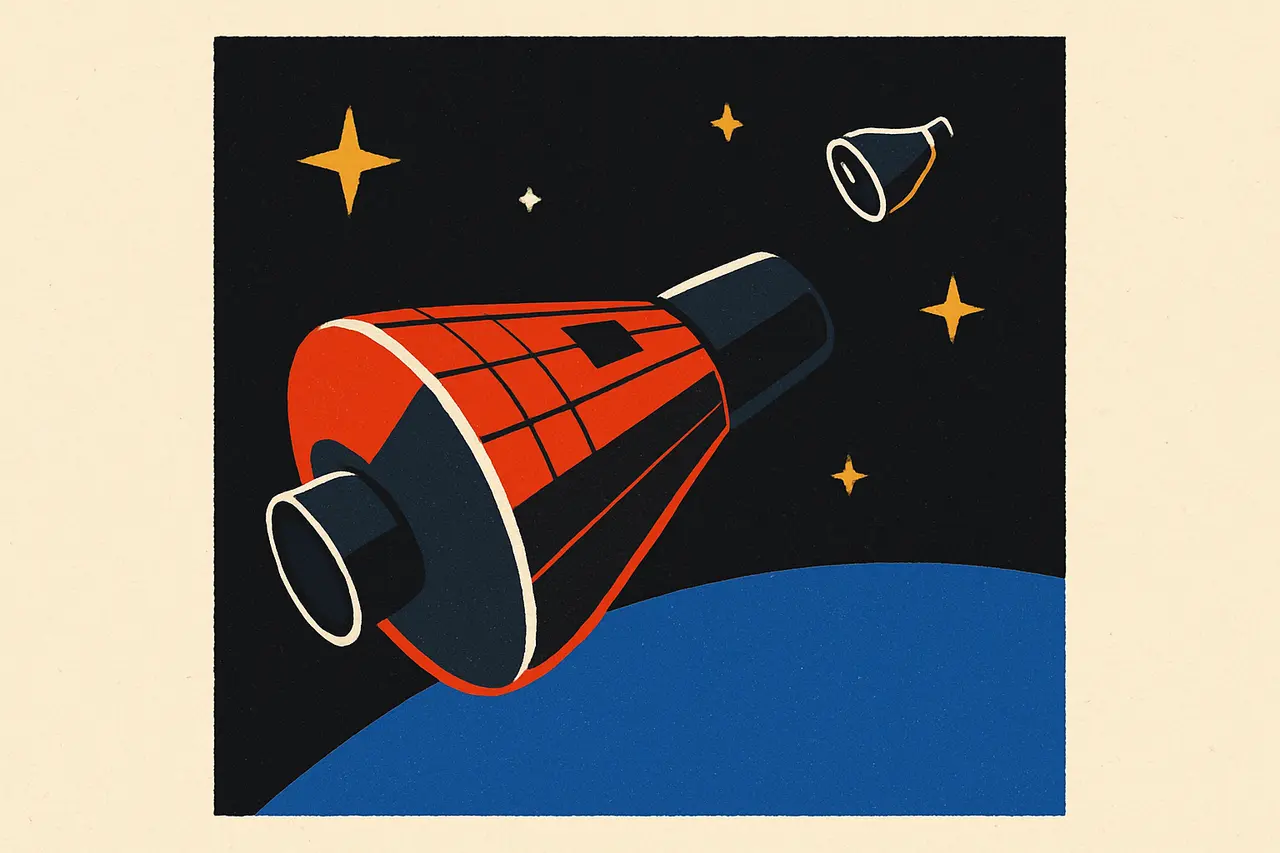
Launched December 4, 1965, Gemini VII flew 330 hours, then a record, partly with its crew out of their spacesuits.
Gemini VII, launched from Cape Kennedy on December 4, 1965, kept Frank Borman and James Lovell in orbit for 330 hours and 35 minutes (13 days, 18 hours), the longest anyone had stayed in space and a record that stood until 1970.
The flight is always called the 14-day mission, which slightly rounds it up: the crew completed 206 revolutions before retrofire on December 18. Its purpose was to show that people could live in weightlessness for about as long as a lunar round trip would take, with doctors running eight medical experiments alongside the engineering tests.
One of the mission’s stated priorities was to evaluate a “shirt sleeve” environment for two weeks. On December 6, 45 hours in, Lovell took his spacesuit off; after some swapping, both men flew suitless for the rest of the mission, putting the suits back on only for the rendezvous and for reentry. It was a test of whether crews could live, not just survive, in a cramped capsule for weeks.
Gemini VII also served as a target. On December 15, Gemini VI-A, flown by Walter Schirra and Thomas Stafford, caught up with it, and the two craft held station for 5 hours 19 minutes, circling and approaching each other. NASA records this as the first time two spacecraft were maneuvered relative to each other by their crews, the world’s first rendezvous of two crewed spacecraft.
Borman and Lovell splashed down southwest of Bermuda just 12.2 km from the target point and were pronounced in “better than expected” physical condition. Three years later the same two men flew Apollo 8, among the first people to orbit the Moon.
Sources & references
5 referencesWell-established. Corroborated by 3 independent sources.