Caesar was stabbed 23 times, but only one wound was fatal
On this day · 15 March 44 BC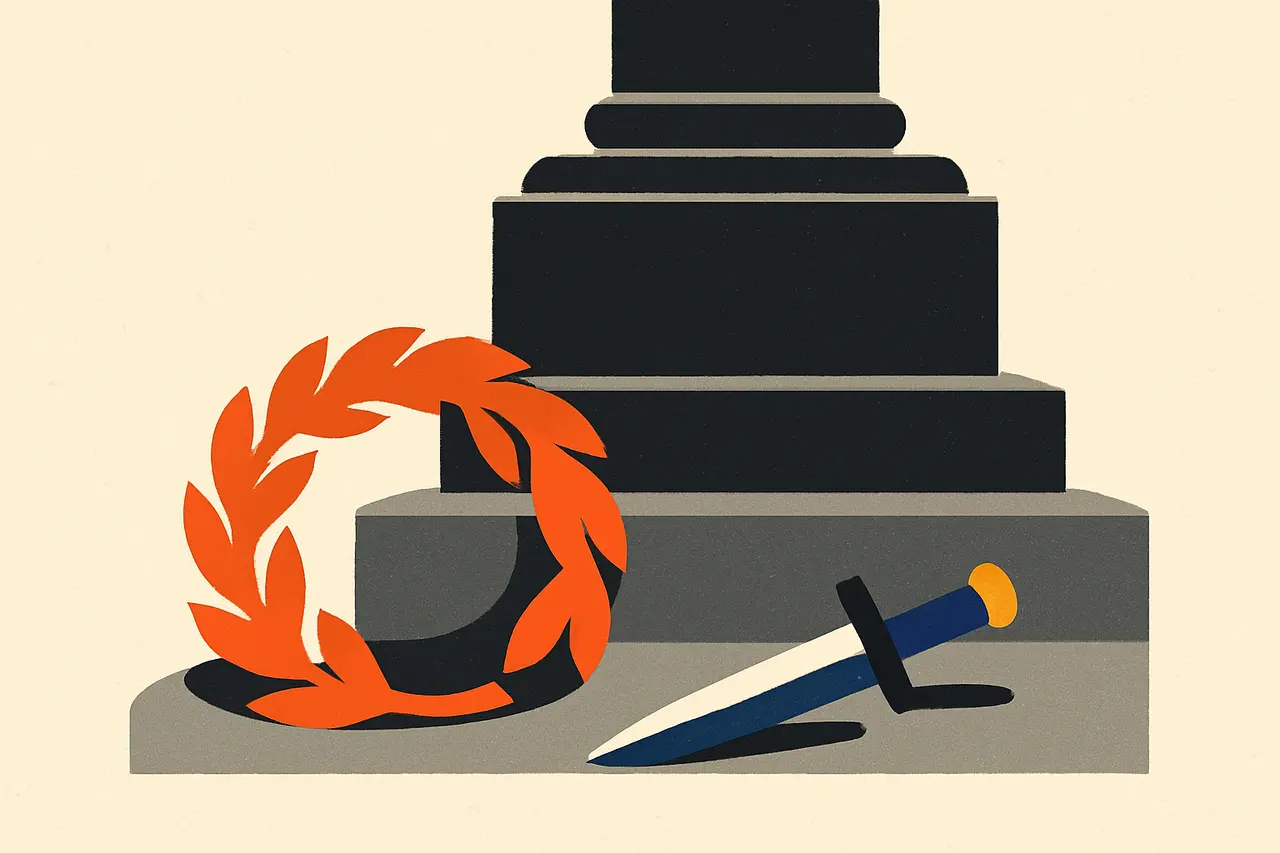
Caesar's physician judged just one of the 23 wounds he took on the Ides of March 44 BC deadly, and Caesar probably never said 'Et tu, Brute.'
Julius Caesar was stabbed 23 times on 15 March 44 BC by a conspiracy of more than sixty Roman senators, yet according to the biographer Suetonius only one of those wounds was fatal: the second, in the chest. The judgement came from Caesar’s physician Antistius, who examined the body. Every other blow, in his view, would have been survivable on its own.
The killing took place in the Curia of Pompey, a meeting hall at the entrance to Pompey’s theatre complex, where the Senate had been called to sit that day. Caesar, newly declared dictator for life, was surrounded by men pretending to present a petition. One of them pulled his toga away from his neck and the daggers followed. The attackers struck so wildly that some of them wounded each other.
Did Caesar really say “Et tu, Brute”?
Almost certainly not. Suetonius writes that Caesar died without a word, giving only a groan at the first blow. He adds that “some have written” that Caesar said to Marcus Brutus, in Greek, kai su, teknon: “You too, my child?” The Latin Et tu, Brute? comes from Shakespeare, writing around 1599, more than sixteen centuries later. Plutarch, the other main ancient source, has Caesar simply pull his toga over his head when he saw Brutus among the attackers.
Can you stand where it happened?
Yes. The remains of the Curia of Pompey lie in Rome’s Largo di Torre Argentina, a sunken square uncovered in 1926 together with four Republican-era temples. For decades it could only be viewed from the pavement above. After work to make it accessible, it opened to visitors in June 2023.
The murder did not save the Republic. It started a new round of civil war, and Caesar’s heir Octavian emerged as Augustus, Rome’s first emperor. Emperors went on dying the same way: Caligula was cut down by his own guards in AD 41.
Sources & references
4 referencesWell-established. Corroborated by 3 independent sources.