What limits human sprint speed isn't muscle power - it's time
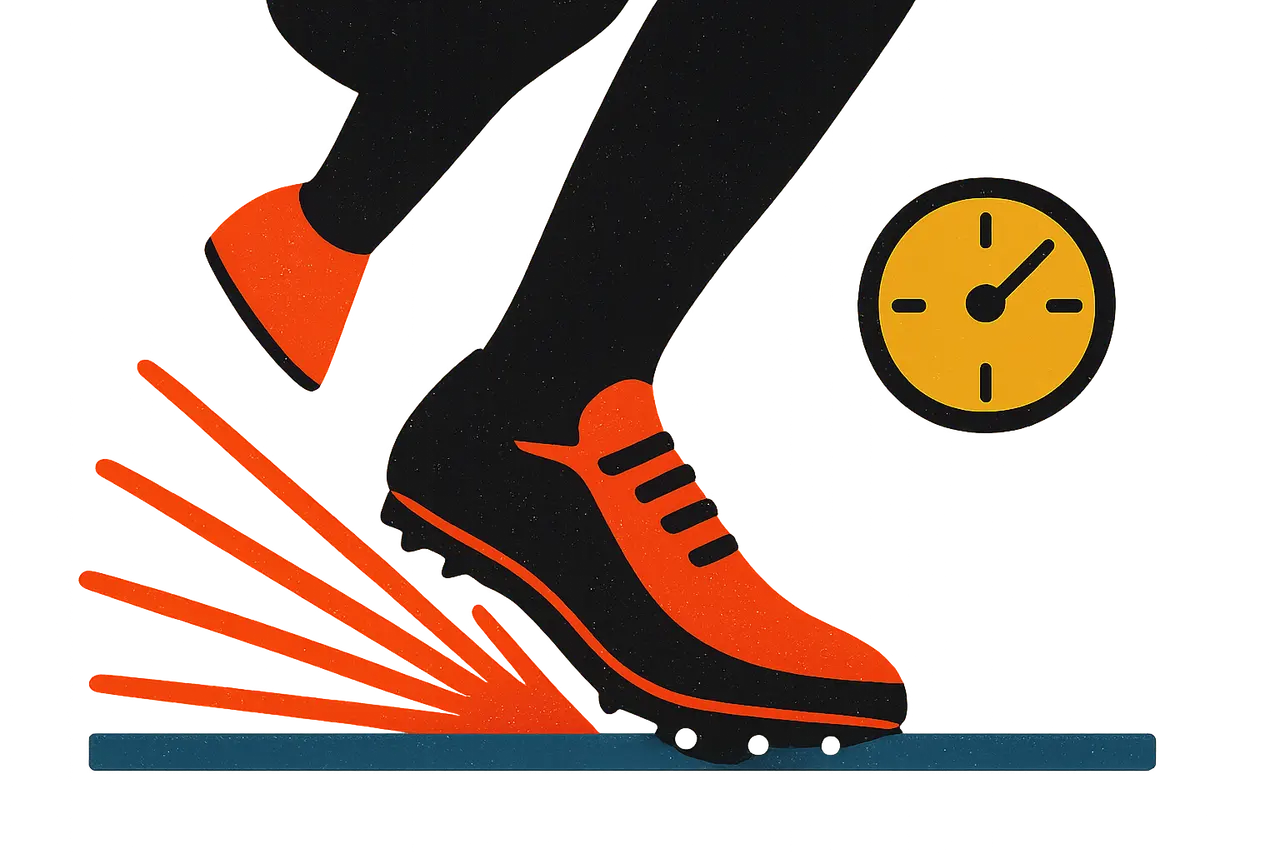
Sprinters' legs can already hit the ground far harder than they need to. The real ceiling is how little time the foot spends down.
Even at full sprint, an elite runner’s foot kisses the track for less than a tenth of a second per step. Research led by physiologist Peter Weyand found that this vanishingly brief contact time - not raw muscle strength - is what caps human speed.
The bottleneck lives in the muscle fibers themselves. Sprinting is powered by fast-twitch fibers, which can contract explosively but still take a finite amount of time to recruit and reach peak force. In a sub-0.1-second ground contact, there simply aren’t enough milliseconds to apply all the force the leg is capable of. Pushing faster means asking those fibers to fire even more quickly, and that firing rate, not their strength, is where biology runs out of road.
To separate the two, Weyand’s team used a clever treadmill protocol. They had athletes run forward at top speed, then hop on one leg and run backward on the same high-speed belt. Hopping and backward running let the limbs deliver far more force per contact than ordinary sprinting ever demands, proving that force capacity isn’t the limit - the foot just leaves the ground before that force can be fully unleashed.
The limit isn’t how hard you can push the ground - it’s how fast you can push it before your foot leaves again.
Their calculations suggested startling headroom: humans might be biologically capable of 35-40 mph (56-64 km/h), well beyond the roughly 28 mph (45 km/h) peak Usain Bolt reached. Bolt’s freakish height and long stride made him an outlier, not a ceiling - which leaves open the unsettling possibility that the true limit is a runner nobody has met yet.
Sources & references
2 referencesWell-established. Corroborated by 2 independent sources.