The Beer Hall Putsch ended in a gunfight, not a beer hall
On this day · 8 November 1923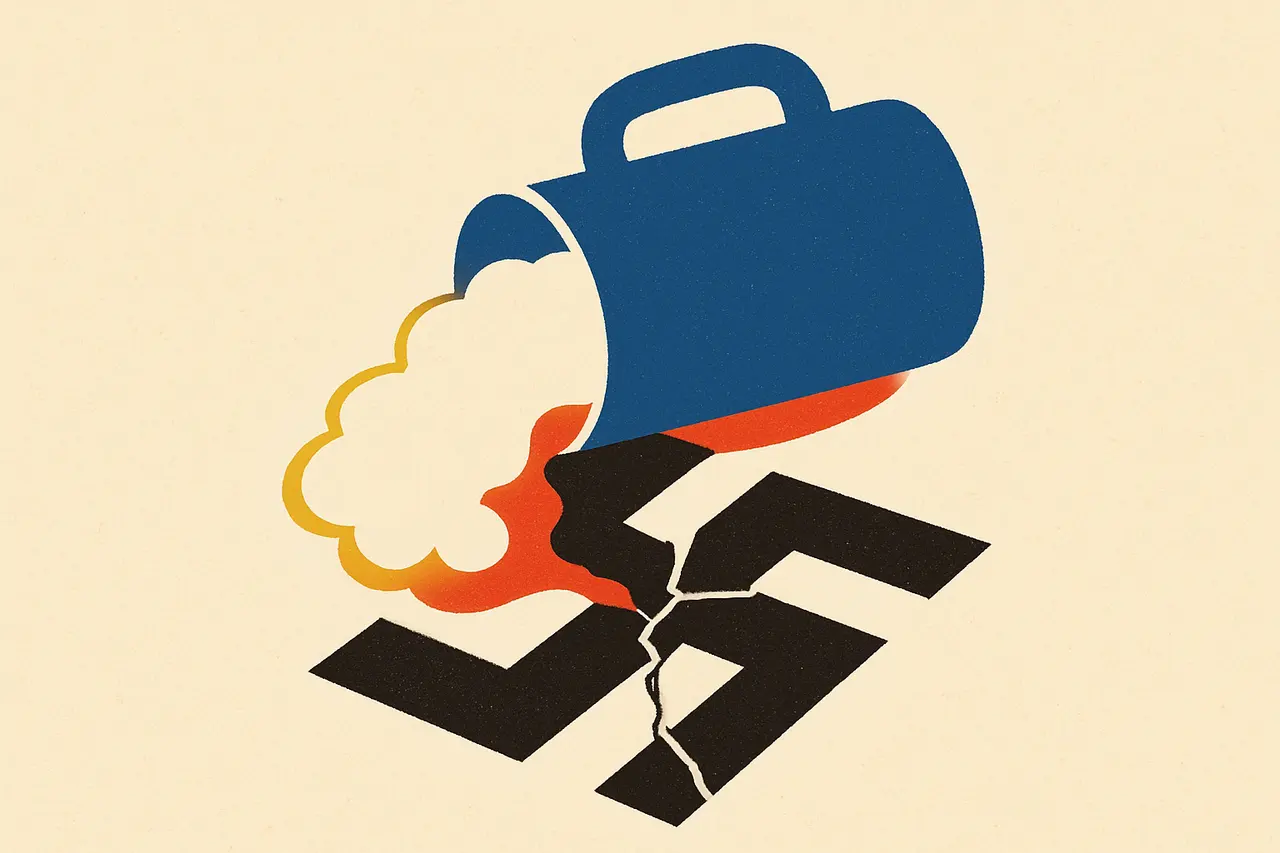
Hitler's 1923 coup began with a pistol shot in a Munich beer hall but died the next day in a police volley at the Odeonsplatz.
The Beer Hall Putsch was Adolf Hitler’s failed coup of 8–9 November 1923 in Munich: it began when he fired a pistol into the ceiling of the Bürgerbräukeller beer hall, and it was crushed the next morning when Bavarian police opened fire on his marchers at the Odeonsplatz.
Did the putsch happen in the beer hall?
Only the first act. On the evening of 8 November, Hitler’s men surrounded the hall where Bavaria’s state commissioner, Gustav von Kahr, was speaking. Hitler burst in, declared a “national revolution”, and bullied Kahr and the army and police chiefs into backing him at gunpoint. He then left them in the custody of the war hero General Erich Ludendorff, who let them go. Once free, they denounced the coup and called in troops.
The decisive moment came on 9 November. Some 2,000 putschists marched through the city towards the Feldherrnhalle and met a police cordon at the Odeonsplatz. Who fired first was never established. The death toll depends on who is counting: the US Holocaust Memorial Museum records 14 Nazis and four police officers killed there, plus two more Nazis elsewhere in the city, while Bavaria’s state historical lexicon counts 15 putschists, one uninvolved bystander and four police — 20 dead in all.
Why was Hitler’s sentence so light?
Hitler fled, and was arrested on 11 November at a supporter’s villa in Uffing. At his trial (26 February – 1 April 1924), a judge known for leniency to right-wing defendants let him lecture the court in his Iron Cross. Convicted of high treason, he received the lightest allowable sentence, five years, in comfortable custody at Landsberg, where he dictated the first volume of Mein Kampf to Rudolf Hess. He was paroled on 20 December 1924.
The lesson he drew was to take power through the ballot box, which led to his appointment as chancellor in 1933. After 1933 the Nazis turned the putsch into a cult, with its own “Blood Order” medal. A plaque to the four police officers who stopped the march went up opposite the Feldherrnhalle only in 2010.
Sources & references
5 referencesWell-established. Corroborated by 3 independent sources.