Lunokhod 1 was the first rover to drive on another world
On this day · 17 November 1970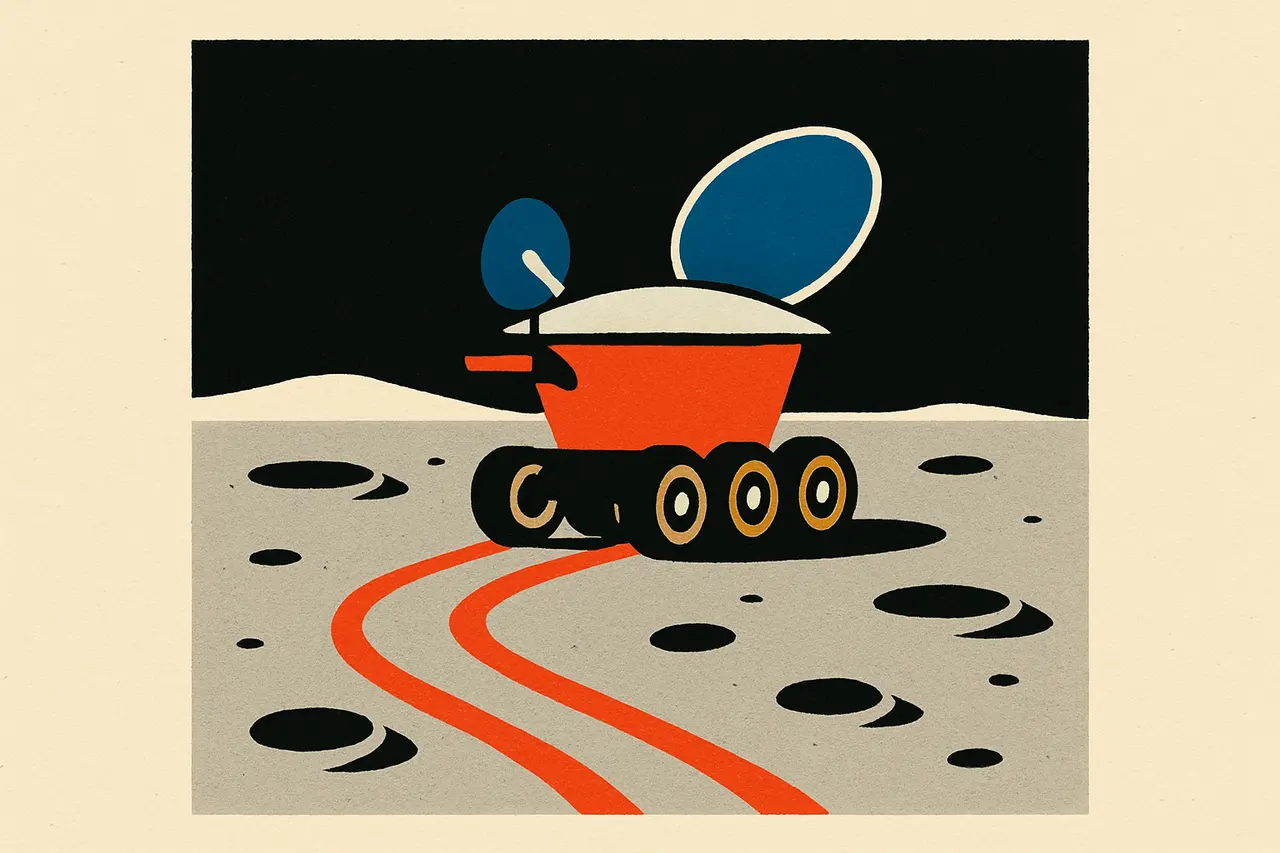
In 1970 a Soviet tub on eight wheels began driving across the Moon — 10.5 km that took Mars rovers years to match.
The first rover to drive on another world was the Soviet Union’s Lunokhod 1, which rolled down a ramp from the Luna 17 lander onto the Moon’s Mare Imbrium, the Sea of Rains, on November 17, 1970. Steered by a five-person team at a control centre near Moscow, it covered about 10.5 kilometres before operations ended on October 4, 1971.
The rover was a tub-shaped body with a large convex lid riding on eight independently powered wheels. Solar panels ran it by day; through the two-week lunar nights, when temperatures dropped to about minus 150 °C, a polonium-210 heater kept it from freezing. Designed to last three lunar days, it survived eleven, returning some 20,000 television pictures and 200 panoramas and carrying out more than 500 soil tests.
How far that really is
Ten kilometres sounds modest, but Lunokhod 1 covered it in roughly ten months. NASA’s Opportunity rover needed about six years to pass the same mark on Mars. Milestones in off-world driving since then:
- 1971: Lunokhod 1 stops at about 10.5 km.
- 1972: Apollo 17 astronauts Gene Cernan and Harrison Schmitt drive their lunar rover 35.7 km.
- 1973: Lunokhod 2 drives an estimated 37 to 39 km on the Moon, a distance Opportunity took more than a decade to match.
- 2015: Opportunity completes the first extraterrestrial marathon on Mars, on its way to a 45.16 km record.
- October 11, 2026: NASA’s Perseverance passes Opportunity’s total, after earlier overtaking both Lunokhod 2 and the Apollo 17 astronauts’ lunar rover.
Lunokhod 1 is still parked on the Moon. NASA’s Lunar Reconnaissance Orbiter has photographed the lander, the rover and its tracks, and in 2010 scientists bounced an unusually strong laser signal off its retroreflector, showing the device had not been degraded by dust.
Sources & references
4 referencesWell-established. Corroborated by 3 independent sources.