Earth's Largest Waterfall Is Hidden Underwater
The planet's mightiest waterfall isn't Angel Falls or Niagara — it's a colossal river of cold water cascading unseen across the ocean floor.
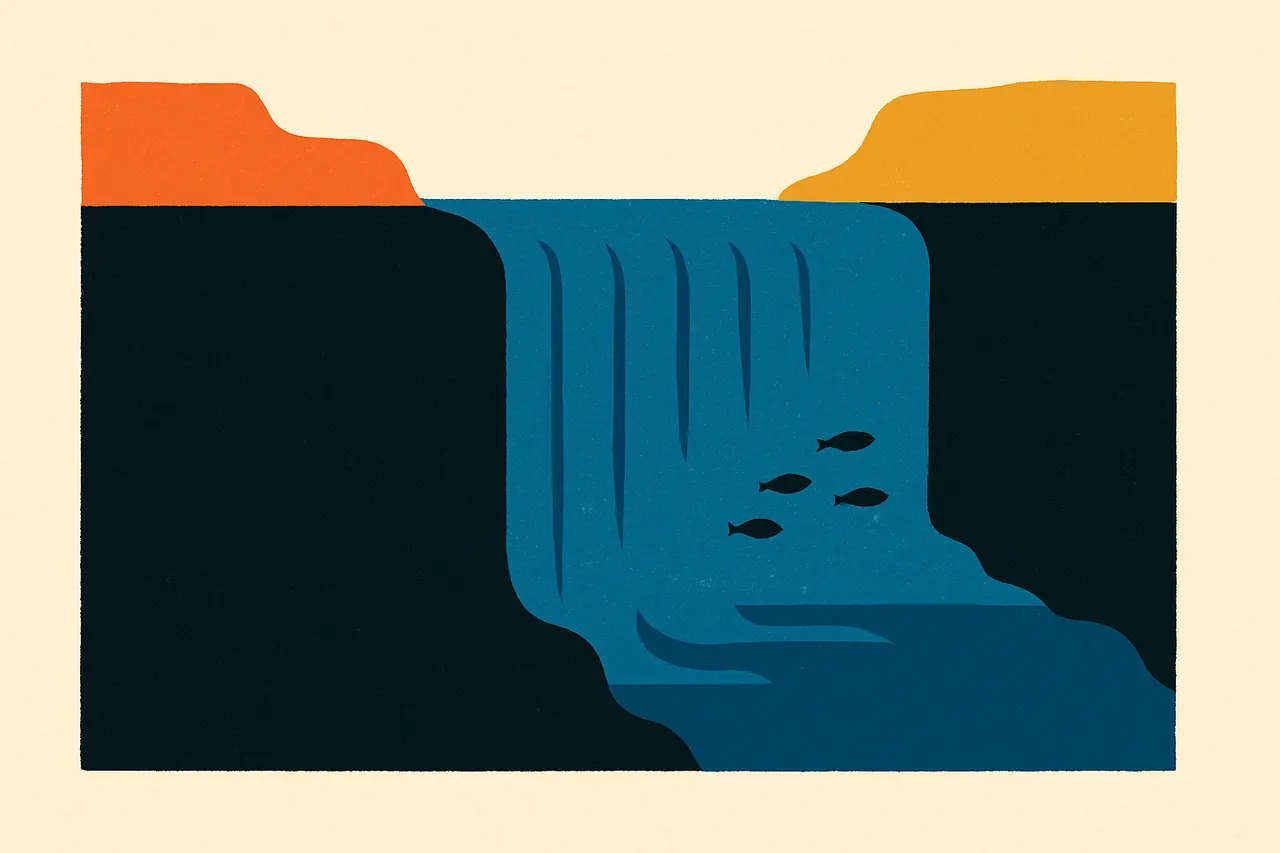
The single largest waterfall on Earth is one no one has ever seen. It lies in the Denmark Strait, the stretch of ocean between Iceland and Greenland, where frigid, dense water from the Nordic Seas slides beneath warmer water and pours over a vast submarine drop.
According to NOAA, this hidden cataract plunges roughly 11,500 feet — beginning about 2,000 feet below the surface and falling to around 10,000 feet, nearly a two-mile descent. That dwarfs Angel Falls in Venezuela, the tallest land waterfall, which drops a comparatively modest 3,212 feet.
The flow is staggering: an estimated 123 million cubic feet of water cascading downward every second.
The mechanism is density, not gravity over a cliff edge. Cold Arctic water is heavier, so it sinks and flows south along the seabed. Peer-reviewed work funded by the NSF measures this overflow at about 3.5 million cubic meters per second, making it the single largest contributor to the deep limb of the Atlantic’s overturning circulation — a current that helps drive the planet’s climate.
Sources & references
2 referencesWell-established. Corroborated by 2 independent sources.