Sea Ice Grows Icicles of Death That Freeze the Seafloor
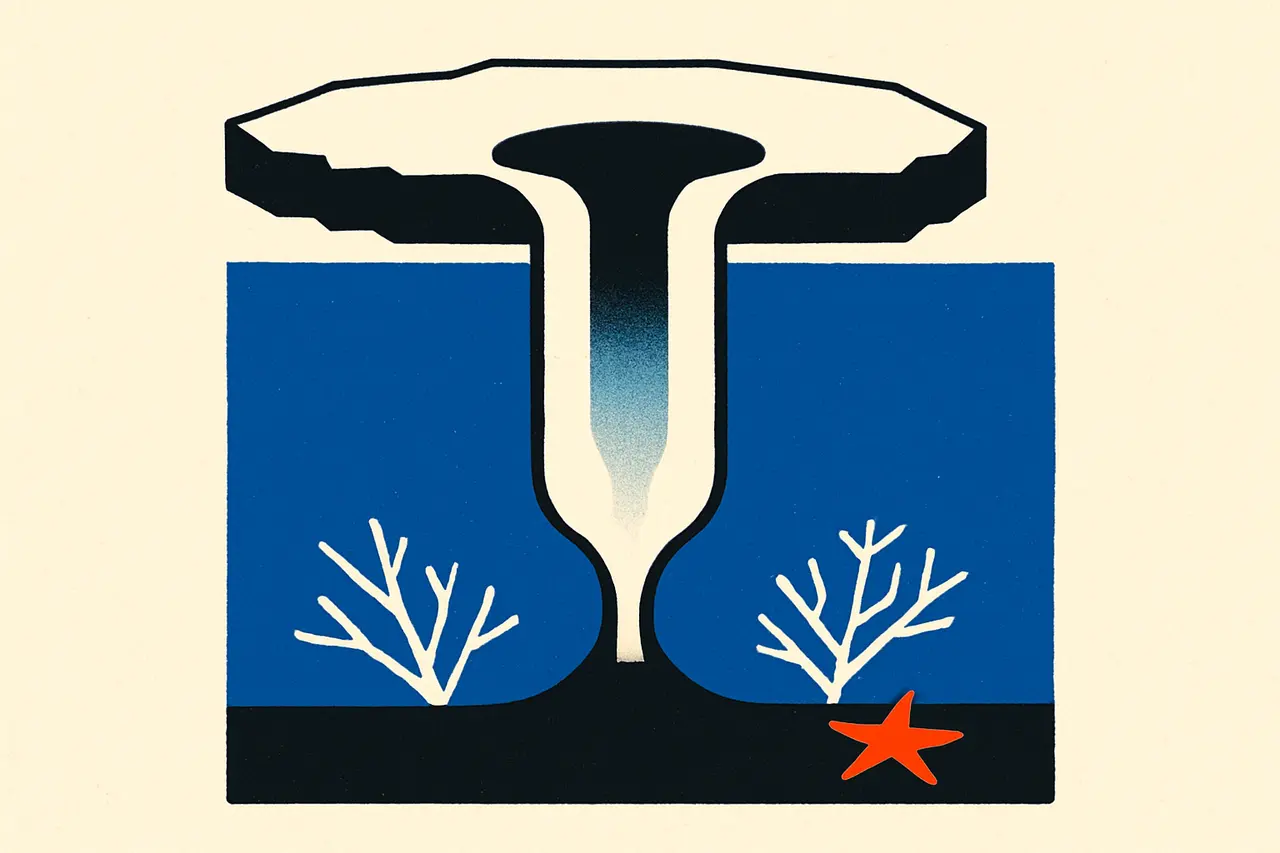
As polar sea ice forms, super-cold brine sinks and freezes a hollow tube of ice downward, sometimes locking the seabed in deadly frost.
When seawater freezes into sea ice, it pushes out its salt. The leftover liquid is a dense, intensely cold brine — staying liquid only because so much salt is dissolved in it. Heavier than the water below, this brine drains downward through cracks in the ice.
Here is the strange part. The surrounding seawater is already near its freezing point of about −2 °C, so the moment the colder brine touches it, that water freezes. A fragile hollow tube of ice grows downward around the sinking plume, sheathing it like a straw. Scientists call it a brinicle.
Where the tip reaches the seabed, a creeping web of ice spreads outward — freezing slow-moving starfish and sea urchins where they sit.
A brinicle was first filmed in 2011 off Antarctica’s Little Razorback Island for the BBC’s Frozen Planet, earning its nickname, the icicle of death. Researchers compare the process to an “inverse chemical garden,” a self-building structure that grows down instead of up, driven entirely by differences in density and temperature.
Sources & references
2 referencesWell-established. Corroborated by 2 independent sources.