The potato, tomato and maize all crossed the Atlantic after 1492
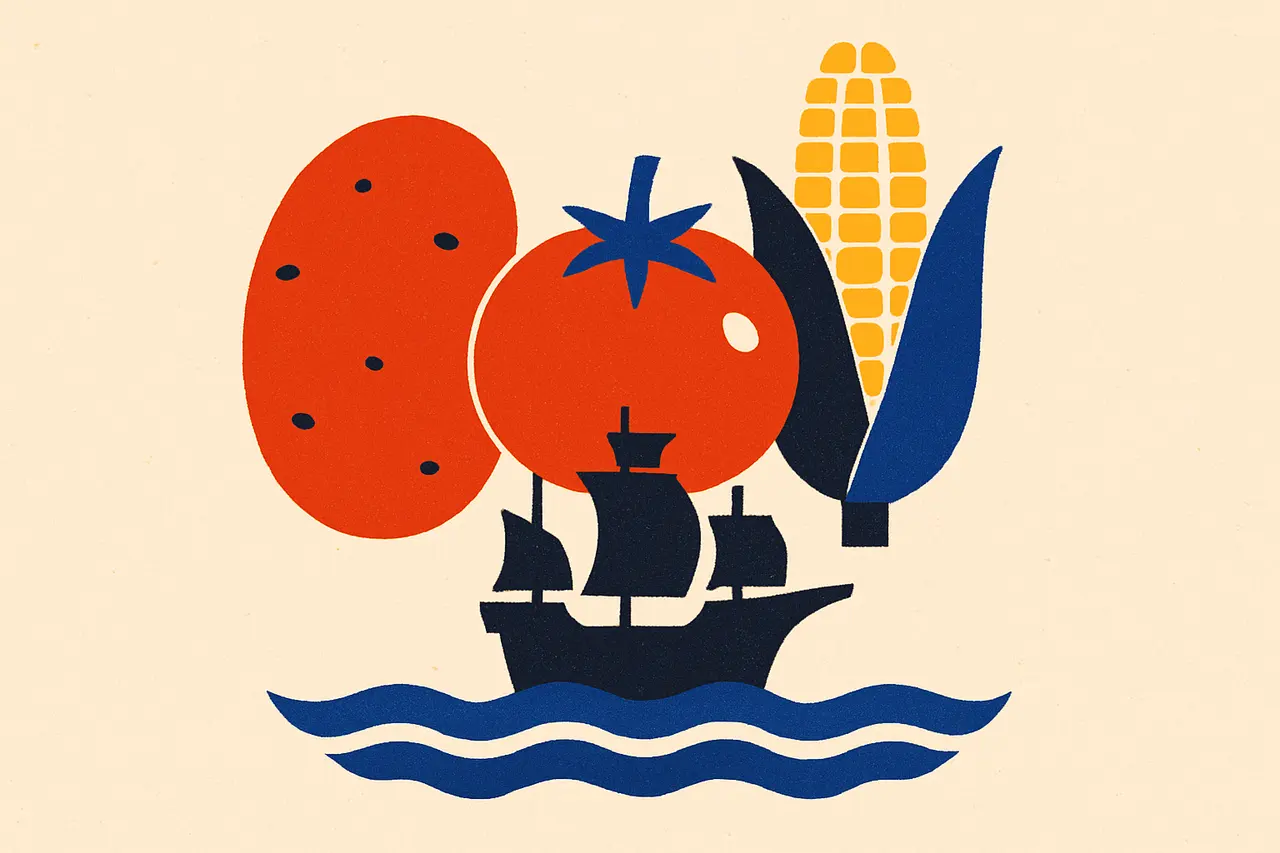
Three foods the Old World can't imagine living without were unknown there before Columbus.
Before 1492, no one in Europe, Asia or Africa had ever tasted a potato, a tomato or an ear of maize. All three are native to the Americas, and only the voyages that followed Columbus — the vast biological swap historians call the Columbian Exchange — carried them east across the Atlantic, alongside cassava, peanuts, pineapples and chili peppers.
The potato mattered most. Cheap, nutrient-dense and able to grow where grain failed, its spread between 1700 and 1900 “improved nutrition, checked famine, and led to a sustained spurt of demographic growth” from the British Isles to central Russia.
The same dependence turned deadly: when blight struck Ireland in 1845, “a million starved, and two million emigrated.”
The traffic ran both ways. Old World staples poured into the Americas — wheat, sugarcane, coffee, and citrus — along with the livestock that would remake whole economies: horses, cattle and pigs, which transformed the Great Plains and the vaquero ranching of the Spanish colonies.
But the exchange’s heaviest cargo was invisible. Smallpox, measles and influenza, against which Indigenous Americans had no acquired immunity, swept ahead of the colonists themselves. The toll was catastrophic: depopulation estimates for Native American societies run between roughly 75% and 95% in the centuries after contact, a collapse with few parallels in recorded history.
One American export quietly conquered the rest of the planet’s kitchens: the chili pepper. Carried by Portuguese and Spanish traders, it reached Asia within decades and became indispensable to Indian, Thai and Sichuan cooking — none of which knew chili heat before 1492, however ancient those cuisines now feel.
Sources & references
3 referencesWell-established. Corroborated by 3 independent sources.