Apollo 11 landed on the Moon on July 20, 1969
Armstrong and Aldrin spent almost a day on the Moon but walked outside for just two and a half hours. One thing they left still works.
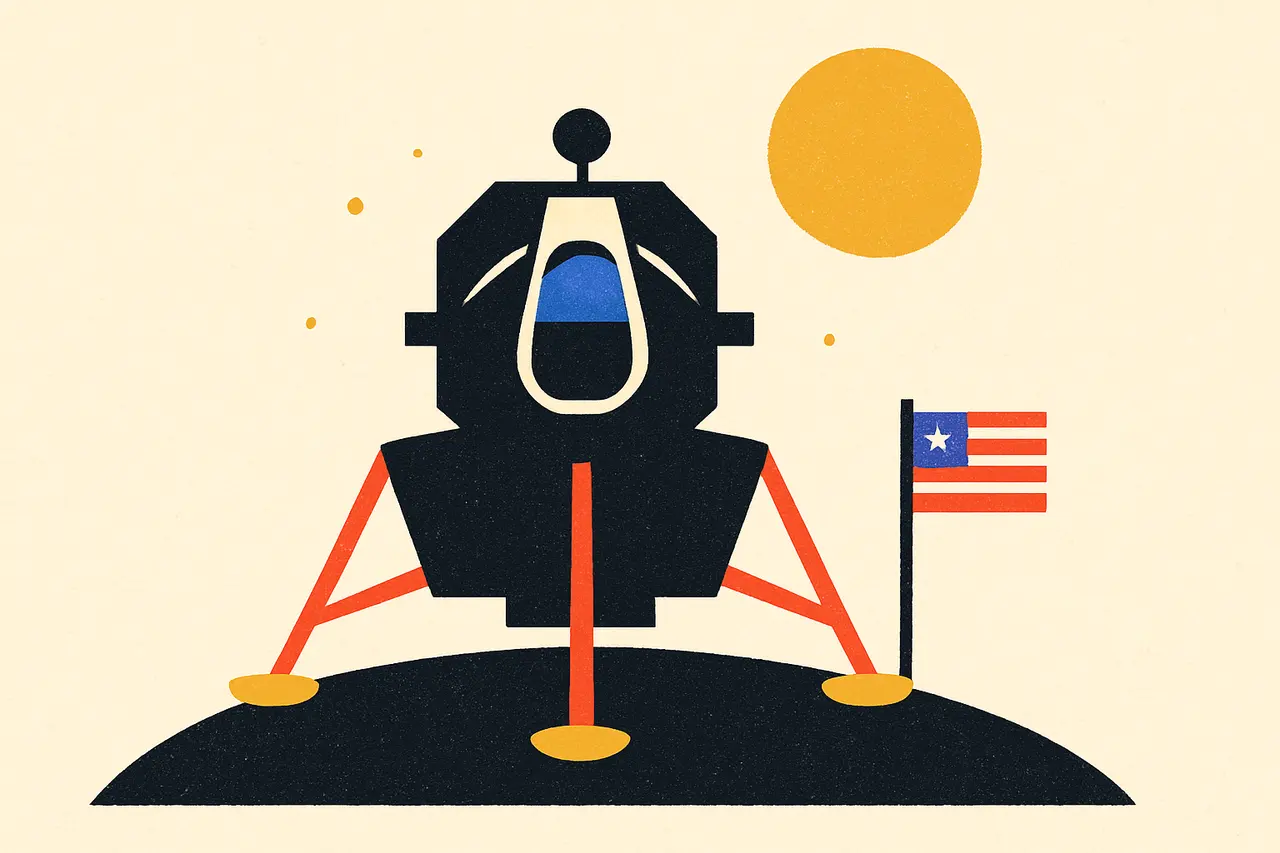
Apollo 11’s lunar module Eagle landed in the Moon’s Sea of Tranquility on July 20, 1969, at about 20:17 UTC (4:17 p.m. in Houston), making Neil Armstrong and Buzz Aldrin the first people to land on another world. In the last minutes Armstrong flew by hand to avoid West crater, a sharp-rimmed hole about 180 metres across, and set down some 6 km from the planned site while Michael Collins orbited in Columbia.
How long did they actually walk on the Moon?
Far less time than the mission’s length suggests. Armstrong and Aldrin spent 21 hours 36 minutes on the surface, but nearly all of it inside the cramped lander, checking systems, eating, resting and preparing for liftoff. Armstrong’s first step came more than six hours after touchdown, and their only moonwalk lasted just over two and a half hours, ending 111 hours 39 minutes into the mission.
In that window they planted a flag, photographed the site, collected rock and soil, and Aldrin set out a small package of experiments. Later crews stayed far longer: the Apollo 17 moonwalks added up to more than 22 hours.
Is anything Apollo 11 left behind still working?
Yes. The laser ranging retroreflector, a panel of 100 fused-silica corner cubes that needs no power, sends a laser pulse straight back to the telescope that fired it. NASA’s Jet Propulsion Laboratory calls it the only lunar experiment operating continuously since Apollo. The return is faint: under good conditions an observatory catches about one photon every few seconds.
Timing those round trips, together with arrays left by Apollo 14 and 15, has shown that the Earth–Moon distance grows by about 3.8 cm (1.5 in) a year and that the Moon has a fluid core. The same data find no difference in how gravity pulls on the Moon and Earth despite their different make-up, a test of a key assumption in Einstein’s theory of gravity.
Sources & references
5 referencesWell-established. Corroborated by 4 independent sources.