Why is the Parthenon a ruin? A gunpowder blast in 1687
On this day · 26 September 1687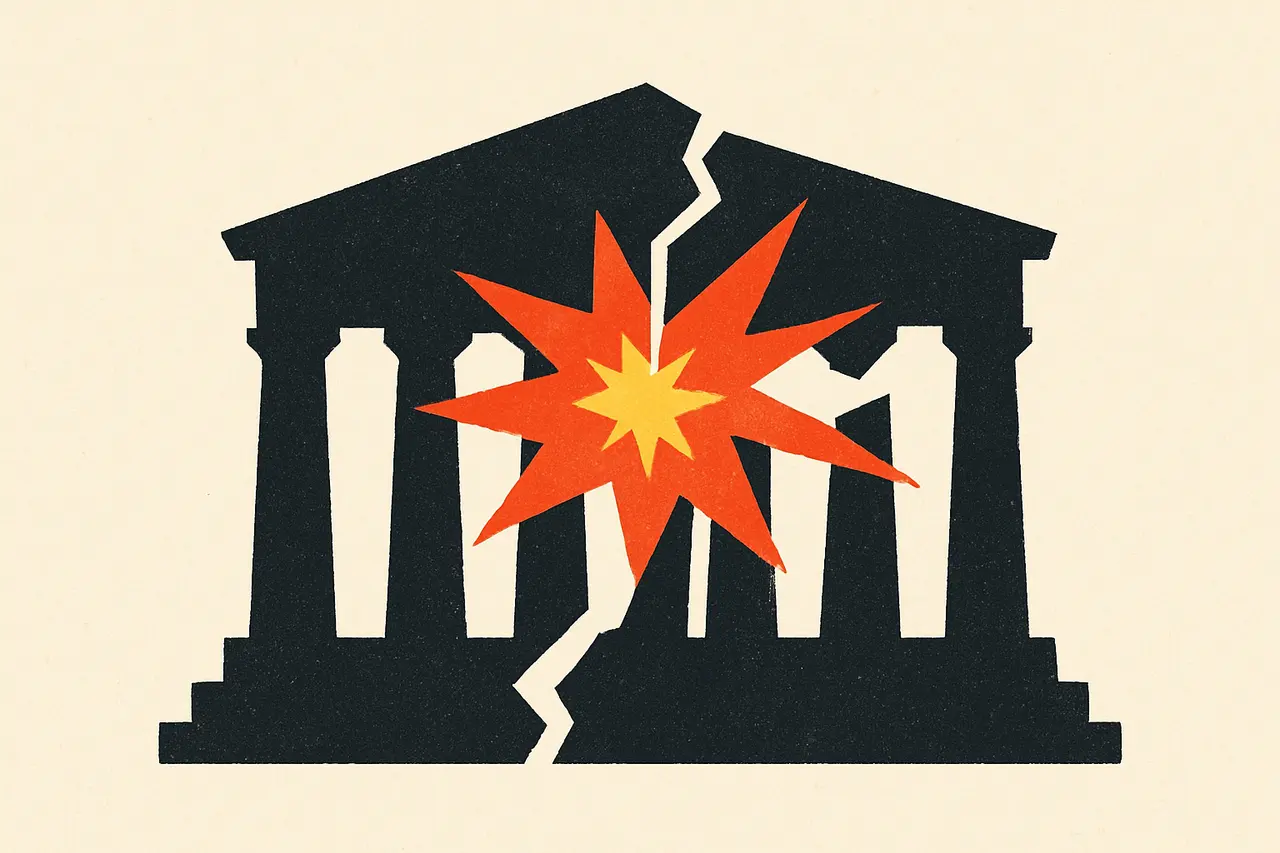
A Venetian shell hit the Ottoman powder store inside the Parthenon in 1687 — and Venice held Athens for barely a year afterwards.
The Parthenon is a roofless ruin mainly because of one explosion: on the night of 26 September 1687, during a Venetian siege of Ottoman-held Athens, a mortar shell from Francesco Morosini’s artillery hit the gunpowder the garrison had stored inside the temple, then in use as a mosque, and blew out most of the building.
The temple had survived more than 2,100 years largely intact, as church, cathedral and mosque. It was not the first Acropolis monument wrecked by stored gunpowder.
- 1645: A lightning bolt ignites gunpowder stored in the Propylaia, the Acropolis gateway, causing severe damage.
- 1686: Expecting Morosini’s army, the Ottomans dismantle the little Temple of Athena Nike and reuse its blocks to strengthen the walls.
- 26 September 1687: After eight days of bombardment, a shell reaches the powder magazine. The long sides and roof are blown apart, architectural blocks fall in heaps around the hill, and the fire burns for two days. The garrison surrenders.
- 1687–88: Morosini tries to remove Athena’s chariot and horses from the west pediment. The rope is cut and the sculptures shatter; the pieces lie where they fell until excavators retrieve them in 1835.
- 1688: The Venetians leave Athens after barely a year. The Ottomans return, fill the Acropolis with small houses and build a small mosque inside the ruined Parthenon.
- 1834: The new Greek state proclaims the Acropolis an archaeological site; a dedicated conservation committee follows in 1975.
No reliable count of the dead survives. Byron, writing over a century later, knew whom to blame:
“Heard some curious extracts from the life of Morosini, the blundering Venetian, who blew up the Acropolis of Athens with a bomb, and be damned to him!” — Lord Byron, journal
The irony is that Venice gained nothing lasting: the temple was wrecked for a city it held for barely a year.
Sources & references
4 referencesWell-established. Corroborated by 2 independent sources.