Why can't you tickle yourself? Your brain predicts it
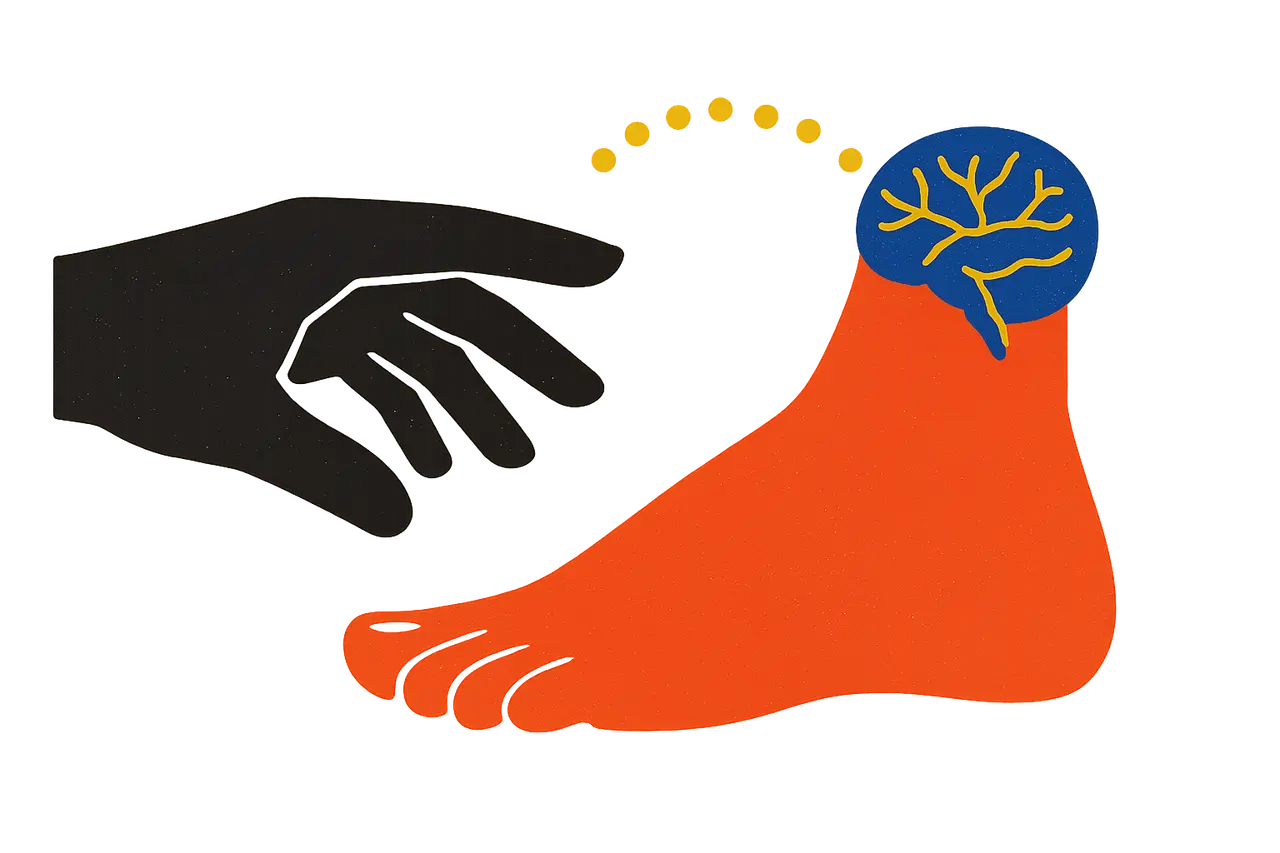
Your brain forecasts the feel of your own touch and turns it down — unless that prediction breaks, as it does in some people who hear voices.
You can’t tickle yourself because your brain predicts the sensation of your own touch and dampens it before you feel it. The same fingers that leave you unmoved on your own ribs can make you squirm when they belong to someone else.
Whenever you move, the brain sends a copy of the motor command, an efference copy, to the cerebellum, which forecasts the touch that movement should produce. In a 1998 fMRI study, Sarah-Jayne Blakemore, Daniel Wolpert and Chris Frith at University College London found the somatosensory cortex was more active when touch came from outside, and that the cerebellum appeared to supply the prediction used to cancel self-made sensation.
How we know it’s prediction
A 1999 follow-up linked two robots: volunteers moved one with their left hand while the other stroked their right palm. When the researchers added a delay of a fraction of a second, or skewed the direction of the stroke, people rated the touch more ticklish as the mismatch grew. The brain cancels only what it correctly predicts.
The exceptions are telling. In a 2000 study, psychiatric patients who experienced auditory hallucinations or passivity (the sense that their actions are controlled by someone else) rated their own touch as intense and tickly as the experimenter’s. Patients without those symptoms showed the normal damping, suggesting it was the brain’s self-monitoring, not the diagnosis, that had broken down.
The same quirk explains why playground shoves escalate. In a 2003 experiment, pairs of volunteers took turns pressing on each other’s finger, told to return exactly the force they had just received. Because self-made pressure feels roughly half as strong, each person overshot, and the force grew by about 38% a turn. Both sides were honestly reporting what they felt.
Sources & references
5 referencesWell-established. Corroborated by 3 independent sources.