About 8% of your DNA comes from ancient viruses
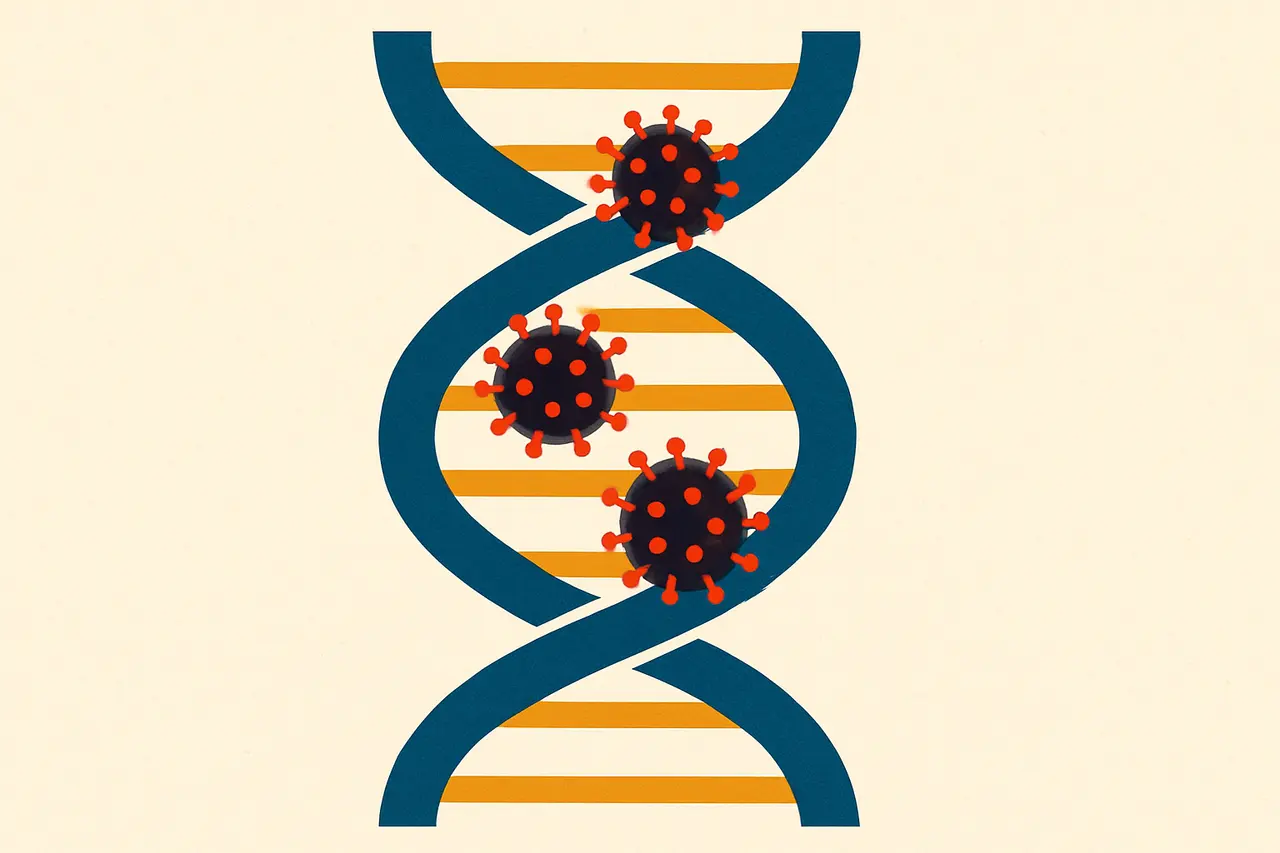
Ancient retroviruses left about 8% of the human genome, four times more than our genes occupy, and some of their genes now build the placenta.
About 8% of the human genome is made of human endogenous retroviruses (HERVs), the remains of viruses that infected the egg and sperm cells of our ancestors millions of years ago and have been inherited ever since.
Retroviruses such as HIV copy their genes into the DNA of the cells they infect. When that happened in a germline cell, the viral insert could pass to offspring and, over generations, become a fixed part of the species. For scale, here is how the viral leftovers compare with the genes that build your body:
| Measure | Figure |
|---|---|
| Share of the genome made of HERVs | 8% |
| Share made of protein-coding genes | less than 2% |
| Ancient viral DNA versus gene DNA, by length | more than four times as much |
| HERV families scientists recognise | at least 31 |
| Families known to make working viruses today | none |
Most HERVs are broken and silenced, though some still produce proteins, and abnormal HERV activity has been linked to conditions including multiple sclerosis and several cancers.
The best-known HERV genes recruited by the body are syncytin-1 and syncytin-2, former viral envelope genes, the tools a virus uses to fuse with a cell. In the human placenta they fuse cells into the syncytiotrophoblast, the layer through which mother and fetus exchange nutrients. It is often said that all mammals rely on this borrowed gene. They don’t rely on the same one: mice, ruminants, dogs and cats each picked up their own syncytin genes from different ancient viruses, a case of convergent evolution. Mice carry syncytin-A and syncytin-B, acquired independently of ours.
How do we know these genes matter? When researchers deleted syncytin-A in mice, the placental cells failed to fuse properly and the embryos died in the womb between days 11.5 and 13.5 of gestation. Viral DNA that once invaded our ancestors has become something placental mammals cannot reproduce without.
Sources & references
4 referencesWell-established. Corroborated by 2 independent sources.